Chapter 5
独妙
Unique Excellence
364
of 659
English Translation
The pottery-making tradition in the Yixing region has a long history spanning thousands of years, dating back to the Neolithic period four to five thousand years ago. The abundant clay mineral resources and the long history of pottery production established a unique natural material foundation for the rise and development of Yixing purple clay pottery. Purple clay is a special mineral earth contained within the interlayer clay and tender clay of Yixing's utilitarian pottery clay. It is primarily composed of quartz, clay minerals, hydromuscovite, and hematite. It possesses excellent plasticity and exhibits distinct differences in color and finished texture from ceramic raw materials in other regions. It has become world-renowned through the advancement and development of purple clay craftsmanship.
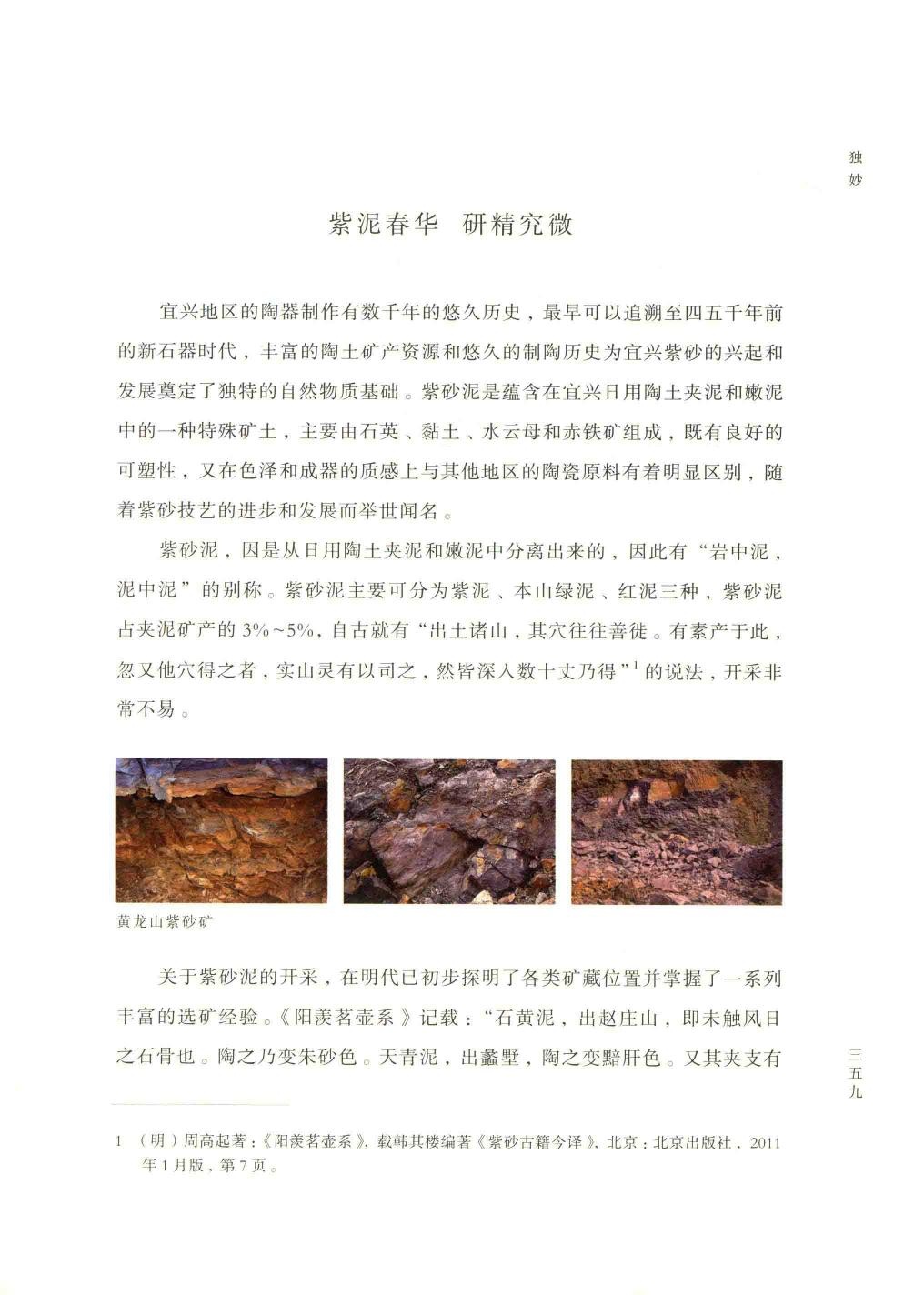
Purple clay, because it is separated from the interlayer clay and tender clay of utilitarian pottery clay, has the alternative name "clay within clay, mud within mud." Purple clay can be mainly divided into three types: purple clay, Benshan green clay, and red clay. Purple clay accounts for 3%–5% of interlayer clay mineral deposits. Since ancient times, there has been a saying: "Emerging from various mountains, its veins often shift favorably. What is produced here may suddenly be found in another vein—truly the mountain spirits govern this. Yet all must be dug dozens of zhang deep to obtain it." Mining is extremely difficult.
## Huanglong Mountain Purple Clay Mine
Regarding the mining of purple clay, by the Ming dynasty, the locations of various mineral deposits had been preliminarily identified, and a series of rich ore-selection experiences had been mastered. *Yangxian Ming Hu Xi* records: "Stone yellow clay comes from Zhaozhuang Mountain—it is the stone essence that has not yet been touched by wind and sun. When fired, it transforms into vermilion color. Sky blue clay comes from Tangzhu; when fired, it transforms into dark liver color. Moreover, within its interlayer there is..."[1]
---
[1] (Ming) Zhou Gaoqi, *Yangxian Ming Hu Xi*, in Han Qilou (ed.), *Modern Translation of Ancient Purple Clay Texts* (Beijing: Beijing Publishing House, January 2011), p. 7.
Chapter 5
独妙
Unique Excellence
Pages 142-405
View Chapter →
English Translation
The pottery-making tradition in the Yixing region has a long history spanning thousands of years, dating back to the Neolithic period four to five thousand years ago. The abundant clay mineral resources and the long history of pottery production established a unique natural material foundation for the rise and development of Yixing purple clay pottery. Purple clay is a special mineral earth contained within the interlayer clay and tender clay of Yixing's utilitarian pottery clay. It is primarily composed of quartz, clay minerals, hydromuscovite, and hematite. It possesses excellent plasticity and exhibits distinct differences in color and finished texture from ceramic raw materials in other regions. It has become world-renowned through the advancement and development of purple clay craftsmanship.
Purple clay, because it is separated from the interlayer clay and tender clay of utilitarian pottery clay, has the alternative name "clay within clay, mud within mud." Purple clay can be mainly divided into three types: purple clay, Benshan green clay, and red clay. Purple clay accounts for 3%–5% of interlayer clay mineral deposits. Since ancient times, there has been a saying: "Emerging from various mountains, its veins often shift favorably. What is produced here may suddenly be found in another vein—truly the mountain spirits govern this. Yet all must be dug dozens of zhang deep to obtain it." Mining is extremely difficult.
## Huanglong Mountain Purple Clay Mine
Regarding the mining of purple clay, by the Ming dynasty, the locations of various mineral deposits had been preliminarily identified, and a series of rich ore-selection experiences had been mastered. *Yangxian Ming Hu Xi* records: "Stone yellow clay comes from Zhaozhuang Mountain—it is the stone essence that has not yet been touched by wind and sun. When fired, it transforms into vermilion color. Sky blue clay comes from Tangzhu; when fired, it transforms into dark liver color. Moreover, within its interlayer there is..."[1]
---
[1] (Ming) Zhou Gaoqi, *Yangxian Ming Hu Xi*, in Han Qilou (ed.), *Modern Translation of Ancient Purple Clay Texts* (Beijing: Beijing Publishing House, January 2011), p. 7.
章节导航 Chapter Navigation
Chapter 1
序文
Pages 6-6
Chapter 2
引言
Pages 28-31
Chapter 3
达变
Pages 32-133
Chapter 3
开宗立派
Pages 46-66
Chapter 3
传道授业
Pages 67-98
Chapter 3
大师淳友
Pages 99-120
Chapter 3
学艺谋生
Pages 121-133
Chapter 4
化神
Pages 134-141
Chapter 5
独妙
Pages 142-405
Chapter 5
匠心独运 不苟丝毫
Pages 142-179
Chapter 5
器利善事 物尽其用
Pages 180-199
Chapter 5
紫泥春华 研精究微
Pages 200-405
Chapter 6
驾简
Pages 406-427
Chapter 6
精雕细刻 文质合一
Pages 406-410
Chapter 6
师法自然 妙趣横生
Pages 411-415
Chapter 6
丝来线去 曲尽其妙
Pages 416-427
Chapter 7
明志
Pages 463-485
Chapter 7
高山仰止 淡泊明志
Pages 463-472
Chapter 7
啜墨看茶 气定神闲
Pages 473-478
Chapter 7
齿少心锐 怡志抒情
Pages 479-485
Chapter 8
存真
Pages 428-462
Chapter 8
规圆矩方 弃伪存真
Pages 428-436
Chapter 8
有物有则 钻尖仰高
Pages 437-462
Chapter 9
心营
Pages 506-525
Chapter 9
坚守传统 艺立潮头
Pages 506-513
Chapter 9
新型师承 桃李满园
Pages 514-525
Chapter 10
附录
Pages 526-651
Chapter 10
顾景舟紫艺论文
Pages 526-535
Chapter 10
技术课备课笔记
Pages 536-543
Chapter 10
顾景舟艺术年表
Pages 544-651
Chapter 11
参考文献
Pages 652-657
Chapter 12
鸣谢
Pages 658-659