Chapter 5
独妙
Unique Excellence
365
of 659
English Translation
## Clay Types and Their Characteristics
Pear-skin clay fires to a pear-jelly color; light red clay fires to a pine-flower color; pale yellow clay fires to a bean-green color; dense clay fires to a light ochre color; pear-skin mixed with white sand fires to a pale ink color. The mountain's spiritual veins and networks, through ceramic firing and transformation, still reveal various luminous and extraordinary phenomena. Old clay, extracted from Tuanshan, is fired mixed with white sand in a starry pattern, pressed like pearls from heaven; when blended with sky-blue and stone-yellow, it produces various shades of antique coloring.[1] Modern geological surveys have further confirmed that the Yixing purple sand ore veins and their properties fundamentally accord with the records of Ming dynasty scholar Zhou Gaoqi.
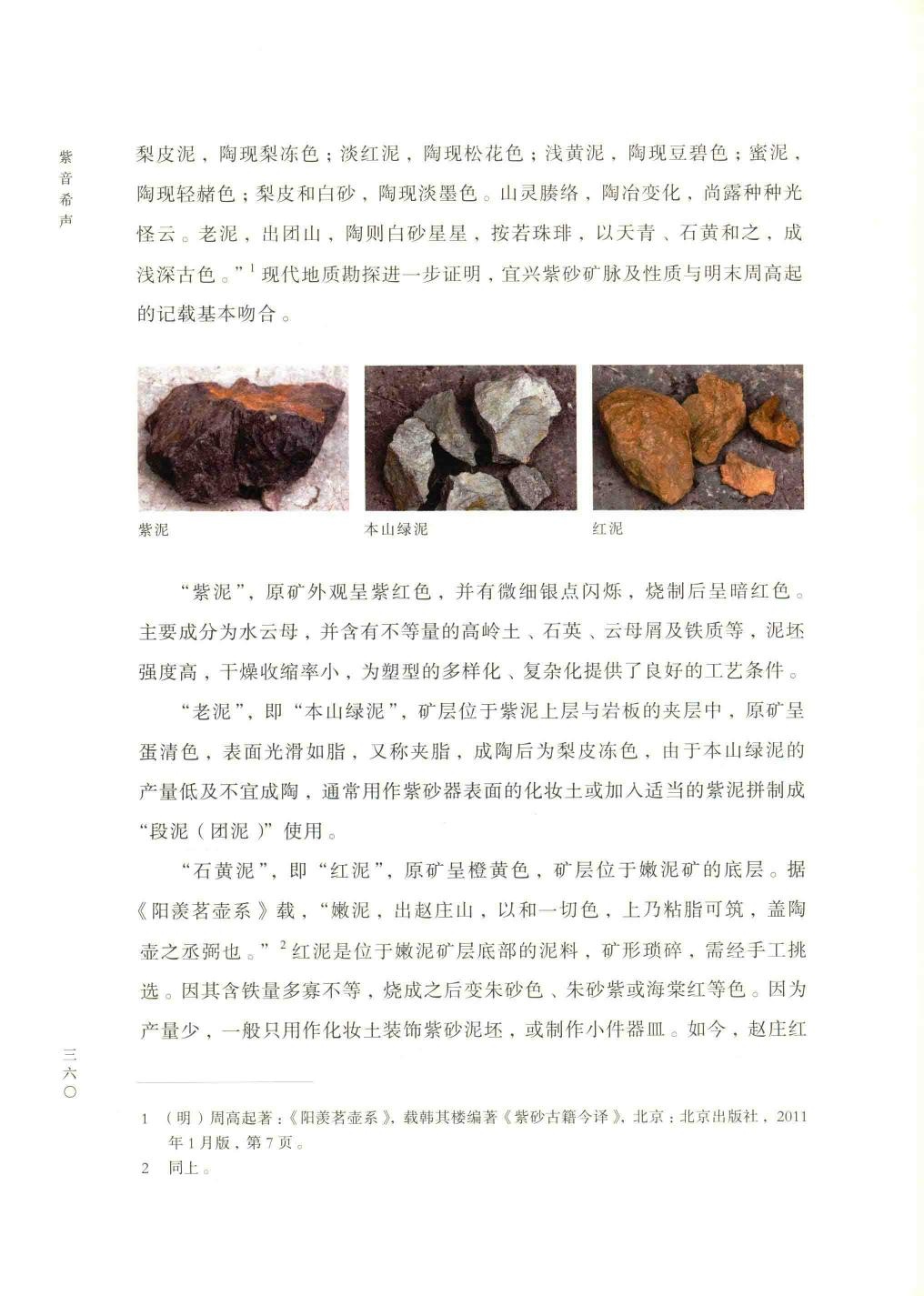
**Purple Clay** | **Benshan Green Clay** | **Red Clay**
"Purple clay" (*zini*) appears purple-red in its raw ore state, with fine silver specks glittering throughout. After firing, it becomes dark red. Its main component is hydromuscovite, containing varying amounts of kaolin, quartz, mica, and iron compounds. The clay body has high strength and low drying shrinkage rate, providing excellent technical conditions for diverse and complex forming.
"Old clay" (*laoni*), also known as "Benshan green clay," is found in the layer between the purple clay stratum and the rock plate. The raw ore appears egg-white in color, with a surface smooth as fat—hence also called "interlayer fat" (*jiazhi*). After firing, it becomes pear-skin jelly color. Due to the low yield of Benshan green clay and its difficulty in forming pottery, it is typically used as a slip coating on the surface of purple sand wares, or mixed with appropriate amounts of purple clay to create "duan clay (tuan clay)" for use.
"Stone-yellow clay,"[2] also known as "red clay," appears orange-yellow in its raw ore state. The ore layer is located at the bottom stratum of tender clay (*nennni*). According to *The Yangxian Famous Teapot System* (*Yangxian Minghu Xi*), "Tender clay, extracted from Zhaozhuang Mountain, can be blended with all colors. Its upper layer is sticky and fatty, suitable for building, as it becomes elastic after firing."[3] Red clay is the clay material located at the bottom of the tender clay ore layer. The ore formation is fragmentary and requires manual selection. Due to its varying iron content, after firing it transforms into vermillion, vermillion-purple, or crabapple-red colors. Because of its scarcity, it is generally only used as a decorative slip for purple sand clay bodies, or for making small vessels. Today, Zhaozhuang red clay...
---
[1] Zhou Gaoqi (Ming dynasty), *The Yangxian Famous Teapot System* (*Yangxian Minghu Xi*), in Han Qilou, ed., *Modern Translation of Ancient Purple Sand Texts* (Beijing: Beijing Publishing House, January 2011), p. 7.
[2] Ibid.
[3] Ibid.
Chapter 5
独妙
Unique Excellence
Pages 142-405
View Chapter →
English Translation
## Clay Types and Their Characteristics
Pear-skin clay fires to a pear-jelly color; light red clay fires to a pine-flower color; pale yellow clay fires to a bean-green color; dense clay fires to a light ochre color; pear-skin mixed with white sand fires to a pale ink color. The mountain's spiritual veins and networks, through ceramic firing and transformation, still reveal various luminous and extraordinary phenomena. Old clay, extracted from Tuanshan, is fired mixed with white sand in a starry pattern, pressed like pearls from heaven; when blended with sky-blue and stone-yellow, it produces various shades of antique coloring.[1] Modern geological surveys have further confirmed that the Yixing purple sand ore veins and their properties fundamentally accord with the records of Ming dynasty scholar Zhou Gaoqi.
**Purple Clay** | **Benshan Green Clay** | **Red Clay**
"Purple clay" (*zini*) appears purple-red in its raw ore state, with fine silver specks glittering throughout. After firing, it becomes dark red. Its main component is hydromuscovite, containing varying amounts of kaolin, quartz, mica, and iron compounds. The clay body has high strength and low drying shrinkage rate, providing excellent technical conditions for diverse and complex forming.
"Old clay" (*laoni*), also known as "Benshan green clay," is found in the layer between the purple clay stratum and the rock plate. The raw ore appears egg-white in color, with a surface smooth as fat—hence also called "interlayer fat" (*jiazhi*). After firing, it becomes pear-skin jelly color. Due to the low yield of Benshan green clay and its difficulty in forming pottery, it is typically used as a slip coating on the surface of purple sand wares, or mixed with appropriate amounts of purple clay to create "duan clay (tuan clay)" for use.
"Stone-yellow clay,"[2] also known as "red clay," appears orange-yellow in its raw ore state. The ore layer is located at the bottom stratum of tender clay (*nennni*). According to *The Yangxian Famous Teapot System* (*Yangxian Minghu Xi*), "Tender clay, extracted from Zhaozhuang Mountain, can be blended with all colors. Its upper layer is sticky and fatty, suitable for building, as it becomes elastic after firing."[3] Red clay is the clay material located at the bottom of the tender clay ore layer. The ore formation is fragmentary and requires manual selection. Due to its varying iron content, after firing it transforms into vermillion, vermillion-purple, or crabapple-red colors. Because of its scarcity, it is generally only used as a decorative slip for purple sand clay bodies, or for making small vessels. Today, Zhaozhuang red clay...
---
[1] Zhou Gaoqi (Ming dynasty), *The Yangxian Famous Teapot System* (*Yangxian Minghu Xi*), in Han Qilou, ed., *Modern Translation of Ancient Purple Sand Texts* (Beijing: Beijing Publishing House, January 2011), p. 7.
[2] Ibid.
[3] Ibid.
章节导航 Chapter Navigation
Chapter 1
序文
Pages 6-6
Chapter 2
引言
Pages 28-31
Chapter 3
达变
Pages 32-133
Chapter 3
开宗立派
Pages 46-66
Chapter 3
传道授业
Pages 67-98
Chapter 3
大师淳友
Pages 99-120
Chapter 3
学艺谋生
Pages 121-133
Chapter 4
化神
Pages 134-141
Chapter 5
独妙
Pages 142-405
Chapter 5
匠心独运 不苟丝毫
Pages 142-179
Chapter 5
器利善事 物尽其用
Pages 180-199
Chapter 5
紫泥春华 研精究微
Pages 200-405
Chapter 6
驾简
Pages 406-427
Chapter 6
精雕细刻 文质合一
Pages 406-410
Chapter 6
师法自然 妙趣横生
Pages 411-415
Chapter 6
丝来线去 曲尽其妙
Pages 416-427
Chapter 7
明志
Pages 463-485
Chapter 7
高山仰止 淡泊明志
Pages 463-472
Chapter 7
啜墨看茶 气定神闲
Pages 473-478
Chapter 7
齿少心锐 怡志抒情
Pages 479-485
Chapter 8
存真
Pages 428-462
Chapter 8
规圆矩方 弃伪存真
Pages 428-436
Chapter 8
有物有则 钻尖仰高
Pages 437-462
Chapter 9
心营
Pages 506-525
Chapter 9
坚守传统 艺立潮头
Pages 506-513
Chapter 9
新型师承 桃李满园
Pages 514-525
Chapter 10
附录
Pages 526-651
Chapter 10
顾景舟紫艺论文
Pages 526-535
Chapter 10
技术课备课笔记
Pages 536-543
Chapter 10
顾景舟艺术年表
Pages 544-651
Chapter 11
参考文献
Pages 652-657
Chapter 12
鸣谢
Pages 658-659