Chapter 5
独妙
Unique Excellence
366
of 659
English Translation
The clay ore reserves are nearly exhausted. Red clay from Huanglong Mountain, Yudong, Chuanbu, and other locations are the main ore sources for modern zisha pottery.
## Traditional Mining vs. Modern Methods
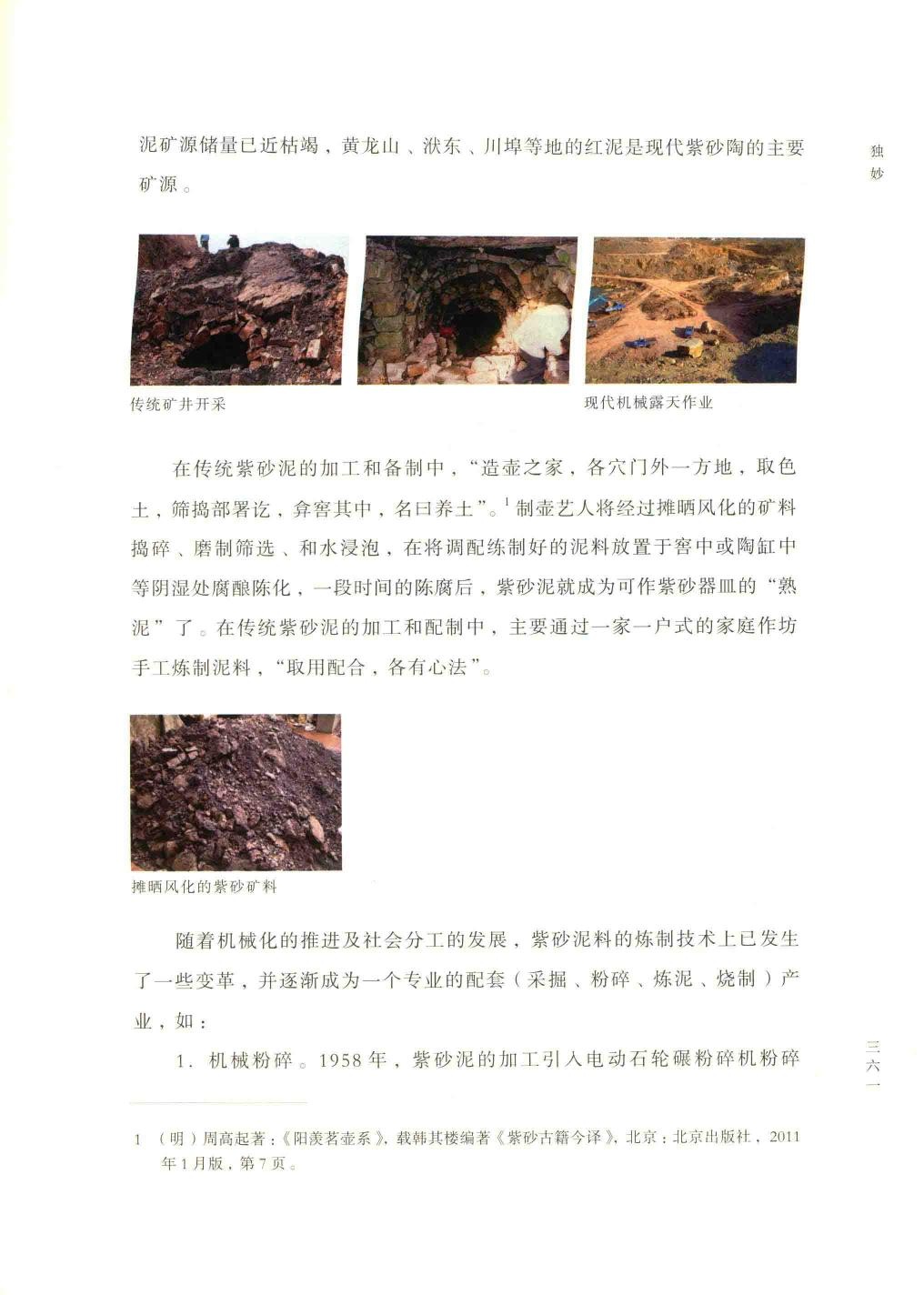
Traditional mine shaft extraction | Modern mechanical open-pit operations
## Traditional Clay Processing and Preparation
In the traditional processing and preparation of zisha clay, "pottery-making families would each dig a square plot of land outside their door, taking clay of various colors, crushing and sifting it according to their methods, mixing it together—this was called 'nurturing the clay.'"[1] Craftsmen would take the ore material that had been spread out to weather and dry, crush it, grind and sift it, soak it in water, then place the blended and kneaded clay in a cellar or ceramic jar in a cool, damp place to ferment and age. After a period of decomposition, the zisha clay would become "mature clay" suitable for making zisha ware. In the traditional processing and preparation of zisha clay, individual household workshops would manually refine the clay material, with "each having their own secret methods for extraction and blending."
*Zisha ore material spread out to weather and dry*
## Modern Developments
With the advancement of mechanization and the development of social division of labor, some changes have occurred in the clay refining technology, gradually forming a specialized supporting industry (mining, crushing, clay refining, firing). For example:
1. **Mechanical crushing.** In 1958, the processing of zisha clay introduced electric stone wheel crushers for pulverization.
---
[1] (Ming Dynasty) Zhou Gaoqi, *Yangxian Minghu Xi*, contained in Han Qilou (ed.), *Modern Translation of Ancient Zisha Texts*, Beijing: Beijing Publishing House, January 2011 edition, p. 7.
Chapter 5
独妙
Unique Excellence
Pages 142-405
View Chapter →
English Translation
The clay ore reserves are nearly exhausted. Red clay from Huanglong Mountain, Yudong, Chuanbu, and other locations are the main ore sources for modern zisha pottery.
## Traditional Mining vs. Modern Methods
Traditional mine shaft extraction | Modern mechanical open-pit operations
## Traditional Clay Processing and Preparation
In the traditional processing and preparation of zisha clay, "pottery-making families would each dig a square plot of land outside their door, taking clay of various colors, crushing and sifting it according to their methods, mixing it together—this was called 'nurturing the clay.'"[1] Craftsmen would take the ore material that had been spread out to weather and dry, crush it, grind and sift it, soak it in water, then place the blended and kneaded clay in a cellar or ceramic jar in a cool, damp place to ferment and age. After a period of decomposition, the zisha clay would become "mature clay" suitable for making zisha ware. In the traditional processing and preparation of zisha clay, individual household workshops would manually refine the clay material, with "each having their own secret methods for extraction and blending."
*Zisha ore material spread out to weather and dry*
## Modern Developments
With the advancement of mechanization and the development of social division of labor, some changes have occurred in the clay refining technology, gradually forming a specialized supporting industry (mining, crushing, clay refining, firing). For example:
1. **Mechanical crushing.** In 1958, the processing of zisha clay introduced electric stone wheel crushers for pulverization.
---
[1] (Ming Dynasty) Zhou Gaoqi, *Yangxian Minghu Xi*, contained in Han Qilou (ed.), *Modern Translation of Ancient Zisha Texts*, Beijing: Beijing Publishing House, January 2011 edition, p. 7.
章节导航 Chapter Navigation
Chapter 1
序文
Pages 6-6
Chapter 2
引言
Pages 28-31
Chapter 3
达变
Pages 32-133
Chapter 3
开宗立派
Pages 46-66
Chapter 3
传道授业
Pages 67-98
Chapter 3
大师淳友
Pages 99-120
Chapter 3
学艺谋生
Pages 121-133
Chapter 4
化神
Pages 134-141
Chapter 5
独妙
Pages 142-405
Chapter 5
匠心独运 不苟丝毫
Pages 142-179
Chapter 5
器利善事 物尽其用
Pages 180-199
Chapter 5
紫泥春华 研精究微
Pages 200-405
Chapter 6
驾简
Pages 406-427
Chapter 6
精雕细刻 文质合一
Pages 406-410
Chapter 6
师法自然 妙趣横生
Pages 411-415
Chapter 6
丝来线去 曲尽其妙
Pages 416-427
Chapter 7
明志
Pages 463-485
Chapter 7
高山仰止 淡泊明志
Pages 463-472
Chapter 7
啜墨看茶 气定神闲
Pages 473-478
Chapter 7
齿少心锐 怡志抒情
Pages 479-485
Chapter 8
存真
Pages 428-462
Chapter 8
规圆矩方 弃伪存真
Pages 428-436
Chapter 8
有物有则 钻尖仰高
Pages 437-462
Chapter 9
心营
Pages 506-525
Chapter 9
坚守传统 艺立潮头
Pages 506-513
Chapter 9
新型师承 桃李满园
Pages 514-525
Chapter 10
附录
Pages 526-651
Chapter 10
顾景舟紫艺论文
Pages 526-535
Chapter 10
技术课备课笔记
Pages 536-543
Chapter 10
顾景舟艺术年表
Pages 544-651
Chapter 11
参考文献
Pages 652-657
Chapter 12
鸣谢
Pages 658-659