Chapter 5
独妙
Unique Excellence
370
of 659
English Translation
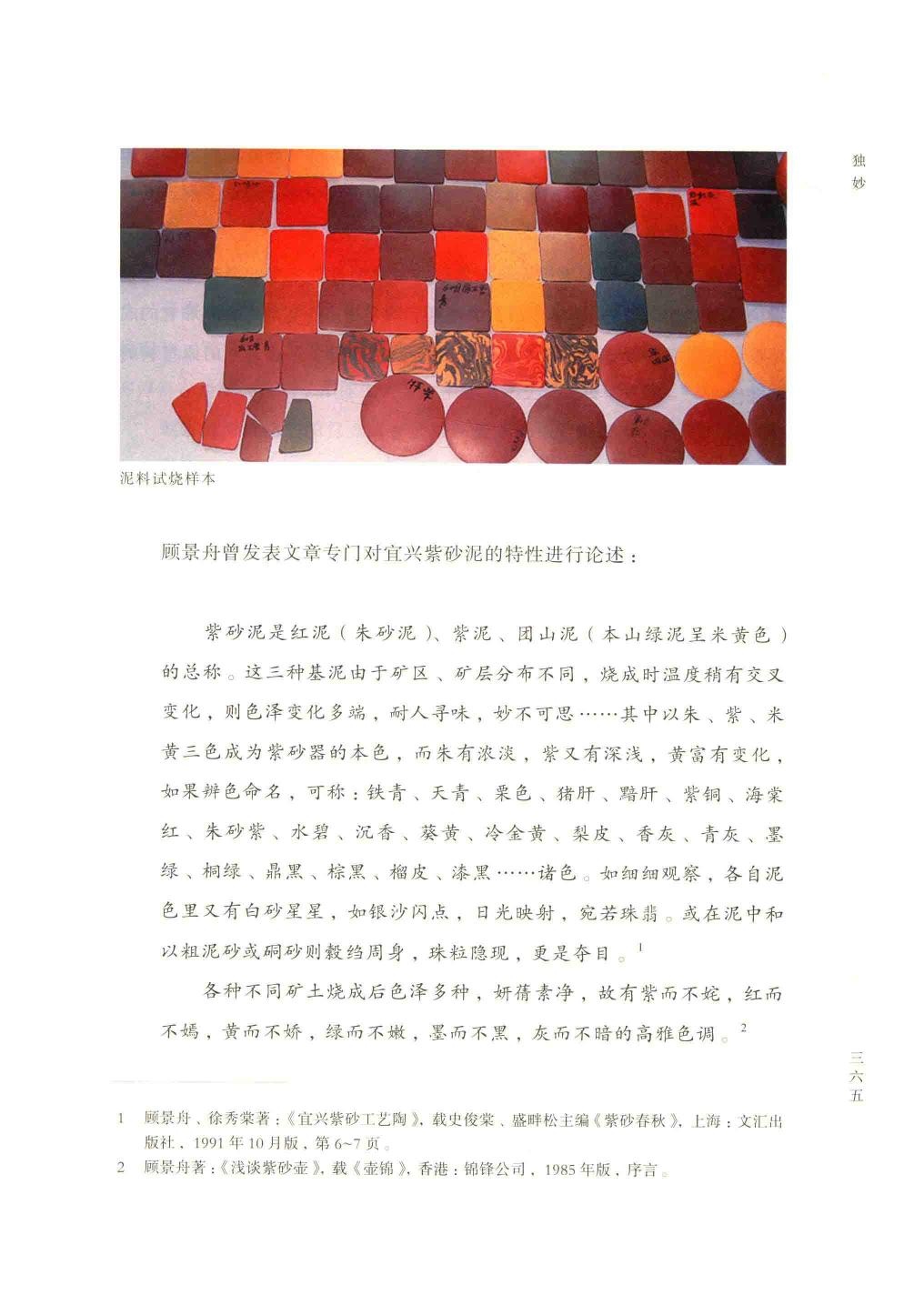
## Clay Material Test-Fired Samples
Gu Jingzhou once published an article specifically discussing the characteristics of Yixing purple clay.
Purple clay is the collective term for red clay (cinnabar clay), purple clay, and Tuanshan clay (native green clay, which appears rice-yellow in color). These three base clays vary in color endlessly due to differences in mining areas and mineral layer distribution, as well as slight variations in firing temperatures during the kiln process—fascinating and wonderful beyond words... Among them, vermillion, purple, and rice-yellow form the natural colors of purple clay ware. Vermillion has gradations from light to dark, purple has depths from shallow to deep, and yellow is rich in variation.
There are cinnabar purple, aqua blue, agarwood, yellow-yellow, cold golden yellow, pear skin, incense ash, blue-gray, black-green, paulownia green, steel black, brown-black, pomegranate skin, and submerged black, among other colors. Upon careful observation, within each clay color there are also white sandy specks, like flashing points of silver sand. When reflected in sunlight, they appear like pearls. Or when coarse clay sand or grog is mixed into the clay, the texture appears throughout the body, with pearl-like qualities appearing and disappearing—even more striking.
Various mineral soils produce multiple colors after firing, elegant and pure in their tea-like quality. Thus there is the refined color palette of "purple without excess, red without vulgarity, yellow without garishness, green without immaturity, ink without blackness, and gray without dullness."
---
[1] Xu Xiutang, in Shi Jundang and Sheng Pansong, eds., *Spring and Autumn of Purple Clay* (Shanghai: Wenjiang Publishing House, October 1991 edition), pp. 6-7.
[2] Xu Xiutang, *Yixing Purple Clay Teapots* (Hong Kong: Jinfeng Company, 1985 edition), Preface.
Chapter 5
独妙
Unique Excellence
Pages 142-405
View Chapter →
English Translation
## Clay Material Test-Fired Samples
Gu Jingzhou once published an article specifically discussing the characteristics of Yixing purple clay.
Purple clay is the collective term for red clay (cinnabar clay), purple clay, and Tuanshan clay (native green clay, which appears rice-yellow in color). These three base clays vary in color endlessly due to differences in mining areas and mineral layer distribution, as well as slight variations in firing temperatures during the kiln process—fascinating and wonderful beyond words... Among them, vermillion, purple, and rice-yellow form the natural colors of purple clay ware. Vermillion has gradations from light to dark, purple has depths from shallow to deep, and yellow is rich in variation.
There are cinnabar purple, aqua blue, agarwood, yellow-yellow, cold golden yellow, pear skin, incense ash, blue-gray, black-green, paulownia green, steel black, brown-black, pomegranate skin, and submerged black, among other colors. Upon careful observation, within each clay color there are also white sandy specks, like flashing points of silver sand. When reflected in sunlight, they appear like pearls. Or when coarse clay sand or grog is mixed into the clay, the texture appears throughout the body, with pearl-like qualities appearing and disappearing—even more striking.
Various mineral soils produce multiple colors after firing, elegant and pure in their tea-like quality. Thus there is the refined color palette of "purple without excess, red without vulgarity, yellow without garishness, green without immaturity, ink without blackness, and gray without dullness."
---
[1] Xu Xiutang, in Shi Jundang and Sheng Pansong, eds., *Spring and Autumn of Purple Clay* (Shanghai: Wenjiang Publishing House, October 1991 edition), pp. 6-7.
[2] Xu Xiutang, *Yixing Purple Clay Teapots* (Hong Kong: Jinfeng Company, 1985 edition), Preface.
章节导航 Chapter Navigation
Chapter 1
序文
Pages 6-6
Chapter 2
引言
Pages 28-31
Chapter 3
达变
Pages 32-133
Chapter 3
开宗立派
Pages 46-66
Chapter 3
传道授业
Pages 67-98
Chapter 3
大师淳友
Pages 99-120
Chapter 3
学艺谋生
Pages 121-133
Chapter 4
化神
Pages 134-141
Chapter 5
独妙
Pages 142-405
Chapter 5
匠心独运 不苟丝毫
Pages 142-179
Chapter 5
器利善事 物尽其用
Pages 180-199
Chapter 5
紫泥春华 研精究微
Pages 200-405
Chapter 6
驾简
Pages 406-427
Chapter 6
精雕细刻 文质合一
Pages 406-410
Chapter 6
师法自然 妙趣横生
Pages 411-415
Chapter 6
丝来线去 曲尽其妙
Pages 416-427
Chapter 7
明志
Pages 463-485
Chapter 7
高山仰止 淡泊明志
Pages 463-472
Chapter 7
啜墨看茶 气定神闲
Pages 473-478
Chapter 7
齿少心锐 怡志抒情
Pages 479-485
Chapter 8
存真
Pages 428-462
Chapter 8
规圆矩方 弃伪存真
Pages 428-436
Chapter 8
有物有则 钻尖仰高
Pages 437-462
Chapter 9
心营
Pages 506-525
Chapter 9
坚守传统 艺立潮头
Pages 506-513
Chapter 9
新型师承 桃李满园
Pages 514-525
Chapter 10
附录
Pages 526-651
Chapter 10
顾景舟紫艺论文
Pages 526-535
Chapter 10
技术课备课笔记
Pages 536-543
Chapter 10
顾景舟艺术年表
Pages 544-651
Chapter 11
参考文献
Pages 652-657
Chapter 12
鸣谢
Pages 658-659