Chapter 5
独妙
Unique Excellence
371
of 659
English Translation
## Preparing the Clay
Gu Jingzhou believed that mastering the properties of clay materials was essential foundational knowledge for purple clay creation and production. He made this requirement of his students: "In our production knowledge, we should understand some of the scientific principles of clay materials."
Therefore, Gu Jingzhou placed particular emphasis on the most fundamental and critical role of clay materials in the forming process of purple clay wares. He believed: "The greatest characteristic of purple clay is determined by its raw materials and its forming method... All kinds of forms are in the hands, and success is achieved with bare hands. This is the characteristic of its raw materials."
## Wedging Clay by Hand: Ge Taozhong
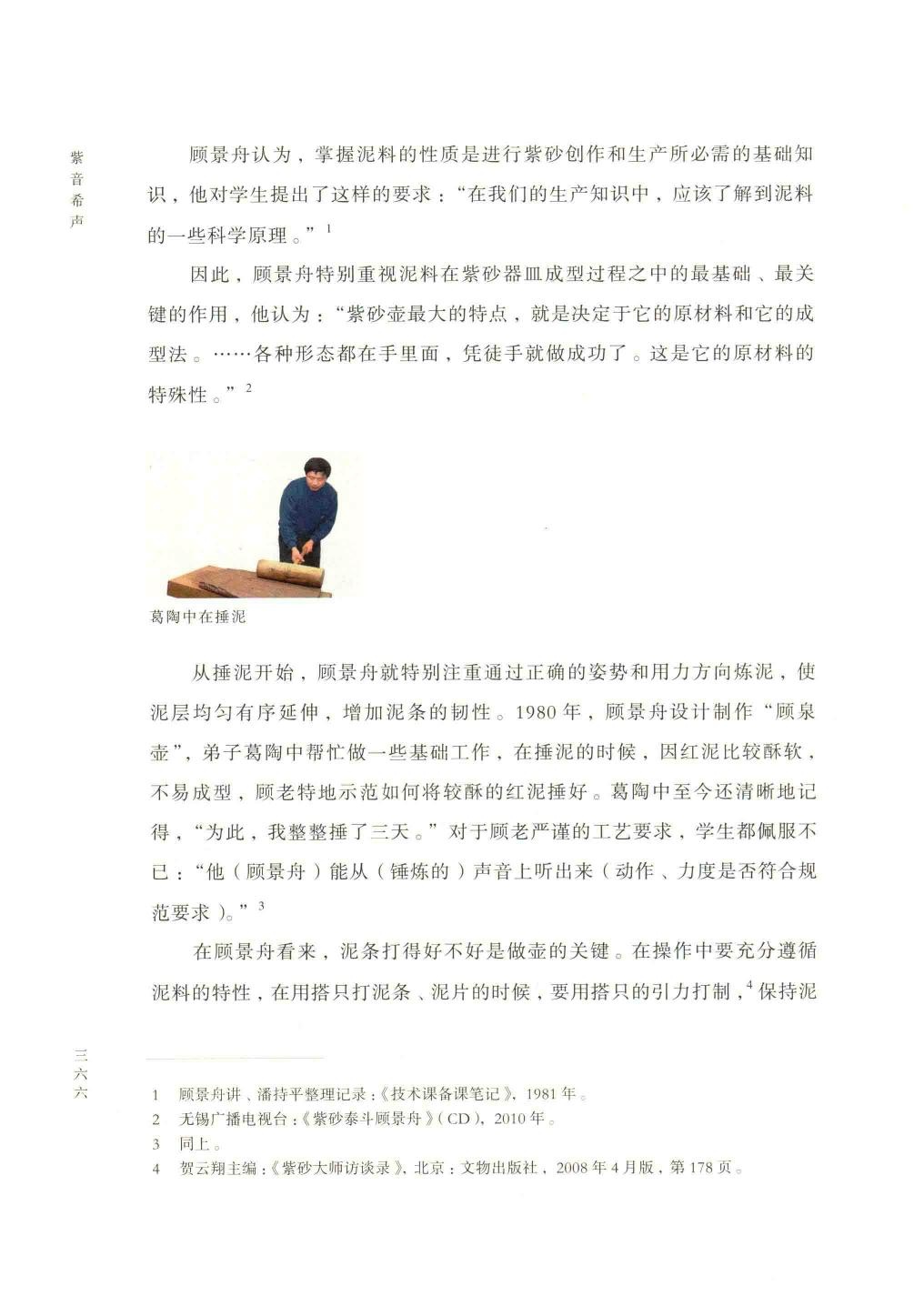
From the wedging of clay, Gu Jingzhou paid special attention to kneading the clay through correct posture and direction of force, making the clay layers extend uniformly and orderly, increasing the toughness of the clay coils. In 1980, when Gu Jingzhou designed and made the "Gu Fan Teapot," his disciple Ge Taozhong helped with some foundational work. When wedging the clay, because red clay is relatively soft and crumbly and not easy to form, Master Gu specially demonstrated how to properly wedge the more crumbly red clay. Ge Taozhong still clearly remembers to this day, "For this, I wedged for three whole days." Regarding Master Gu's rigorous technical requirements, his students were all deeply impressed: "He (Gu Jingzhou) could tell from the sound (whether the movements and force met the standard requirements)."[1]
In Gu Jingzhou's view, whether the clay coils were beaten well was the key to making teapots. In practice, one must fully follow the characteristics of the clay material. When using a mallet to beat clay coils and clay slabs, one should use the gravitational force of the mallet to strike, maintaining the clay...
---
[1] Gu Jingzhou (lecturer), Pan Chiping (recorder and compiler): *Technical Course Preparation Notes*, 1981
[2] Wuxi Radio and Television Station: *Purple Clay Master Gu Jingzhou* (CD), 2010
[3] Ibid.
[4] Edited by Guo Yunxiang: *Interviews with Purple Clay Masters*, Beijing: Cultural Relics Publishing House, April 2008 edition, p. 178
Chapter 5
独妙
Unique Excellence
Pages 142-405
View Chapter →
English Translation
## Preparing the Clay
Gu Jingzhou believed that mastering the properties of clay materials was essential foundational knowledge for purple clay creation and production. He made this requirement of his students: "In our production knowledge, we should understand some of the scientific principles of clay materials."
Therefore, Gu Jingzhou placed particular emphasis on the most fundamental and critical role of clay materials in the forming process of purple clay wares. He believed: "The greatest characteristic of purple clay is determined by its raw materials and its forming method... All kinds of forms are in the hands, and success is achieved with bare hands. This is the characteristic of its raw materials."
## Wedging Clay by Hand: Ge Taozhong
From the wedging of clay, Gu Jingzhou paid special attention to kneading the clay through correct posture and direction of force, making the clay layers extend uniformly and orderly, increasing the toughness of the clay coils. In 1980, when Gu Jingzhou designed and made the "Gu Fan Teapot," his disciple Ge Taozhong helped with some foundational work. When wedging the clay, because red clay is relatively soft and crumbly and not easy to form, Master Gu specially demonstrated how to properly wedge the more crumbly red clay. Ge Taozhong still clearly remembers to this day, "For this, I wedged for three whole days." Regarding Master Gu's rigorous technical requirements, his students were all deeply impressed: "He (Gu Jingzhou) could tell from the sound (whether the movements and force met the standard requirements)."[1]
In Gu Jingzhou's view, whether the clay coils were beaten well was the key to making teapots. In practice, one must fully follow the characteristics of the clay material. When using a mallet to beat clay coils and clay slabs, one should use the gravitational force of the mallet to strike, maintaining the clay...
---
[1] Gu Jingzhou (lecturer), Pan Chiping (recorder and compiler): *Technical Course Preparation Notes*, 1981
[2] Wuxi Radio and Television Station: *Purple Clay Master Gu Jingzhou* (CD), 2010
[3] Ibid.
[4] Edited by Guo Yunxiang: *Interviews with Purple Clay Masters*, Beijing: Cultural Relics Publishing House, April 2008 edition, p. 178
章节导航 Chapter Navigation
Chapter 1
序文
Pages 6-6
Chapter 2
引言
Pages 28-31
Chapter 3
达变
Pages 32-133
Chapter 3
开宗立派
Pages 46-66
Chapter 3
传道授业
Pages 67-98
Chapter 3
大师淳友
Pages 99-120
Chapter 3
学艺谋生
Pages 121-133
Chapter 4
化神
Pages 134-141
Chapter 5
独妙
Pages 142-405
Chapter 5
匠心独运 不苟丝毫
Pages 142-179
Chapter 5
器利善事 物尽其用
Pages 180-199
Chapter 5
紫泥春华 研精究微
Pages 200-405
Chapter 6
驾简
Pages 406-427
Chapter 6
精雕细刻 文质合一
Pages 406-410
Chapter 6
师法自然 妙趣横生
Pages 411-415
Chapter 6
丝来线去 曲尽其妙
Pages 416-427
Chapter 7
明志
Pages 463-485
Chapter 7
高山仰止 淡泊明志
Pages 463-472
Chapter 7
啜墨看茶 气定神闲
Pages 473-478
Chapter 7
齿少心锐 怡志抒情
Pages 479-485
Chapter 8
存真
Pages 428-462
Chapter 8
规圆矩方 弃伪存真
Pages 428-436
Chapter 8
有物有则 钻尖仰高
Pages 437-462
Chapter 9
心营
Pages 506-525
Chapter 9
坚守传统 艺立潮头
Pages 506-513
Chapter 9
新型师承 桃李满园
Pages 514-525
Chapter 10
附录
Pages 526-651
Chapter 10
顾景舟紫艺论文
Pages 526-535
Chapter 10
技术课备课笔记
Pages 536-543
Chapter 10
顾景舟艺术年表
Pages 544-651
Chapter 11
参考文献
Pages 652-657
Chapter 12
鸣谢
Pages 658-659