Chapter 5
独妙
Unique Excellence
372
of 659
English Translation
The clay strips and slabs receive force evenly, avoiding uneven thickness. Additionally, because zisha clay is beaten multiple times, the "clay gate" can easily become loosened; if beaten too little, the clay's plasticity is poor. Gu Jingzhou summarized from experience that beating around thirteen times is relatively scientific. All of this comes from his keen sensitivity to zisha clay, long-accumulated experience, and rigorous attitude toward zisha creation.
Ge Taozhong recalled: "Master Gu had precise specifications for the size of clay slabs. If a 10-centimeter clay slab was needed, then when beating the clay slab, it could only be beaten to just over 11 centimeters. There were precise specifications for how large and how thick a piece of clay could be beaten—it couldn't be too large, nor too small. The calculations were very precise."
Gu Jingzhou had strict regulations for the method of beating the body cylinder. When beating the bottom, he required four rounds of beating, and the method for each round was different. If the upper opening was slightly larger, only three rounds were needed. When others made teapots according to Gu Jingzhou's designed dimensions, the flavor of the finished product would be different. One important reason for this lies in his unique and distinctive techniques for the beating method and force applied to the body cylinder.
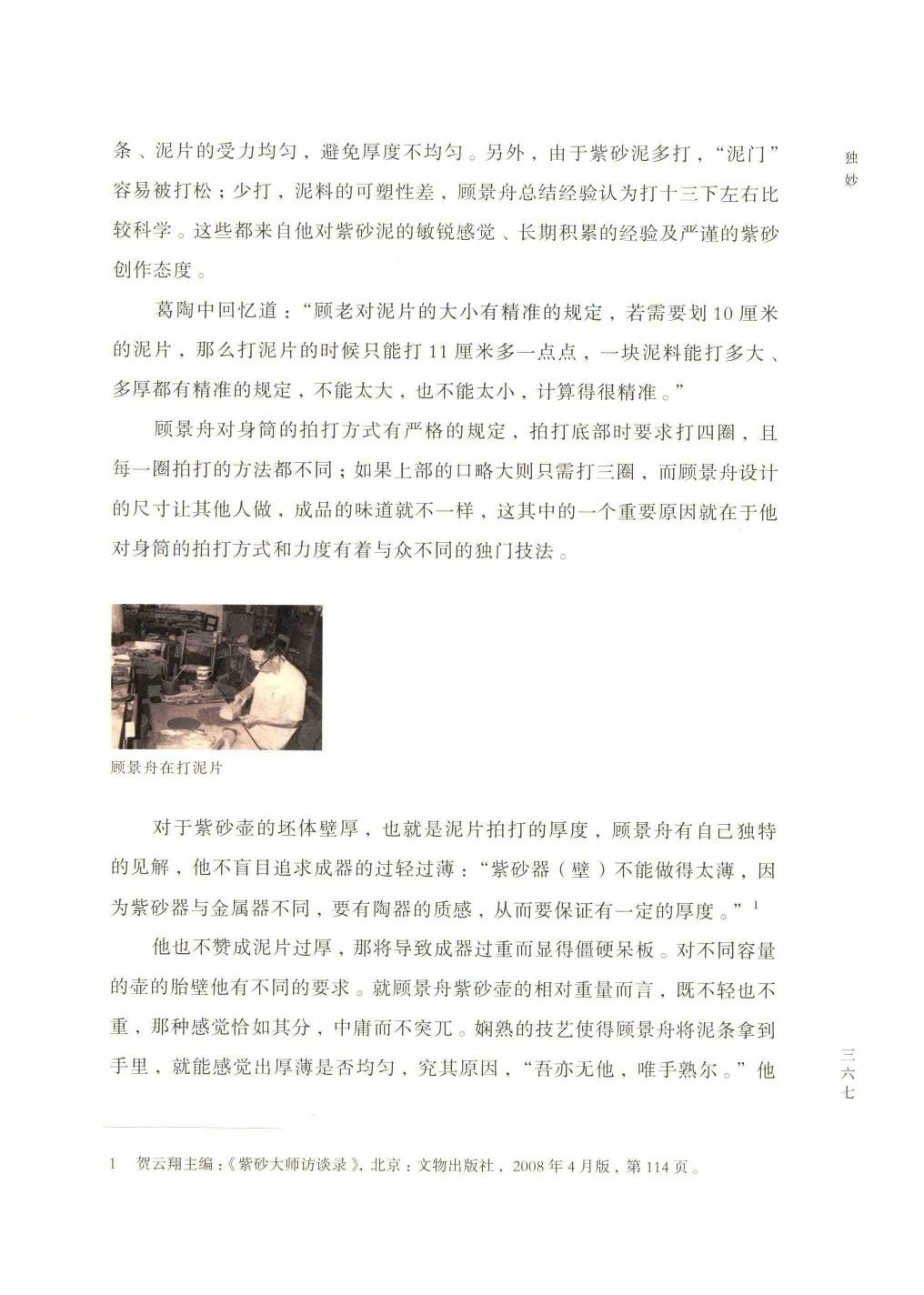
## Gu Jingzhou Beating Clay Slabs
Regarding the wall thickness of the zisha teapot body—that is, the thickness of the beaten clay slabs—Gu Jingzhou had his own unique insights. He did not blindly pursue excessively light or thin finished vessels: "Zisha vessels (walls) cannot be made too thin, because zisha vessels are different from metal vessels; they must have the texture of pottery, and thus must maintain a certain thickness."[1] He also did not approve of clay slabs being too thick, as that would result in finished vessels being too heavy and appearing stiff and rigid. He had different requirements for the body walls of teapots of different capacities. In terms of the relative weight of Gu Jingzhou's zisha teapots, they were neither light nor heavy—that feeling was just right, moderate without being excessive. His skilled craftsmanship enabled Gu Jingzhou to feel whether the thickness was uniform just by taking a clay strip in his hands. The reason for this: "There is no other principle—only familiarity of the hand."
---
[1] Fei Yunxiang, ed., *Interviews with Zisha Masters* (Beijing: Cultural Relics Publishing House, April 2008), p. 114.
Chapter 5
独妙
Unique Excellence
Pages 142-405
View Chapter →
English Translation
The clay strips and slabs receive force evenly, avoiding uneven thickness. Additionally, because zisha clay is beaten multiple times, the "clay gate" can easily become loosened; if beaten too little, the clay's plasticity is poor. Gu Jingzhou summarized from experience that beating around thirteen times is relatively scientific. All of this comes from his keen sensitivity to zisha clay, long-accumulated experience, and rigorous attitude toward zisha creation.
Ge Taozhong recalled: "Master Gu had precise specifications for the size of clay slabs. If a 10-centimeter clay slab was needed, then when beating the clay slab, it could only be beaten to just over 11 centimeters. There were precise specifications for how large and how thick a piece of clay could be beaten—it couldn't be too large, nor too small. The calculations were very precise."
Gu Jingzhou had strict regulations for the method of beating the body cylinder. When beating the bottom, he required four rounds of beating, and the method for each round was different. If the upper opening was slightly larger, only three rounds were needed. When others made teapots according to Gu Jingzhou's designed dimensions, the flavor of the finished product would be different. One important reason for this lies in his unique and distinctive techniques for the beating method and force applied to the body cylinder.
## Gu Jingzhou Beating Clay Slabs
Regarding the wall thickness of the zisha teapot body—that is, the thickness of the beaten clay slabs—Gu Jingzhou had his own unique insights. He did not blindly pursue excessively light or thin finished vessels: "Zisha vessels (walls) cannot be made too thin, because zisha vessels are different from metal vessels; they must have the texture of pottery, and thus must maintain a certain thickness."[1] He also did not approve of clay slabs being too thick, as that would result in finished vessels being too heavy and appearing stiff and rigid. He had different requirements for the body walls of teapots of different capacities. In terms of the relative weight of Gu Jingzhou's zisha teapots, they were neither light nor heavy—that feeling was just right, moderate without being excessive. His skilled craftsmanship enabled Gu Jingzhou to feel whether the thickness was uniform just by taking a clay strip in his hands. The reason for this: "There is no other principle—only familiarity of the hand."
---
[1] Fei Yunxiang, ed., *Interviews with Zisha Masters* (Beijing: Cultural Relics Publishing House, April 2008), p. 114.
章节导航 Chapter Navigation
Chapter 1
序文
Pages 6-6
Chapter 2
引言
Pages 28-31
Chapter 3
达变
Pages 32-133
Chapter 3
开宗立派
Pages 46-66
Chapter 3
传道授业
Pages 67-98
Chapter 3
大师淳友
Pages 99-120
Chapter 3
学艺谋生
Pages 121-133
Chapter 4
化神
Pages 134-141
Chapter 5
独妙
Pages 142-405
Chapter 5
匠心独运 不苟丝毫
Pages 142-179
Chapter 5
器利善事 物尽其用
Pages 180-199
Chapter 5
紫泥春华 研精究微
Pages 200-405
Chapter 6
驾简
Pages 406-427
Chapter 6
精雕细刻 文质合一
Pages 406-410
Chapter 6
师法自然 妙趣横生
Pages 411-415
Chapter 6
丝来线去 曲尽其妙
Pages 416-427
Chapter 7
明志
Pages 463-485
Chapter 7
高山仰止 淡泊明志
Pages 463-472
Chapter 7
啜墨看茶 气定神闲
Pages 473-478
Chapter 7
齿少心锐 怡志抒情
Pages 479-485
Chapter 8
存真
Pages 428-462
Chapter 8
规圆矩方 弃伪存真
Pages 428-436
Chapter 8
有物有则 钻尖仰高
Pages 437-462
Chapter 9
心营
Pages 506-525
Chapter 9
坚守传统 艺立潮头
Pages 506-513
Chapter 9
新型师承 桃李满园
Pages 514-525
Chapter 10
附录
Pages 526-651
Chapter 10
顾景舟紫艺论文
Pages 526-535
Chapter 10
技术课备课笔记
Pages 536-543
Chapter 10
顾景舟艺术年表
Pages 544-651
Chapter 11
参考文献
Pages 652-657
Chapter 12
鸣谢
Pages 658-659