Chapter 5
独妙
Unique Excellence
377
of 659
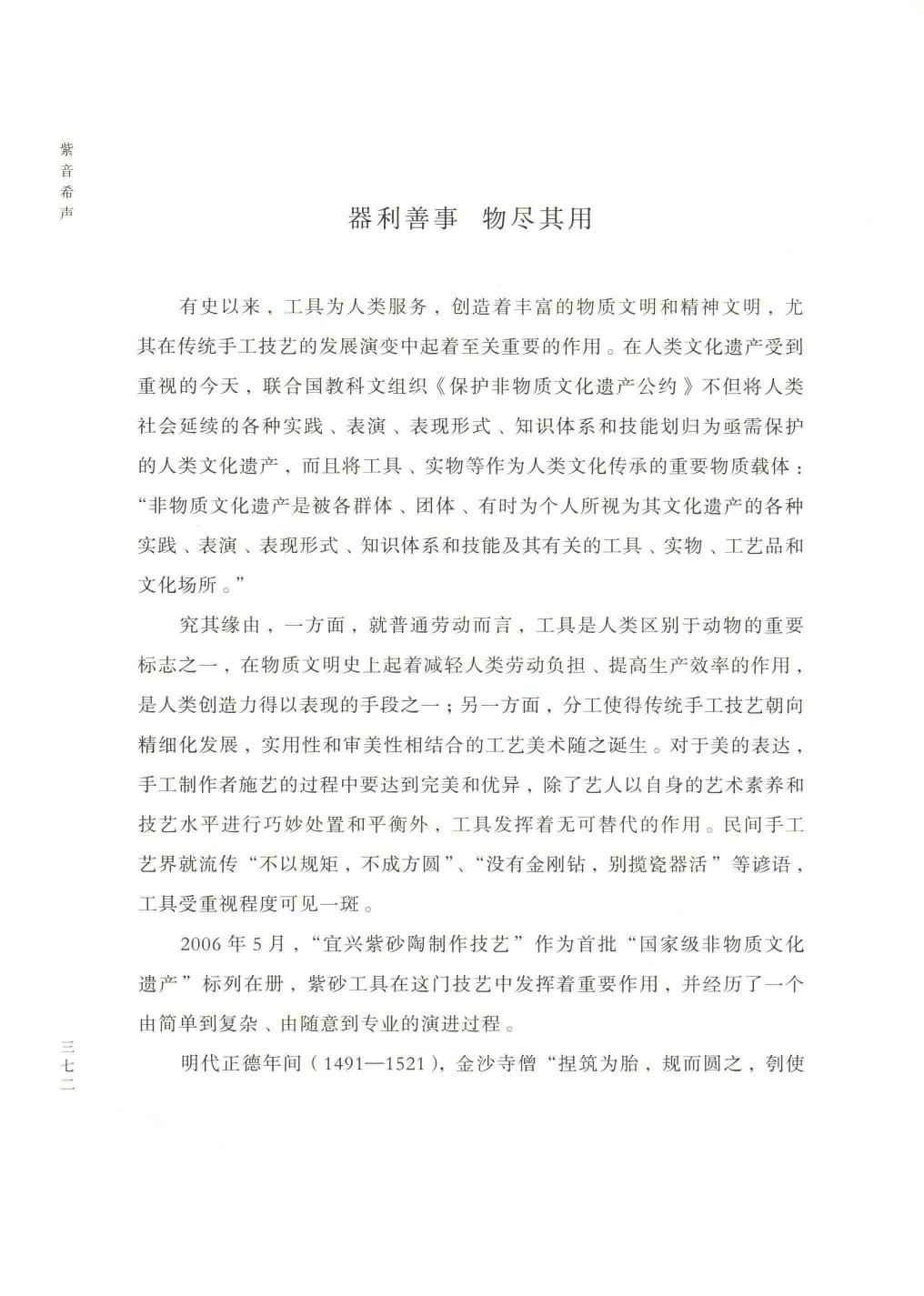
English Translation
## Making the Best Use of Everything
Since ancient times, tools have served humanity, creating abundant material and spiritual civilizations. They have played a crucial role in the development and evolution of traditional handicraft techniques. Today, as human cultural heritage faces neglect, the UNESCO *Convention for the Safeguarding of the Intangible Cultural Heritage* not only classifies various practices, performances, expressions, knowledge systems, and skills that sustain human society as cultural heritage requiring protection, but also recognizes tools and physical objects as important material carriers of human cultural transmission:
> "Intangible cultural heritage means the practices, representations, expressions, knowledge, skills—as well as the instruments, objects, artifacts and cultural spaces associated therewith—that communities, groups and, in some cases, individuals recognize as part of their cultural heritage."
The reasons are twofold. On one hand, in terms of ordinary labor, tools are one of the important markers distinguishing humans from animals. In the history of material civilization, they have served to reduce the burden of human labor and improve production efficiency, representing one of the means by which human creativity is expressed. On the other hand, the division of labor has driven traditional handicraft techniques toward refinement, giving birth to decorative arts that combine practicality with aesthetics. In expressing beauty, craftspeople must achieve perfection and excellence in their creative process. Beyond the artisan's own artistic cultivation and technical skill in making clever adjustments and achieving balance, tools play an irreplaceable role. Folk handicraft circles have long circulated proverbs such as "Without compass and square, one cannot make circles and squares" and "Without a diamond drill, don't take on porcelain work"—testament to the importance placed on tools.
In May 2006, "Yixing Purple Clay Pottery Making Techniques" was listed among the first batch of "National Intangible Cultural Heritage." Purple clay tools play an important role in this craft and have undergone an evolutionary process from simple to complex, from casual to professional.
During the Zhengde period of the Ming Dynasty (1491-1521), a monk from Jinsha Temple "molded clay into forms, made them round with regulations, and used a deer [tool]..."
Chapter 5
独妙
Unique Excellence
Pages 142-405
View Chapter →
English Translation
## Making the Best Use of Everything
Since ancient times, tools have served humanity, creating abundant material and spiritual civilizations. They have played a crucial role in the development and evolution of traditional handicraft techniques. Today, as human cultural heritage faces neglect, the UNESCO *Convention for the Safeguarding of the Intangible Cultural Heritage* not only classifies various practices, performances, expressions, knowledge systems, and skills that sustain human society as cultural heritage requiring protection, but also recognizes tools and physical objects as important material carriers of human cultural transmission:
> "Intangible cultural heritage means the practices, representations, expressions, knowledge, skills—as well as the instruments, objects, artifacts and cultural spaces associated therewith—that communities, groups and, in some cases, individuals recognize as part of their cultural heritage."
The reasons are twofold. On one hand, in terms of ordinary labor, tools are one of the important markers distinguishing humans from animals. In the history of material civilization, they have served to reduce the burden of human labor and improve production efficiency, representing one of the means by which human creativity is expressed. On the other hand, the division of labor has driven traditional handicraft techniques toward refinement, giving birth to decorative arts that combine practicality with aesthetics. In expressing beauty, craftspeople must achieve perfection and excellence in their creative process. Beyond the artisan's own artistic cultivation and technical skill in making clever adjustments and achieving balance, tools play an irreplaceable role. Folk handicraft circles have long circulated proverbs such as "Without compass and square, one cannot make circles and squares" and "Without a diamond drill, don't take on porcelain work"—testament to the importance placed on tools.
In May 2006, "Yixing Purple Clay Pottery Making Techniques" was listed among the first batch of "National Intangible Cultural Heritage." Purple clay tools play an important role in this craft and have undergone an evolutionary process from simple to complex, from casual to professional.
During the Zhengde period of the Ming Dynasty (1491-1521), a monk from Jinsha Temple "molded clay into forms, made them round with regulations, and used a deer [tool]..."
章节导航 Chapter Navigation
Chapter 1
序文
Pages 6-6
Chapter 2
引言
Pages 28-31
Chapter 3
达变
Pages 32-133
Chapter 3
开宗立派
Pages 46-66
Chapter 3
传道授业
Pages 67-98
Chapter 3
大师淳友
Pages 99-120
Chapter 3
学艺谋生
Pages 121-133
Chapter 4
化神
Pages 134-141
Chapter 5
独妙
Pages 142-405
Chapter 5
匠心独运 不苟丝毫
Pages 142-179
Chapter 5
器利善事 物尽其用
Pages 180-199
Chapter 5
紫泥春华 研精究微
Pages 200-405
Chapter 6
驾简
Pages 406-427
Chapter 6
精雕细刻 文质合一
Pages 406-410
Chapter 6
师法自然 妙趣横生
Pages 411-415
Chapter 6
丝来线去 曲尽其妙
Pages 416-427
Chapter 7
明志
Pages 463-485
Chapter 7
高山仰止 淡泊明志
Pages 463-472
Chapter 7
啜墨看茶 气定神闲
Pages 473-478
Chapter 7
齿少心锐 怡志抒情
Pages 479-485
Chapter 8
存真
Pages 428-462
Chapter 8
规圆矩方 弃伪存真
Pages 428-436
Chapter 8
有物有则 钻尖仰高
Pages 437-462
Chapter 9
心营
Pages 506-525
Chapter 9
坚守传统 艺立潮头
Pages 506-513
Chapter 9
新型师承 桃李满园
Pages 514-525
Chapter 10
附录
Pages 526-651
Chapter 10
顾景舟紫艺论文
Pages 526-535
Chapter 10
技术课备课笔记
Pages 536-543
Chapter 10
顾景舟艺术年表
Pages 544-651
Chapter 11
参考文献
Pages 652-657
Chapter 12
鸣谢
Pages 658-659