Chapter 5
独妙
Unique Excellence
405
of 659
English Translation
## Threads Come and Go, Curves Exhaust Their Wonder
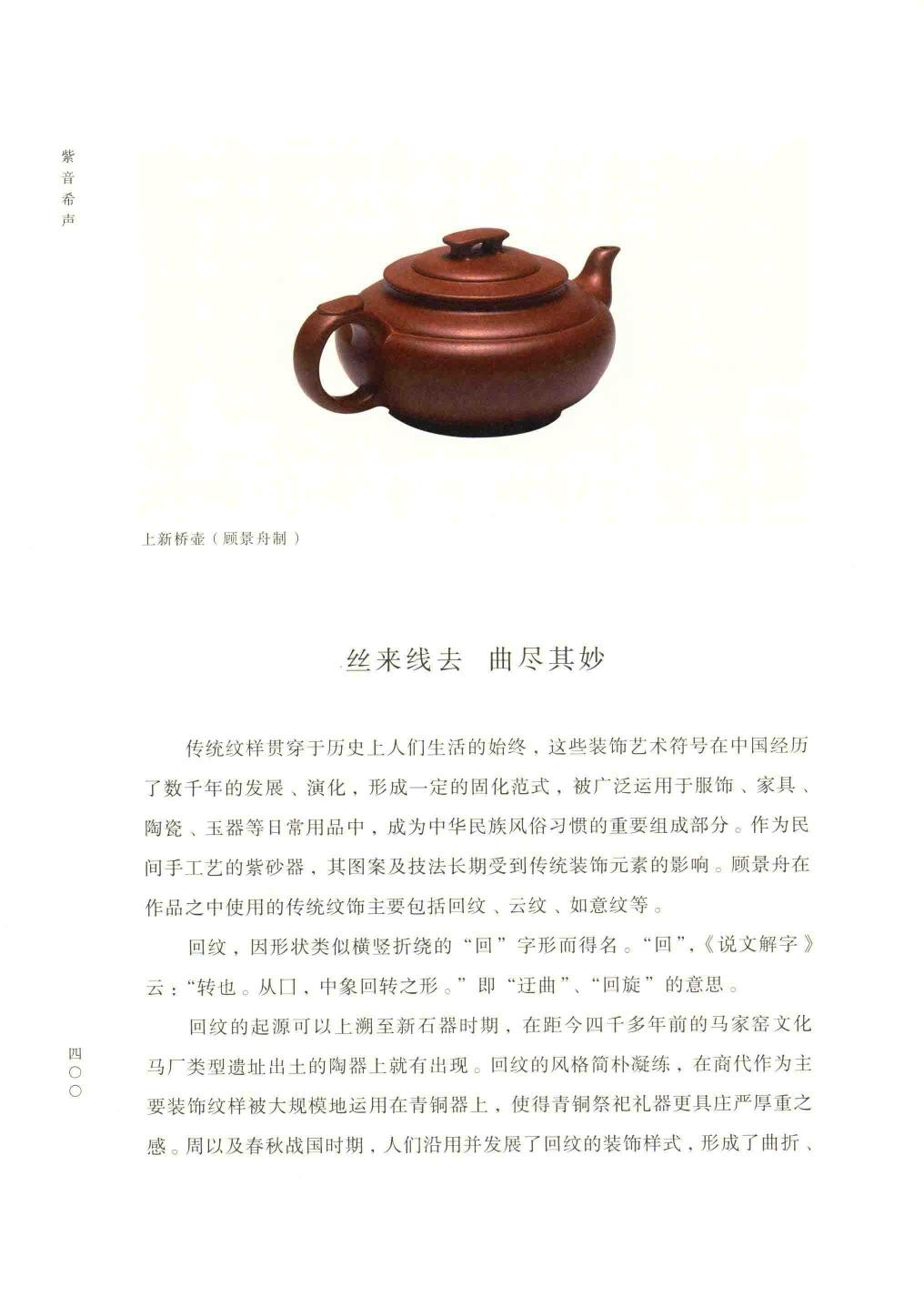
Traditional patterns have run throughout the lives of people across history. These decorative artistic symbols have undergone thousands of years of development and evolution in China, forming certain fixed paradigms that have been widely applied to daily items such as clothing, furniture, ceramics, and jade objects, becoming an important component of the customs and habits of the Chinese nation. As a folk handicraft, Yixing pottery and its patterns and techniques have long been influenced by traditional decorative elements. The traditional patterns that Gu Jingzhou used in his works mainly include the key-fret pattern, cloud pattern, and ruyi pattern.
The key-fret pattern (*huiwen*) gets its name from its shape resembling the character "回" (*hui*) with its horizontal tight folds and winding turns. The character "回" is explained in *Shuowen Jiezi* as: "to turn. From 口 (*kou*), the center symbolizes the form of turning back." This means "to revolve" or "to return."
The origin of the key-fret pattern can be traced back to the Neolithic period, appearing on pottery excavated from Majiayao culture Machang-type sites dating back more than four thousand years. The style of the key-fret pattern is simple and refined. During the Shang dynasty, it was used on a large scale as a primary decorative pattern on bronze vessels, giving bronze ritual vessels a more solemn and weighty feeling. During the Zhou dynasty and the Spring and Autumn and Warring States periods, people continued to use and develop the decorative style of the key-fret pattern, forming meandering and
Chapter 5
独妙
Unique Excellence
Pages 142-405
View Chapter →
English Translation
## Threads Come and Go, Curves Exhaust Their Wonder
Traditional patterns have run throughout the lives of people across history. These decorative artistic symbols have undergone thousands of years of development and evolution in China, forming certain fixed paradigms that have been widely applied to daily items such as clothing, furniture, ceramics, and jade objects, becoming an important component of the customs and habits of the Chinese nation. As a folk handicraft, Yixing pottery and its patterns and techniques have long been influenced by traditional decorative elements. The traditional patterns that Gu Jingzhou used in his works mainly include the key-fret pattern, cloud pattern, and ruyi pattern.
The key-fret pattern (*huiwen*) gets its name from its shape resembling the character "回" (*hui*) with its horizontal tight folds and winding turns. The character "回" is explained in *Shuowen Jiezi* as: "to turn. From 口 (*kou*), the center symbolizes the form of turning back." This means "to revolve" or "to return."
The origin of the key-fret pattern can be traced back to the Neolithic period, appearing on pottery excavated from Majiayao culture Machang-type sites dating back more than four thousand years. The style of the key-fret pattern is simple and refined. During the Shang dynasty, it was used on a large scale as a primary decorative pattern on bronze vessels, giving bronze ritual vessels a more solemn and weighty feeling. During the Zhou dynasty and the Spring and Autumn and Warring States periods, people continued to use and develop the decorative style of the key-fret pattern, forming meandering and
章节导航 Chapter Navigation
Chapter 1
序文
Pages 6-6
Chapter 2
引言
Pages 28-31
Chapter 3
达变
Pages 32-133
Chapter 3
开宗立派
Pages 46-66
Chapter 3
传道授业
Pages 67-98
Chapter 3
大师淳友
Pages 99-120
Chapter 3
学艺谋生
Pages 121-133
Chapter 4
化神
Pages 134-141
Chapter 5
独妙
Pages 142-405
Chapter 5
匠心独运 不苟丝毫
Pages 142-179
Chapter 5
器利善事 物尽其用
Pages 180-199
Chapter 5
紫泥春华 研精究微
Pages 200-405
Chapter 6
驾简
Pages 406-427
Chapter 6
精雕细刻 文质合一
Pages 406-410
Chapter 6
师法自然 妙趣横生
Pages 411-415
Chapter 6
丝来线去 曲尽其妙
Pages 416-427
Chapter 7
明志
Pages 463-485
Chapter 7
高山仰止 淡泊明志
Pages 463-472
Chapter 7
啜墨看茶 气定神闲
Pages 473-478
Chapter 7
齿少心锐 怡志抒情
Pages 479-485
Chapter 8
存真
Pages 428-462
Chapter 8
规圆矩方 弃伪存真
Pages 428-436
Chapter 8
有物有则 钻尖仰高
Pages 437-462
Chapter 9
心营
Pages 506-525
Chapter 9
坚守传统 艺立潮头
Pages 506-513
Chapter 9
新型师承 桃李满园
Pages 514-525
Chapter 10
附录
Pages 526-651
Chapter 10
顾景舟紫艺论文
Pages 526-535
Chapter 10
技术课备课笔记
Pages 536-543
Chapter 10
顾景舟艺术年表
Pages 544-651
Chapter 11
参考文献
Pages 652-657
Chapter 12
鸣谢
Pages 658-659