Chapter 6
驾简
Mastering Simplicity
408
of 659
English Translation
From the abstract primitive spiral patterns of Neolithic painted pottery culture, to the solemn cloud and thunder patterns of the Shang and Zhou dynasties, and then to the cloud and vapor motifs with strong flowing movement in the Qin and Han periods, cloud patterns continuously evolved and transformed with the progression of society. From the Wei, Jin, Northern and Southern Dynasties through the Sui and Tang periods, the traditional flowing cloud and vapor patterns gradually evolved into cloud decorations with cloud heads as the primary element and cloud tails as secondary features. The relatively early periods of the Sixteen Kingdoms, Northern Wei, and Western Wei clearly bore the painting style of the Western Regions, while Sui dynasty Dunhuang murals already distinctly possessed the traditional painting style of the Han people. During this period, the "cloud shoulder pattern" appeared, decorating the shoulders of vessels. Song dynasty cloud patterns generally maintained the layered cloud style, but by the Yuan dynasty they gradually evolved into dense, curling cloud head patterns with multiple layers.
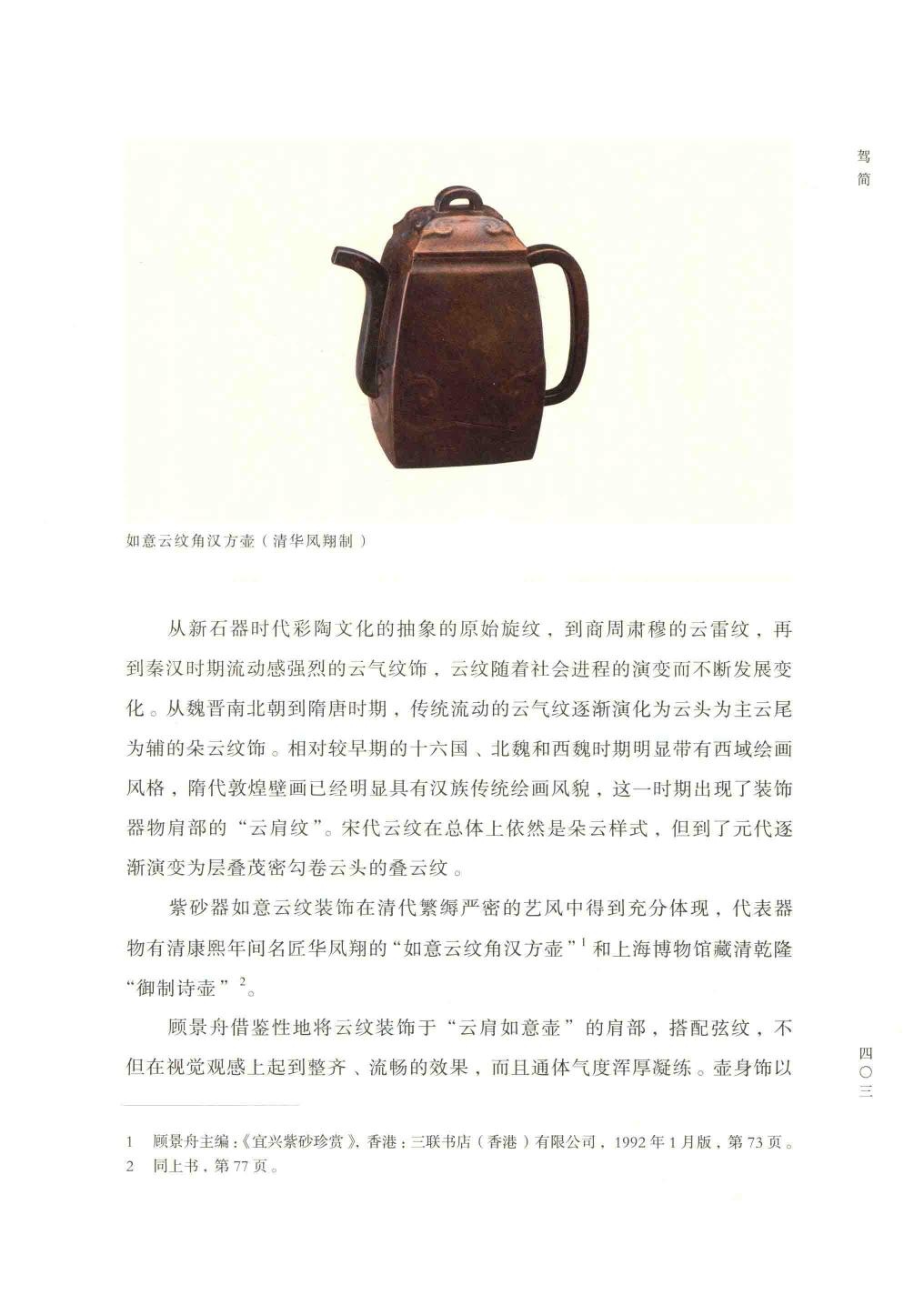
The ruyi cloud pattern decoration on Yixing pottery was fully embodied in the rigorous and meticulous artistic style of the Qing dynasty. Representative works include the "Ruyi Cloud Pattern Square Han Pot" by the renowned craftsman Hua Fengxiang from the Kangxi reign period, and the "Imperial Poetry Pot" from the Qianlong period housed in the Shanghai Museum.[1]
Gu Jingzhou innovatively applied cloud pattern decoration to the shoulder of his "Cloud Shoulder Ruyi Pot," paired with string patterns. This not only created a neat and flowing visual effect, but also gave the entire vessel a dignified and refined bearing. The body of the pot is decorated with...
---
[1] Gu Jingzhou, ed., *Appreciation of Yixing Zisha Pottery* (Hong Kong: Joint Publishing (H.K.) Co., Ltd., January 1992), p. 73.
[2] Ibid., p. 77.
Chapter 6
驾简
Mastering Simplicity
Pages 406-427
View Chapter →
English Translation
From the abstract primitive spiral patterns of Neolithic painted pottery culture, to the solemn cloud and thunder patterns of the Shang and Zhou dynasties, and then to the cloud and vapor motifs with strong flowing movement in the Qin and Han periods, cloud patterns continuously evolved and transformed with the progression of society. From the Wei, Jin, Northern and Southern Dynasties through the Sui and Tang periods, the traditional flowing cloud and vapor patterns gradually evolved into cloud decorations with cloud heads as the primary element and cloud tails as secondary features. The relatively early periods of the Sixteen Kingdoms, Northern Wei, and Western Wei clearly bore the painting style of the Western Regions, while Sui dynasty Dunhuang murals already distinctly possessed the traditional painting style of the Han people. During this period, the "cloud shoulder pattern" appeared, decorating the shoulders of vessels. Song dynasty cloud patterns generally maintained the layered cloud style, but by the Yuan dynasty they gradually evolved into dense, curling cloud head patterns with multiple layers.
The ruyi cloud pattern decoration on Yixing pottery was fully embodied in the rigorous and meticulous artistic style of the Qing dynasty. Representative works include the "Ruyi Cloud Pattern Square Han Pot" by the renowned craftsman Hua Fengxiang from the Kangxi reign period, and the "Imperial Poetry Pot" from the Qianlong period housed in the Shanghai Museum.[1]
Gu Jingzhou innovatively applied cloud pattern decoration to the shoulder of his "Cloud Shoulder Ruyi Pot," paired with string patterns. This not only created a neat and flowing visual effect, but also gave the entire vessel a dignified and refined bearing. The body of the pot is decorated with...
---
[1] Gu Jingzhou, ed., *Appreciation of Yixing Zisha Pottery* (Hong Kong: Joint Publishing (H.K.) Co., Ltd., January 1992), p. 73.
[2] Ibid., p. 77.
章节导航 Chapter Navigation
Chapter 1
序文
Pages 6-6
Chapter 2
引言
Pages 28-31
Chapter 3
达变
Pages 32-133
Chapter 3
开宗立派
Pages 46-66
Chapter 3
传道授业
Pages 67-98
Chapter 3
大师淳友
Pages 99-120
Chapter 3
学艺谋生
Pages 121-133
Chapter 4
化神
Pages 134-141
Chapter 5
独妙
Pages 142-405
Chapter 5
匠心独运 不苟丝毫
Pages 142-179
Chapter 5
器利善事 物尽其用
Pages 180-199
Chapter 5
紫泥春华 研精究微
Pages 200-405
Chapter 6
驾简
Pages 406-427
Chapter 6
精雕细刻 文质合一
Pages 406-410
Chapter 6
师法自然 妙趣横生
Pages 411-415
Chapter 6
丝来线去 曲尽其妙
Pages 416-427
Chapter 7
明志
Pages 463-485
Chapter 7
高山仰止 淡泊明志
Pages 463-472
Chapter 7
啜墨看茶 气定神闲
Pages 473-478
Chapter 7
齿少心锐 怡志抒情
Pages 479-485
Chapter 8
存真
Pages 428-462
Chapter 8
规圆矩方 弃伪存真
Pages 428-436
Chapter 8
有物有则 钻尖仰高
Pages 437-462
Chapter 9
心营
Pages 506-525
Chapter 9
坚守传统 艺立潮头
Pages 506-513
Chapter 9
新型师承 桃李满园
Pages 514-525
Chapter 10
附录
Pages 526-651
Chapter 10
顾景舟紫艺论文
Pages 526-535
Chapter 10
技术课备课笔记
Pages 536-543
Chapter 10
顾景舟艺术年表
Pages 544-651
Chapter 11
参考文献
Pages 652-657
Chapter 12
鸣谢
Pages 658-659