Chapter 6
驾简
Mastering Simplicity
409
of 659
English Translation
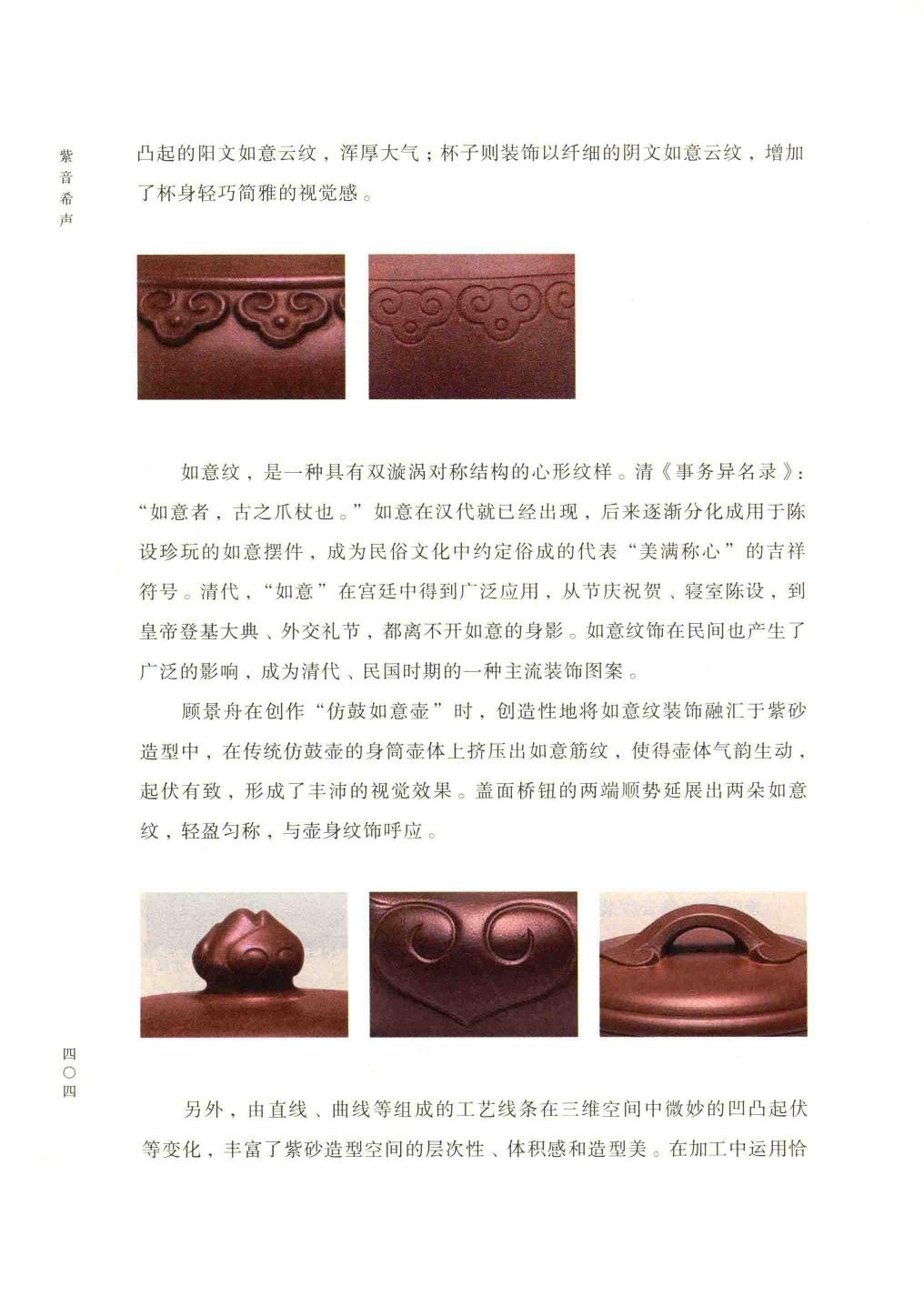
The raised ruyi cloud patterns on the western side are robust and grand in spirit; the cup is decorated with delicate incised ruyi cloud patterns, adding a visual sense of lightness and elegant simplicity to the body.
The ruyi pattern is a heart-shaped motif with a symmetrical double-spiral structure. The Qing dynasty *Record of Alternative Names for Things* states:
> "The ruyi was originally an ancient scratching staff."
The ruyi already appeared during the Han dynasty, and later gradually evolved into ornamental ruyi objects used for display, becoming a conventionally established auspicious symbol representing "perfect satisfaction" in folk culture. During the Qing dynasty, the "ruyi" was widely used in the imperial court—from festival celebrations and study room furnishings to the emperor's enthronement ceremonies and diplomatic protocols, the presence of the ruyi was indispensable. Ruyi decorative patterns also had a widespread influence among the common people, becoming a mainstream decorative motif during the Qing dynasty and Republican period.
When Gu Jingzhou created the "Imitation Drum Ruyi Teapot," he creatively integrated ruyi pattern decoration into the Zisha clay form. He pressed ruyi rib patterns onto the cylindrical body of the traditional imitation drum teapot, making the vessel's spirit lively and animated, with undulating rhythms that created an abundant visual effect. The two ends of the bridge-shaped knob on the lid naturally extend into two ruyi patterns, light and well-proportioned, echoing the decorative patterns on the body.
Additionally, the craft lines composed of straight lines, curves, and other elements, with their subtle convex and concave undulations in three-dimensional space, enriched the layering, sense of volume, and sculptural beauty of the Zisha clay form's spatial structure. The appropriate application of these techniques in the crafting process...
---
[Note: The text appears to end mid-sentence in the original]
Chapter 6
驾简
Mastering Simplicity
Pages 406-427
View Chapter →
English Translation
The raised ruyi cloud patterns on the western side are robust and grand in spirit; the cup is decorated with delicate incised ruyi cloud patterns, adding a visual sense of lightness and elegant simplicity to the body.
The ruyi pattern is a heart-shaped motif with a symmetrical double-spiral structure. The Qing dynasty *Record of Alternative Names for Things* states:
> "The ruyi was originally an ancient scratching staff."
The ruyi already appeared during the Han dynasty, and later gradually evolved into ornamental ruyi objects used for display, becoming a conventionally established auspicious symbol representing "perfect satisfaction" in folk culture. During the Qing dynasty, the "ruyi" was widely used in the imperial court—from festival celebrations and study room furnishings to the emperor's enthronement ceremonies and diplomatic protocols, the presence of the ruyi was indispensable. Ruyi decorative patterns also had a widespread influence among the common people, becoming a mainstream decorative motif during the Qing dynasty and Republican period.
When Gu Jingzhou created the "Imitation Drum Ruyi Teapot," he creatively integrated ruyi pattern decoration into the Zisha clay form. He pressed ruyi rib patterns onto the cylindrical body of the traditional imitation drum teapot, making the vessel's spirit lively and animated, with undulating rhythms that created an abundant visual effect. The two ends of the bridge-shaped knob on the lid naturally extend into two ruyi patterns, light and well-proportioned, echoing the decorative patterns on the body.
Additionally, the craft lines composed of straight lines, curves, and other elements, with their subtle convex and concave undulations in three-dimensional space, enriched the layering, sense of volume, and sculptural beauty of the Zisha clay form's spatial structure. The appropriate application of these techniques in the crafting process...
---
[Note: The text appears to end mid-sentence in the original]
章节导航 Chapter Navigation
Chapter 1
序文
Pages 6-6
Chapter 2
引言
Pages 28-31
Chapter 3
达变
Pages 32-133
Chapter 3
开宗立派
Pages 46-66
Chapter 3
传道授业
Pages 67-98
Chapter 3
大师淳友
Pages 99-120
Chapter 3
学艺谋生
Pages 121-133
Chapter 4
化神
Pages 134-141
Chapter 5
独妙
Pages 142-405
Chapter 5
匠心独运 不苟丝毫
Pages 142-179
Chapter 5
器利善事 物尽其用
Pages 180-199
Chapter 5
紫泥春华 研精究微
Pages 200-405
Chapter 6
驾简
Pages 406-427
Chapter 6
精雕细刻 文质合一
Pages 406-410
Chapter 6
师法自然 妙趣横生
Pages 411-415
Chapter 6
丝来线去 曲尽其妙
Pages 416-427
Chapter 7
明志
Pages 463-485
Chapter 7
高山仰止 淡泊明志
Pages 463-472
Chapter 7
啜墨看茶 气定神闲
Pages 473-478
Chapter 7
齿少心锐 怡志抒情
Pages 479-485
Chapter 8
存真
Pages 428-462
Chapter 8
规圆矩方 弃伪存真
Pages 428-436
Chapter 8
有物有则 钻尖仰高
Pages 437-462
Chapter 9
心营
Pages 506-525
Chapter 9
坚守传统 艺立潮头
Pages 506-513
Chapter 9
新型师承 桃李满园
Pages 514-525
Chapter 10
附录
Pages 526-651
Chapter 10
顾景舟紫艺论文
Pages 526-535
Chapter 10
技术课备课笔记
Pages 536-543
Chapter 10
顾景舟艺术年表
Pages 544-651
Chapter 11
参考文献
Pages 652-657
Chapter 12
鸣谢
Pages 658-659