Chapter 3
达变
Adaptation
44
of 659
English Translation
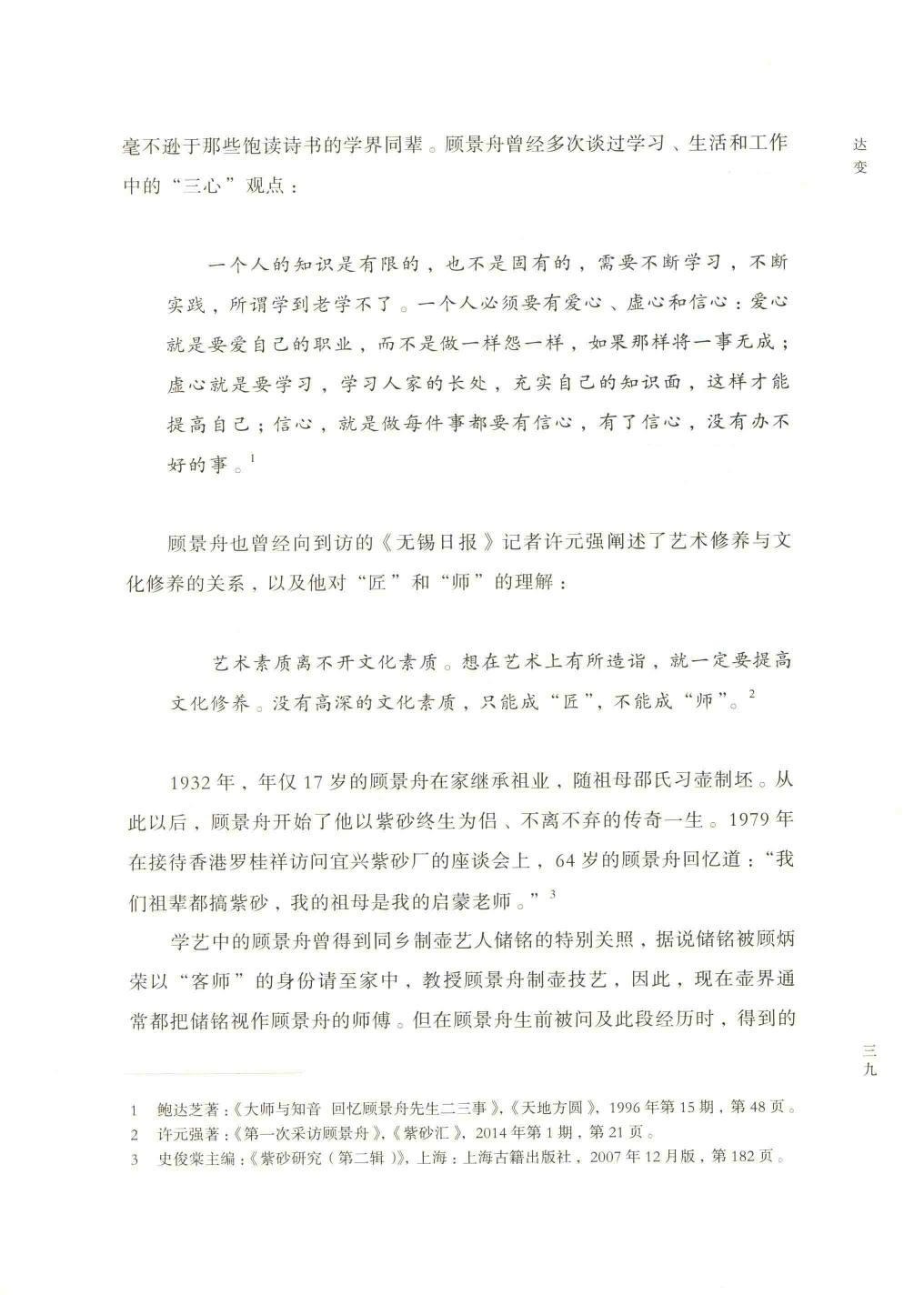
Gu Jingzhou was in no way inferior to those scholarly peers who were well-versed in classical literature. He spoke many times about his "three hearts" philosophy regarding study, life, and work:
> A person's knowledge is limited and not inherent; it requires continuous learning and constant practice. As the saying goes, one learns until old age but never finishes learning. A person must have three hearts: love, humility, and confidence. Love means loving one's profession, rather than complaining about whatever one does—if one does that, nothing will be accomplished. Humility means learning, learning from others' strengths and enriching one's own knowledge base, which is the only way to improve oneself. Confidence means having faith in everything one does; with confidence, there is nothing that cannot be accomplished well.[1]
Gu Jingzhou also once explained to Xu Yuanqiang, a visiting reporter from *Wuxi Daily*, the relationship between artistic cultivation and cultural cultivation, as well as his understanding of "craftsman" (*jiang*) versus "master" (*shi*):
> Artistic quality cannot be separated from cultural quality. To achieve something in art, one must certainly elevate one's cultural cultivation. Without profound cultural quality, one can only become a "craftsman," not a "master."[2]
In 1932, at only 17 years of age, Gu Jingzhou inherited the family business at home, learning the craft of pottery-making from his grandmother, Lady Shao. From that point forward, Gu Jingzhou began his legendary life devoted entirely to Yixing pottery, never abandoning it. In 1979, at a symposium welcoming Hong Kong's Luo Guixiang's visit to the Yixing Purple Clay Factory, the 64-year-old Gu Jingzhou recalled: "Our ancestors all worked with purple clay; my grandmother was my first teacher."[3]
During his apprenticeship, Gu Jingzhou received special attention from Chu Ming, a fellow townsman and pottery artisan. It is said that Chu Ming was invited to the family home by Gu Bingrong in the capacity of a "guest teacher" to instruct Gu Jingzhou in the art of teapot-making. Therefore, the pottery world today generally regards Chu Ming as Gu Jingzhou's master. However, when Gu Jingzhou was asked about this experience during his lifetime, the response received
---
[1] Bao Dazhi, "Master and Kindred Spirit: Remembering Two or Three Matters about Mr. Gu Jingzhou," *Tiandi Fangyuan*, Issue 15 (1996), p. 48.
[2] Xu Yuanqiang, "The First Interview with Gu Jingzhou," *Zisha Hui*, Issue 1 (2014), p. 21.
[3] Shi Jundang, ed., *Yixing Pottery Research (Volume 2)* (Shanghai: Shanghai Guji Publishing House, December 2007), p. 182.
Chapter 3
达变
Adaptation
Pages 32-133
View Chapter →
English Translation
Gu Jingzhou was in no way inferior to those scholarly peers who were well-versed in classical literature. He spoke many times about his "three hearts" philosophy regarding study, life, and work:
> A person's knowledge is limited and not inherent; it requires continuous learning and constant practice. As the saying goes, one learns until old age but never finishes learning. A person must have three hearts: love, humility, and confidence. Love means loving one's profession, rather than complaining about whatever one does—if one does that, nothing will be accomplished. Humility means learning, learning from others' strengths and enriching one's own knowledge base, which is the only way to improve oneself. Confidence means having faith in everything one does; with confidence, there is nothing that cannot be accomplished well.[1]
Gu Jingzhou also once explained to Xu Yuanqiang, a visiting reporter from *Wuxi Daily*, the relationship between artistic cultivation and cultural cultivation, as well as his understanding of "craftsman" (*jiang*) versus "master" (*shi*):
> Artistic quality cannot be separated from cultural quality. To achieve something in art, one must certainly elevate one's cultural cultivation. Without profound cultural quality, one can only become a "craftsman," not a "master."[2]
In 1932, at only 17 years of age, Gu Jingzhou inherited the family business at home, learning the craft of pottery-making from his grandmother, Lady Shao. From that point forward, Gu Jingzhou began his legendary life devoted entirely to Yixing pottery, never abandoning it. In 1979, at a symposium welcoming Hong Kong's Luo Guixiang's visit to the Yixing Purple Clay Factory, the 64-year-old Gu Jingzhou recalled: "Our ancestors all worked with purple clay; my grandmother was my first teacher."[3]
During his apprenticeship, Gu Jingzhou received special attention from Chu Ming, a fellow townsman and pottery artisan. It is said that Chu Ming was invited to the family home by Gu Bingrong in the capacity of a "guest teacher" to instruct Gu Jingzhou in the art of teapot-making. Therefore, the pottery world today generally regards Chu Ming as Gu Jingzhou's master. However, when Gu Jingzhou was asked about this experience during his lifetime, the response received
---
[1] Bao Dazhi, "Master and Kindred Spirit: Remembering Two or Three Matters about Mr. Gu Jingzhou," *Tiandi Fangyuan*, Issue 15 (1996), p. 48.
[2] Xu Yuanqiang, "The First Interview with Gu Jingzhou," *Zisha Hui*, Issue 1 (2014), p. 21.
[3] Shi Jundang, ed., *Yixing Pottery Research (Volume 2)* (Shanghai: Shanghai Guji Publishing House, December 2007), p. 182.
章节导航 Chapter Navigation
Chapter 1
序文
Pages 6-6
Chapter 2
引言
Pages 28-31
Chapter 3
达变
Pages 32-133
Chapter 3
开宗立派
Pages 46-66
Chapter 3
传道授业
Pages 67-98
Chapter 3
大师淳友
Pages 99-120
Chapter 3
学艺谋生
Pages 121-133
Chapter 4
化神
Pages 134-141
Chapter 5
独妙
Pages 142-405
Chapter 5
匠心独运 不苟丝毫
Pages 142-179
Chapter 5
器利善事 物尽其用
Pages 180-199
Chapter 5
紫泥春华 研精究微
Pages 200-405
Chapter 6
驾简
Pages 406-427
Chapter 6
精雕细刻 文质合一
Pages 406-410
Chapter 6
师法自然 妙趣横生
Pages 411-415
Chapter 6
丝来线去 曲尽其妙
Pages 416-427
Chapter 7
明志
Pages 463-485
Chapter 7
高山仰止 淡泊明志
Pages 463-472
Chapter 7
啜墨看茶 气定神闲
Pages 473-478
Chapter 7
齿少心锐 怡志抒情
Pages 479-485
Chapter 8
存真
Pages 428-462
Chapter 8
规圆矩方 弃伪存真
Pages 428-436
Chapter 8
有物有则 钻尖仰高
Pages 437-462
Chapter 9
心营
Pages 506-525
Chapter 9
坚守传统 艺立潮头
Pages 506-513
Chapter 9
新型师承 桃李满园
Pages 514-525
Chapter 10
附录
Pages 526-651
Chapter 10
顾景舟紫艺论文
Pages 526-535
Chapter 10
技术课备课笔记
Pages 536-543
Chapter 10
顾景舟艺术年表
Pages 544-651
Chapter 11
参考文献
Pages 652-657
Chapter 12
鸣谢
Pages 658-659