Chapter 3
达变
Adaptation
45
of 659
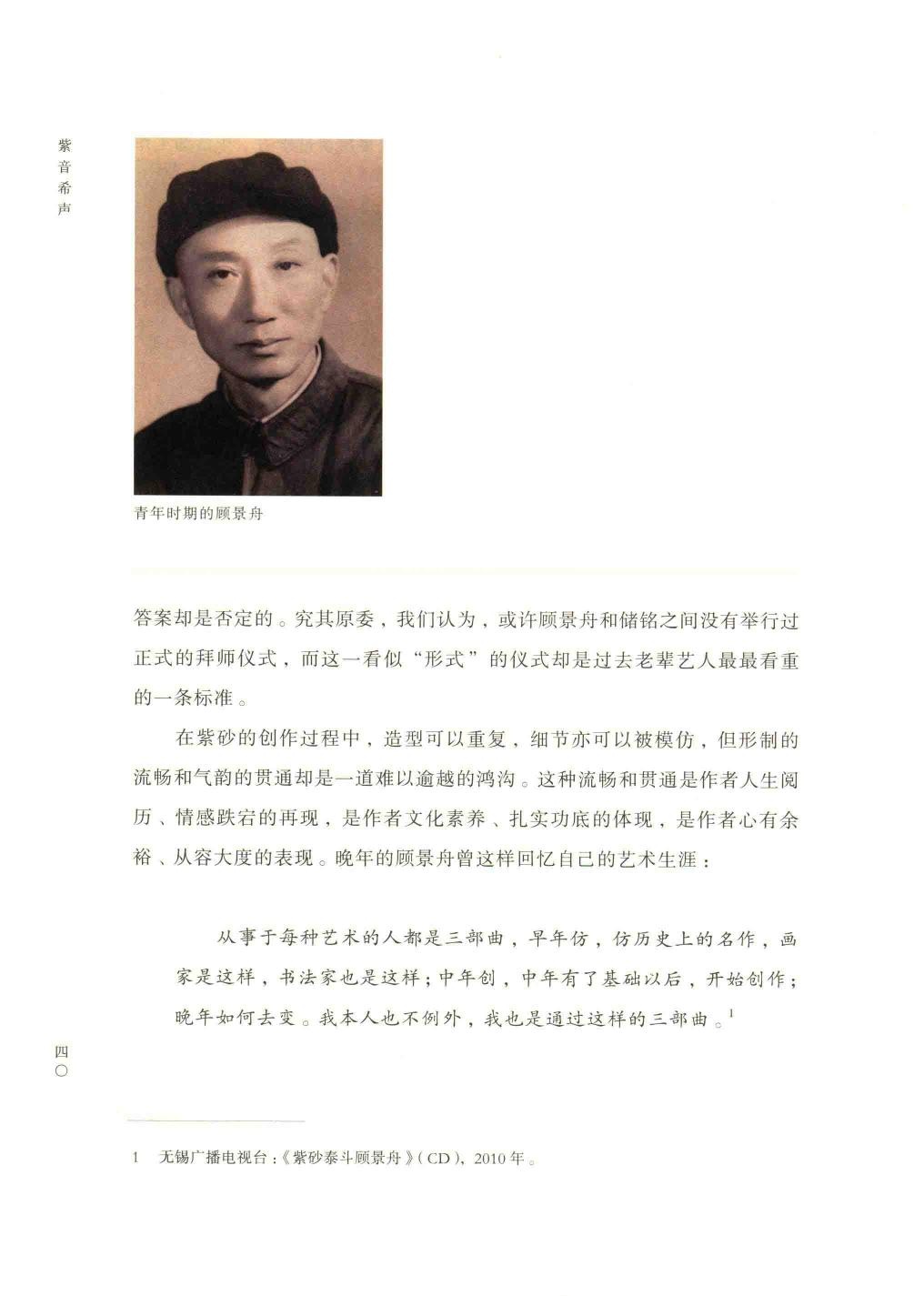
English Translation
The answer, however, is negative. Investigating the reasons, we believe that perhaps there was never a formal apprenticeship ceremony held between Gu Jingzhou and Chu Ming, and this seemingly "formal" ritual was something that the old master artisans of the past valued most highly as a standard.
In the creative process of Yixing pottery, form can be replicated, and details can be imitated, but the fluency of execution and the penetration of spirit constitute an insurmountable chasm. This fluency and penetration are manifestations of the artist's life experience, solid foundation, cultural cultivation, and composed magnanimity—they are reproductions of emotional vicissitudes. In his later years, Gu Jingzhou recalled his artistic career in this way:
> Those engaged in any art form go through three stages. Painters are like this, calligraphers are also like this: in youth, one imitates—imitates famous historical works; in middle age, one creates—after establishing a foundation in middle age, one begins to create; in old age, how does one transform? I myself am no exception; I too have gone through these three stages.[1]
---
[1] Wuxi Radio and Television Station: *The Grand Master of Yixing Pottery, Gu Jingzhou* (CD), 2010.
Chapter 3
达变
Adaptation
Pages 32-133
View Chapter →
English Translation
The answer, however, is negative. Investigating the reasons, we believe that perhaps there was never a formal apprenticeship ceremony held between Gu Jingzhou and Chu Ming, and this seemingly "formal" ritual was something that the old master artisans of the past valued most highly as a standard.
In the creative process of Yixing pottery, form can be replicated, and details can be imitated, but the fluency of execution and the penetration of spirit constitute an insurmountable chasm. This fluency and penetration are manifestations of the artist's life experience, solid foundation, cultural cultivation, and composed magnanimity—they are reproductions of emotional vicissitudes. In his later years, Gu Jingzhou recalled his artistic career in this way:
> Those engaged in any art form go through three stages. Painters are like this, calligraphers are also like this: in youth, one imitates—imitates famous historical works; in middle age, one creates—after establishing a foundation in middle age, one begins to create; in old age, how does one transform? I myself am no exception; I too have gone through these three stages.[1]
---
[1] Wuxi Radio and Television Station: *The Grand Master of Yixing Pottery, Gu Jingzhou* (CD), 2010.
章节导航 Chapter Navigation
Chapter 1
序文
Pages 6-6
Chapter 2
引言
Pages 28-31
Chapter 3
达变
Pages 32-133
Chapter 3
开宗立派
Pages 46-66
Chapter 3
传道授业
Pages 67-98
Chapter 3
大师淳友
Pages 99-120
Chapter 3
学艺谋生
Pages 121-133
Chapter 4
化神
Pages 134-141
Chapter 5
独妙
Pages 142-405
Chapter 5
匠心独运 不苟丝毫
Pages 142-179
Chapter 5
器利善事 物尽其用
Pages 180-199
Chapter 5
紫泥春华 研精究微
Pages 200-405
Chapter 6
驾简
Pages 406-427
Chapter 6
精雕细刻 文质合一
Pages 406-410
Chapter 6
师法自然 妙趣横生
Pages 411-415
Chapter 6
丝来线去 曲尽其妙
Pages 416-427
Chapter 7
明志
Pages 463-485
Chapter 7
高山仰止 淡泊明志
Pages 463-472
Chapter 7
啜墨看茶 气定神闲
Pages 473-478
Chapter 7
齿少心锐 怡志抒情
Pages 479-485
Chapter 8
存真
Pages 428-462
Chapter 8
规圆矩方 弃伪存真
Pages 428-436
Chapter 8
有物有则 钻尖仰高
Pages 437-462
Chapter 9
心营
Pages 506-525
Chapter 9
坚守传统 艺立潮头
Pages 506-513
Chapter 9
新型师承 桃李满园
Pages 514-525
Chapter 10
附录
Pages 526-651
Chapter 10
顾景舟紫艺论文
Pages 526-535
Chapter 10
技术课备课笔记
Pages 536-543
Chapter 10
顾景舟艺术年表
Pages 544-651
Chapter 11
参考文献
Pages 652-657
Chapter 12
鸣谢
Pages 658-659