Chapter 8
存真
Preserving Authenticity
457
of 659
English Translation
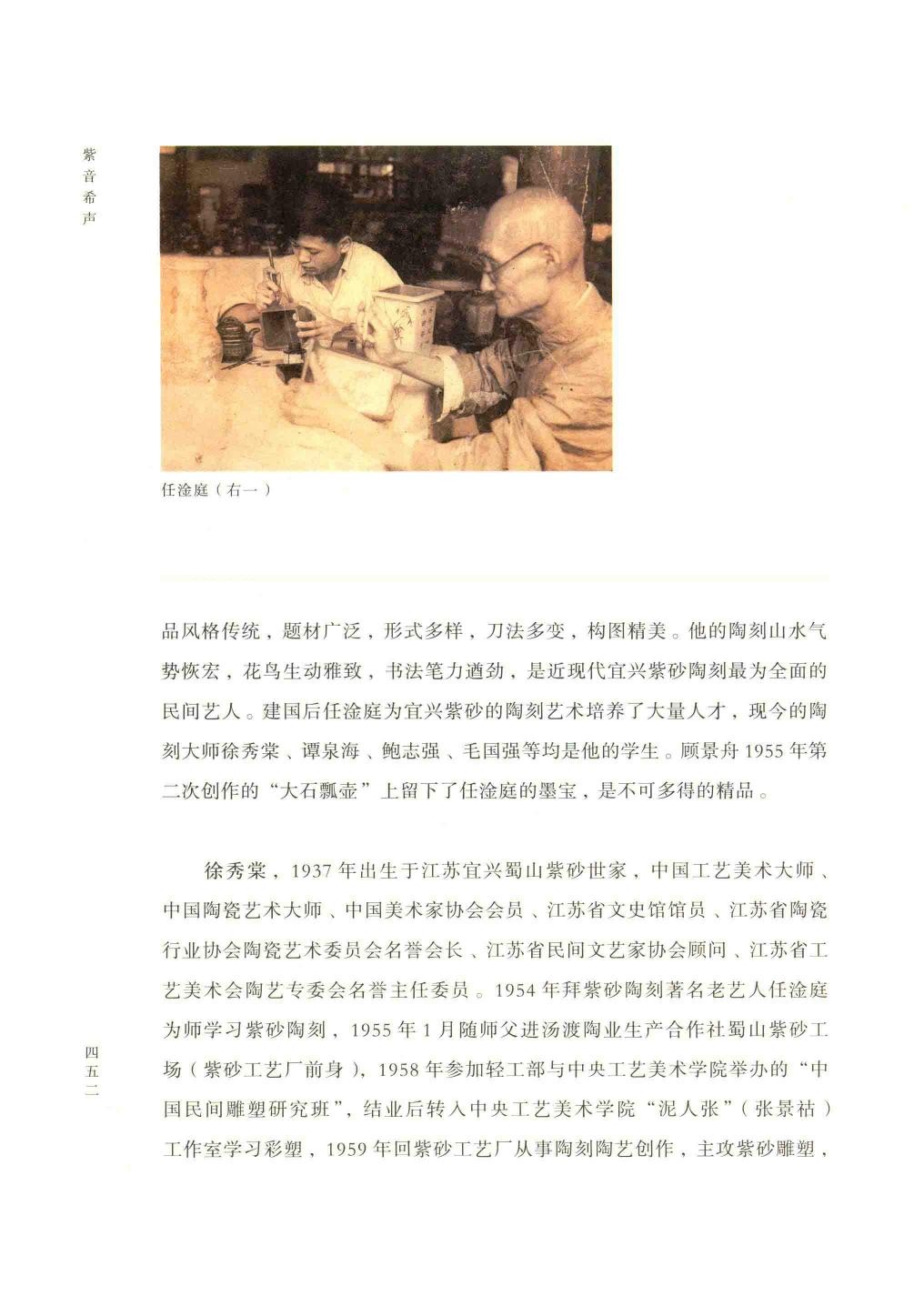
## Ren Qianting (right in photo)
His works embody traditional style with broad subject matter, diverse forms, varied knife techniques, and exquisite composition. His carved landscapes on pottery are grand and magnificent, his flowers and birds vivid and elegant, and his calligraphy powerful and vigorous. He was the most comprehensive folk artisan of modern Yixing zisha pottery carving. After the founding of the People's Republic, Ren Qianting trained a large number of talents in the art of zisha pottery carving. Today's pottery carving masters Xu Xiutang, Tan Quanhai, Bao Zhiqiang, Mao Guoqiang and others were all his students. Gu Jingzhou's second creation of "Da Shi Biao Guo" in 1955 bears Ren Qianting's calligraphy, making it a rare masterpiece.
## Xu Xiutang
Born in 1937 into a zisha pottery family in Shushan, Yixing, Jiangsu Province. Chinese Master of Arts and Crafts, Chinese Master of Ceramic Arts, member of the Chinese Artists Association, member of the Jiangsu Provincial Museum of Literature and History, Honorary President of the Ceramic Art Committee of the Jiangsu Provincial Ceramic Industry Association, Advisor to the Jiangsu Provincial Folk Literature and Art Association, and Honorary Director of the Ceramic Art Special Committee of the Jiangsu Provincial Arts and Crafts Association. In 1954, he apprenticed under the renowned zisha pottery carving master Ren Qianting to study zisha pottery carving. In January 1955, he followed his master into the Tangdu Pottery Production Cooperative Shushan Zisha Workshop (predecessor of the Zisha Craft Factory). In 1958, he participated in the "Chinese Folk Sculpture Research Class" organized by the Ministry of Light Industry and the Central Academy of Arts and Crafts. After graduation, he transferred to the "Clay Figure Zhang" (Zhang Jingshe) studio at the Central Academy of Arts and Crafts to study colored sculpture. In 1959, he returned to the Zisha Craft Factory to engage in pottery carving and ceramic art creation, specializing in zisha sculpture.
Chapter 8
存真
Preserving Authenticity
Pages 428-462
View Chapter →
English Translation
## Ren Qianting (right in photo)
His works embody traditional style with broad subject matter, diverse forms, varied knife techniques, and exquisite composition. His carved landscapes on pottery are grand and magnificent, his flowers and birds vivid and elegant, and his calligraphy powerful and vigorous. He was the most comprehensive folk artisan of modern Yixing zisha pottery carving. After the founding of the People's Republic, Ren Qianting trained a large number of talents in the art of zisha pottery carving. Today's pottery carving masters Xu Xiutang, Tan Quanhai, Bao Zhiqiang, Mao Guoqiang and others were all his students. Gu Jingzhou's second creation of "Da Shi Biao Guo" in 1955 bears Ren Qianting's calligraphy, making it a rare masterpiece.
## Xu Xiutang
Born in 1937 into a zisha pottery family in Shushan, Yixing, Jiangsu Province. Chinese Master of Arts and Crafts, Chinese Master of Ceramic Arts, member of the Chinese Artists Association, member of the Jiangsu Provincial Museum of Literature and History, Honorary President of the Ceramic Art Committee of the Jiangsu Provincial Ceramic Industry Association, Advisor to the Jiangsu Provincial Folk Literature and Art Association, and Honorary Director of the Ceramic Art Special Committee of the Jiangsu Provincial Arts and Crafts Association. In 1954, he apprenticed under the renowned zisha pottery carving master Ren Qianting to study zisha pottery carving. In January 1955, he followed his master into the Tangdu Pottery Production Cooperative Shushan Zisha Workshop (predecessor of the Zisha Craft Factory). In 1958, he participated in the "Chinese Folk Sculpture Research Class" organized by the Ministry of Light Industry and the Central Academy of Arts and Crafts. After graduation, he transferred to the "Clay Figure Zhang" (Zhang Jingshe) studio at the Central Academy of Arts and Crafts to study colored sculpture. In 1959, he returned to the Zisha Craft Factory to engage in pottery carving and ceramic art creation, specializing in zisha sculpture.
章节导航 Chapter Navigation
Chapter 1
序文
Pages 6-6
Chapter 2
引言
Pages 28-31
Chapter 3
达变
Pages 32-133
Chapter 3
开宗立派
Pages 46-66
Chapter 3
传道授业
Pages 67-98
Chapter 3
大师淳友
Pages 99-120
Chapter 3
学艺谋生
Pages 121-133
Chapter 4
化神
Pages 134-141
Chapter 5
独妙
Pages 142-405
Chapter 5
匠心独运 不苟丝毫
Pages 142-179
Chapter 5
器利善事 物尽其用
Pages 180-199
Chapter 5
紫泥春华 研精究微
Pages 200-405
Chapter 6
驾简
Pages 406-427
Chapter 6
精雕细刻 文质合一
Pages 406-410
Chapter 6
师法自然 妙趣横生
Pages 411-415
Chapter 6
丝来线去 曲尽其妙
Pages 416-427
Chapter 7
明志
Pages 463-485
Chapter 7
高山仰止 淡泊明志
Pages 463-472
Chapter 7
啜墨看茶 气定神闲
Pages 473-478
Chapter 7
齿少心锐 怡志抒情
Pages 479-485
Chapter 8
存真
Pages 428-462
Chapter 8
规圆矩方 弃伪存真
Pages 428-436
Chapter 8
有物有则 钻尖仰高
Pages 437-462
Chapter 9
心营
Pages 506-525
Chapter 9
坚守传统 艺立潮头
Pages 506-513
Chapter 9
新型师承 桃李满园
Pages 514-525
Chapter 10
附录
Pages 526-651
Chapter 10
顾景舟紫艺论文
Pages 526-535
Chapter 10
技术课备课笔记
Pages 536-543
Chapter 10
顾景舟艺术年表
Pages 544-651
Chapter 11
参考文献
Pages 652-657
Chapter 12
鸣谢
Pages 658-659