Chapter 9
心营
Heart's Cultivation
515
of 659
English Translation
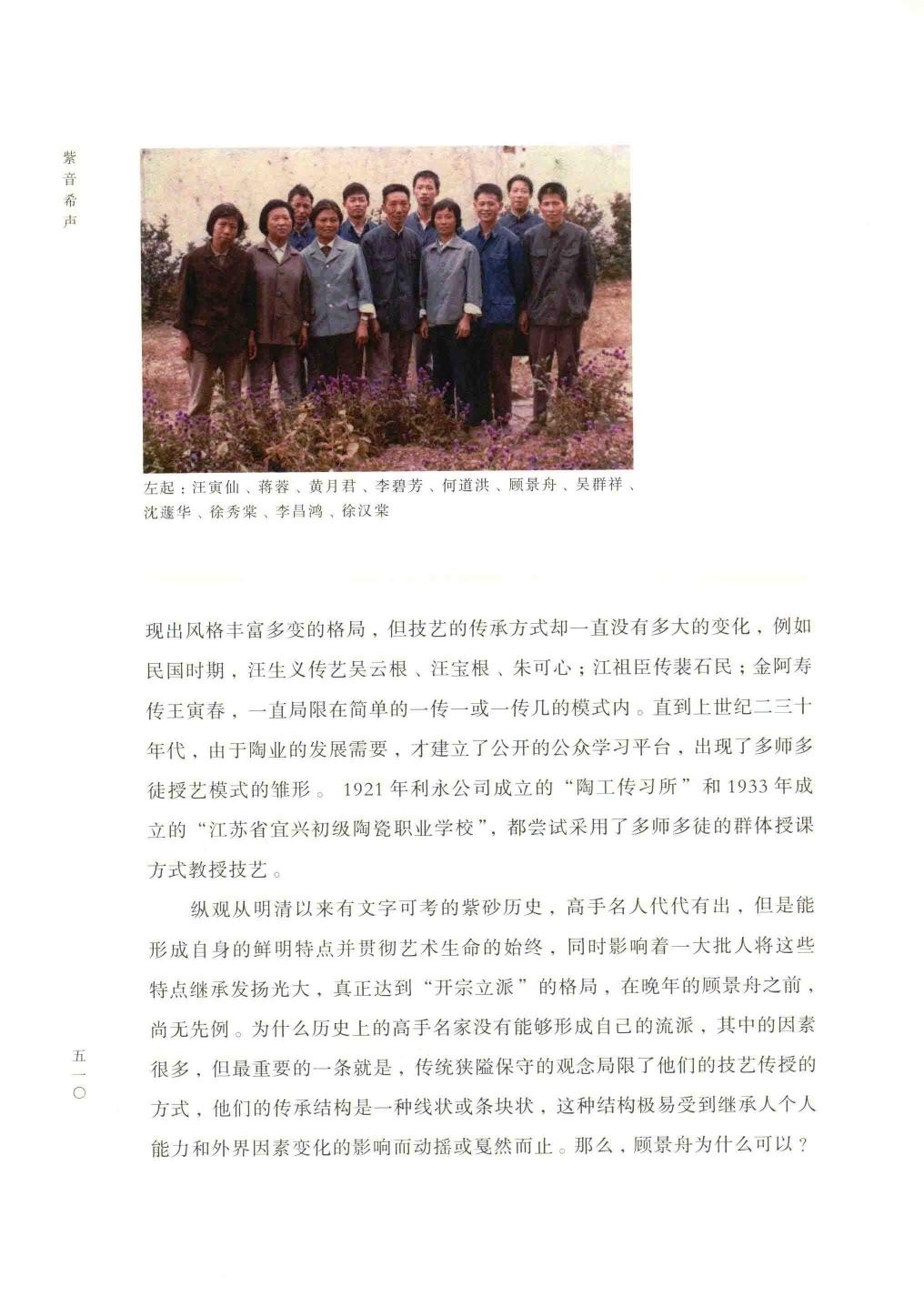
Left to right: Wang Yinxian, Jiang Rong, Huang Yuejun, Li Bifang, He Daohong, Gu Jingzhou, Wu Qunxiang, Shen Lianhua, Xu Xiutang, Li Changhong, Xu Handang
The landscape has evolved to display a rich and varied array of styles, yet the methods of transmitting craftsmanship have remained largely unchanged. For example, during the Republican period, Wang Shengyi passed on his skills to Wu Yungen, Wang Baogen, and Zhu Kexin; Jiang Zuchen taught Pei Shimin; Jin Ashou instructed Wang Yinchun—all confined to the simple model of one master teaching one or a few disciples. It was not until the 1920s and 1930s, driven by the development needs of the pottery industry, that public learning platforms were established, giving rise to the embryonic form of a multi-master, multi-apprentice teaching model. Both the "Pottery Workers' Training Institute" established by the Liyong Company in 1921 and the "Jiangsu Province Yixing Elementary Pottery Vocational School" founded in 1933 experimented with group instruction methods involving multiple masters and multiple apprentices.
Looking back at the documented history of Yixing pottery since the Ming and Qing dynasties, master craftsmen and renowned figures have emerged in every generation. However, before Gu Jingzhou in his later years, there had been no precedent for someone who could form their own distinctive characteristics, maintain them throughout their artistic life, and simultaneously influence a large group of people to inherit and carry forward these characteristics—truly achieving the stature of "founding a school." Why were the master craftsmen and famous artists of history unable to establish their own schools? There are many factors, but the most important is that traditional narrow and conservative attitudes limited their methods of transmitting skills. Their transmission structure was linear or fragmented, a structure extremely vulnerable to disruption or abrupt termination due to changes in the individual capabilities of successors and external factors. So then, why was Gu Jingzhou able to succeed?
Chapter 9
心营
Heart's Cultivation
Pages 506-525
View Chapter →
English Translation
Left to right: Wang Yinxian, Jiang Rong, Huang Yuejun, Li Bifang, He Daohong, Gu Jingzhou, Wu Qunxiang, Shen Lianhua, Xu Xiutang, Li Changhong, Xu Handang
The landscape has evolved to display a rich and varied array of styles, yet the methods of transmitting craftsmanship have remained largely unchanged. For example, during the Republican period, Wang Shengyi passed on his skills to Wu Yungen, Wang Baogen, and Zhu Kexin; Jiang Zuchen taught Pei Shimin; Jin Ashou instructed Wang Yinchun—all confined to the simple model of one master teaching one or a few disciples. It was not until the 1920s and 1930s, driven by the development needs of the pottery industry, that public learning platforms were established, giving rise to the embryonic form of a multi-master, multi-apprentice teaching model. Both the "Pottery Workers' Training Institute" established by the Liyong Company in 1921 and the "Jiangsu Province Yixing Elementary Pottery Vocational School" founded in 1933 experimented with group instruction methods involving multiple masters and multiple apprentices.
Looking back at the documented history of Yixing pottery since the Ming and Qing dynasties, master craftsmen and renowned figures have emerged in every generation. However, before Gu Jingzhou in his later years, there had been no precedent for someone who could form their own distinctive characteristics, maintain them throughout their artistic life, and simultaneously influence a large group of people to inherit and carry forward these characteristics—truly achieving the stature of "founding a school." Why were the master craftsmen and famous artists of history unable to establish their own schools? There are many factors, but the most important is that traditional narrow and conservative attitudes limited their methods of transmitting skills. Their transmission structure was linear or fragmented, a structure extremely vulnerable to disruption or abrupt termination due to changes in the individual capabilities of successors and external factors. So then, why was Gu Jingzhou able to succeed?
章节导航 Chapter Navigation
Chapter 1
序文
Pages 6-6
Chapter 2
引言
Pages 28-31
Chapter 3
达变
Pages 32-133
Chapter 3
开宗立派
Pages 46-66
Chapter 3
传道授业
Pages 67-98
Chapter 3
大师淳友
Pages 99-120
Chapter 3
学艺谋生
Pages 121-133
Chapter 4
化神
Pages 134-141
Chapter 5
独妙
Pages 142-405
Chapter 5
匠心独运 不苟丝毫
Pages 142-179
Chapter 5
器利善事 物尽其用
Pages 180-199
Chapter 5
紫泥春华 研精究微
Pages 200-405
Chapter 6
驾简
Pages 406-427
Chapter 6
精雕细刻 文质合一
Pages 406-410
Chapter 6
师法自然 妙趣横生
Pages 411-415
Chapter 6
丝来线去 曲尽其妙
Pages 416-427
Chapter 7
明志
Pages 463-485
Chapter 7
高山仰止 淡泊明志
Pages 463-472
Chapter 7
啜墨看茶 气定神闲
Pages 473-478
Chapter 7
齿少心锐 怡志抒情
Pages 479-485
Chapter 8
存真
Pages 428-462
Chapter 8
规圆矩方 弃伪存真
Pages 428-436
Chapter 8
有物有则 钻尖仰高
Pages 437-462
Chapter 9
心营
Pages 506-525
Chapter 9
坚守传统 艺立潮头
Pages 506-513
Chapter 9
新型师承 桃李满园
Pages 514-525
Chapter 10
附录
Pages 526-651
Chapter 10
顾景舟紫艺论文
Pages 526-535
Chapter 10
技术课备课笔记
Pages 536-543
Chapter 10
顾景舟艺术年表
Pages 544-651
Chapter 11
参考文献
Pages 652-657
Chapter 12
鸣谢
Pages 658-659