Chapter 9
心营
Heart's Cultivation
516
of 659
English Translation
This was not only because he possessed exceptional personal abilities, but also because with the establishment of New China and the initial completion of socialist transformation, the traditional apprenticeship system of Zisha pottery craftsmanship underwent fundamental changes. Under the public ownership social system, relationships between people changed. The transmission of skills became fair, open, and diversified. This allowed Gu Jingzhou, together with everyone else, to abandon many traditional selfish thoughts for a common collective goal, stepping out of individual family workshops and gathering together on a vast and expansive stage. On this stage, Gu Jingzhou helped numerous aspiring young Zisha practitioners find their place, and ultimately became the most dazzling star on this stage himself.
In 1952, Gu Jingzhou organized Zisha practitioners, including carving artist Ren Ganting, Zhu Kexin, Gu Jingzhou himself, Wang Yinchun, Pei Shimin, Wu Yungen, Jiang Rong, and fifty-nine others in total. Through the platform of what would later become the Zisha Pottery Factory, and via a relatively equal and fair factory-based model, he opened the door to widely accepting disciples and broadly transmitting skills, initiating a new type of curriculum for establishing the "Gu School" Zisha system.
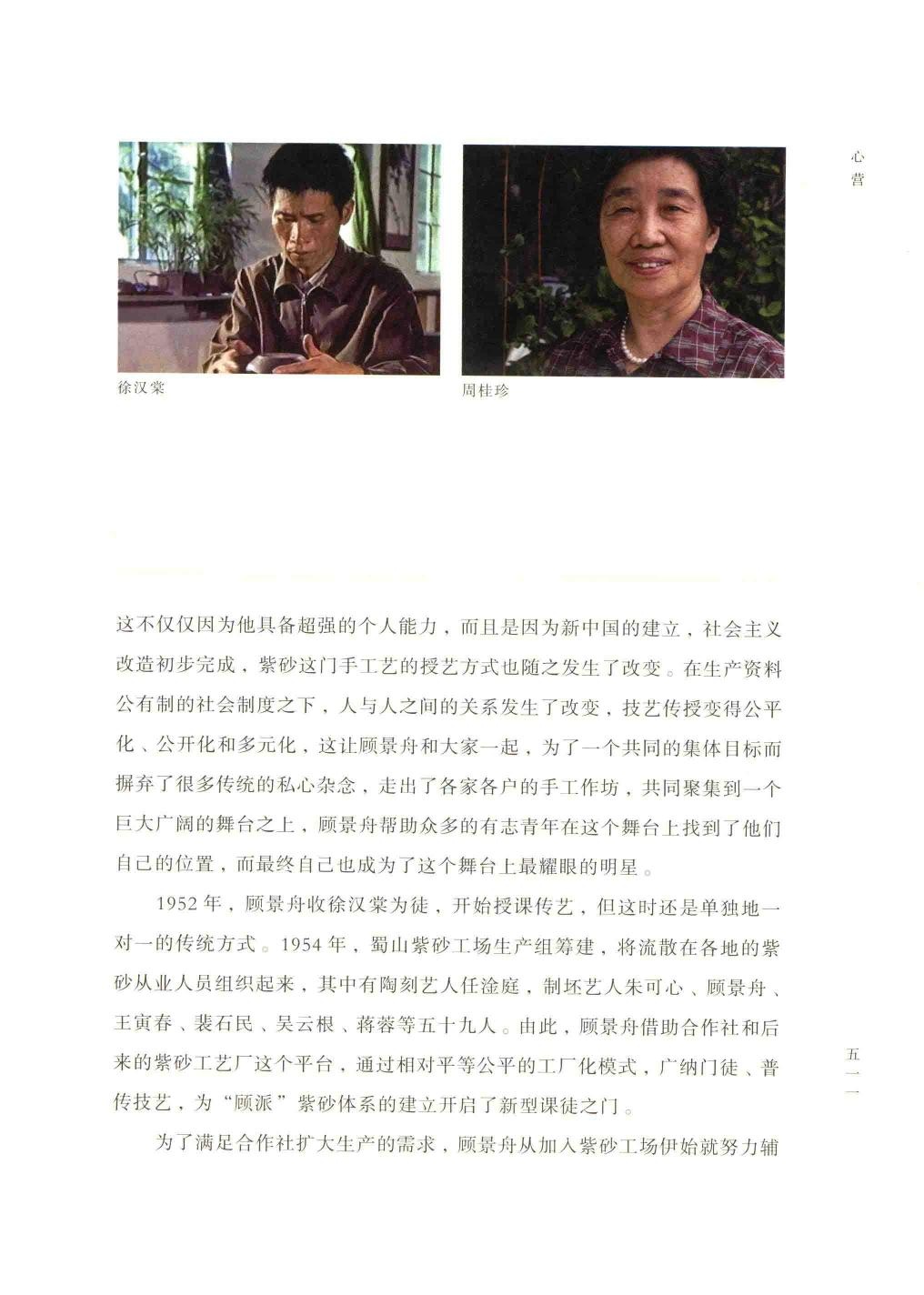
In 1952, Gu Jingzhou accepted Xu Handang as his disciple and began teaching, though this still followed the traditional one-on-one method. In 1954, the Shushan Zisha Workshop production team was established. To meet the cooperative's need for expanded production, from the very beginning of the workshop, Gu Jingzhou made great efforts to assist Zisha craftsmen scattered across various locations in finding their positions under the means of production.
Chapter 9
心营
Heart's Cultivation
Pages 506-525
View Chapter →
English Translation
This was not only because he possessed exceptional personal abilities, but also because with the establishment of New China and the initial completion of socialist transformation, the traditional apprenticeship system of Zisha pottery craftsmanship underwent fundamental changes. Under the public ownership social system, relationships between people changed. The transmission of skills became fair, open, and diversified. This allowed Gu Jingzhou, together with everyone else, to abandon many traditional selfish thoughts for a common collective goal, stepping out of individual family workshops and gathering together on a vast and expansive stage. On this stage, Gu Jingzhou helped numerous aspiring young Zisha practitioners find their place, and ultimately became the most dazzling star on this stage himself.
In 1952, Gu Jingzhou organized Zisha practitioners, including carving artist Ren Ganting, Zhu Kexin, Gu Jingzhou himself, Wang Yinchun, Pei Shimin, Wu Yungen, Jiang Rong, and fifty-nine others in total. Through the platform of what would later become the Zisha Pottery Factory, and via a relatively equal and fair factory-based model, he opened the door to widely accepting disciples and broadly transmitting skills, initiating a new type of curriculum for establishing the "Gu School" Zisha system.
In 1952, Gu Jingzhou accepted Xu Handang as his disciple and began teaching, though this still followed the traditional one-on-one method. In 1954, the Shushan Zisha Workshop production team was established. To meet the cooperative's need for expanded production, from the very beginning of the workshop, Gu Jingzhou made great efforts to assist Zisha craftsmen scattered across various locations in finding their positions under the means of production.
章节导航 Chapter Navigation
Chapter 1
序文
Pages 6-6
Chapter 2
引言
Pages 28-31
Chapter 3
达变
Pages 32-133
Chapter 3
开宗立派
Pages 46-66
Chapter 3
传道授业
Pages 67-98
Chapter 3
大师淳友
Pages 99-120
Chapter 3
学艺谋生
Pages 121-133
Chapter 4
化神
Pages 134-141
Chapter 5
独妙
Pages 142-405
Chapter 5
匠心独运 不苟丝毫
Pages 142-179
Chapter 5
器利善事 物尽其用
Pages 180-199
Chapter 5
紫泥春华 研精究微
Pages 200-405
Chapter 6
驾简
Pages 406-427
Chapter 6
精雕细刻 文质合一
Pages 406-410
Chapter 6
师法自然 妙趣横生
Pages 411-415
Chapter 6
丝来线去 曲尽其妙
Pages 416-427
Chapter 7
明志
Pages 463-485
Chapter 7
高山仰止 淡泊明志
Pages 463-472
Chapter 7
啜墨看茶 气定神闲
Pages 473-478
Chapter 7
齿少心锐 怡志抒情
Pages 479-485
Chapter 8
存真
Pages 428-462
Chapter 8
规圆矩方 弃伪存真
Pages 428-436
Chapter 8
有物有则 钻尖仰高
Pages 437-462
Chapter 9
心营
Pages 506-525
Chapter 9
坚守传统 艺立潮头
Pages 506-513
Chapter 9
新型师承 桃李满园
Pages 514-525
Chapter 10
附录
Pages 526-651
Chapter 10
顾景舟紫艺论文
Pages 526-535
Chapter 10
技术课备课笔记
Pages 536-543
Chapter 10
顾景舟艺术年表
Pages 544-651
Chapter 11
参考文献
Pages 652-657
Chapter 12
鸣谢
Pages 658-659