Chapter 9
心营
Heart's Cultivation
519
of 659
English Translation
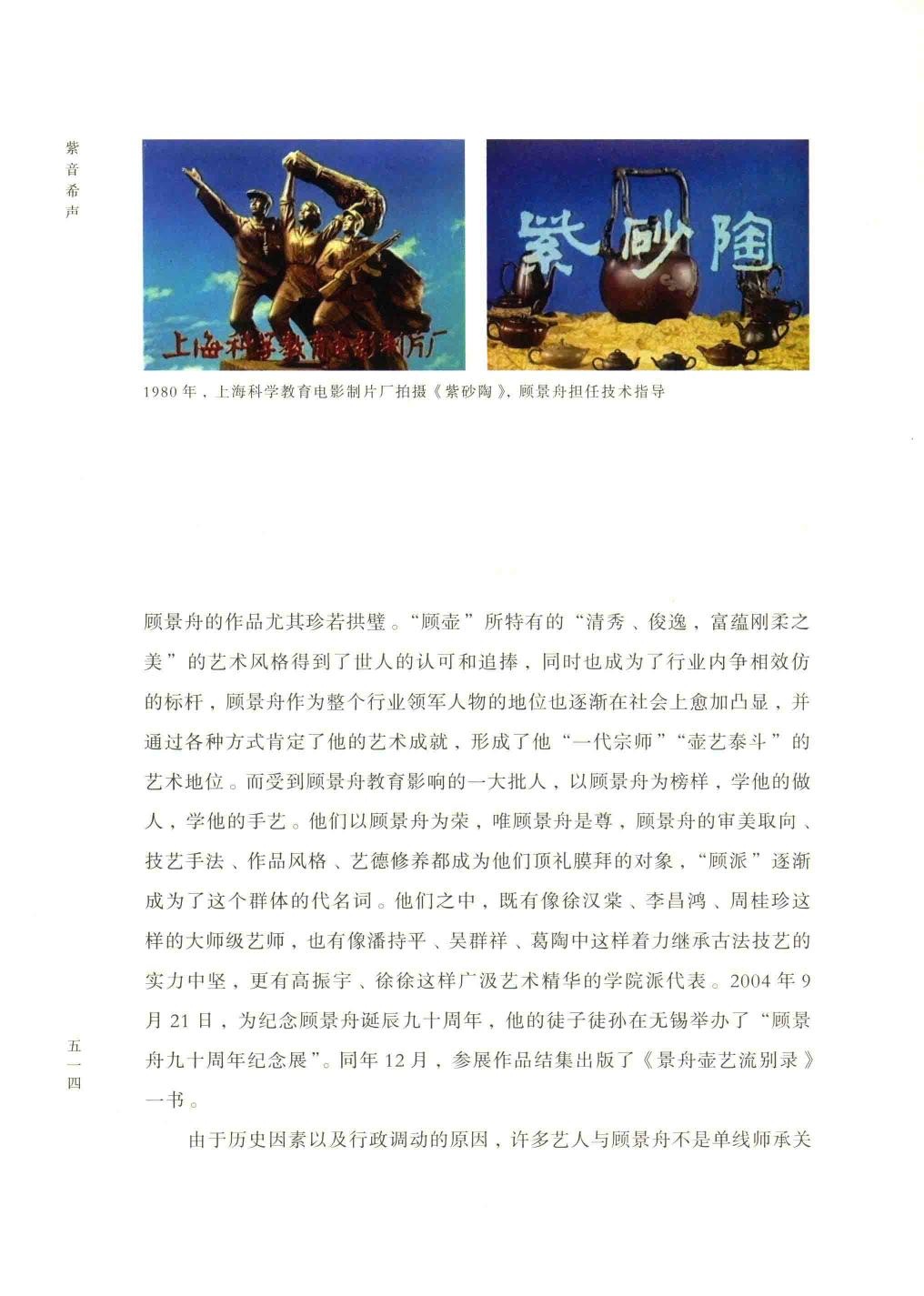
In 1980, the Shanghai Science and Education Film Studio produced *Purple Clay Pottery*, with Gu Jingzhou serving as technical advisor.
Gu Jingzhou's works are especially treasured as precious jade. The unique artistic style of "Gu teapots"—characterized by "elegance, grace, and a beauty that encompasses both strength and gentleness"—has gained recognition and admiration from the world. At the same time, it has become a benchmark that others in the industry eagerly emulate. Gu Jingzhou's position as a leading figure in the entire industry has gradually become increasingly prominent in society, and his artistic achievements have been affirmed through various means, establishing his artistic status as a "master of his generation" and "titan of the teapot art." A large group of people influenced by Gu Jingzhou's teachings have taken him as their model, learning from his character and his craftsmanship. They take pride in Gu Jingzhou and hold him in the highest esteem. Gu Jingzhou's aesthetic preferences, technical methods, artistic style, and moral cultivation have all become objects of their reverence and worship. The "Lei School" has gradually become synonymous with this group. Among them are master-level artisans like Xu Handang, Li Changhong, and Zhou Guizhen; stalwart practitioners dedicated to preserving traditional techniques like Pan Chiping, Wu Qunxiang, and Ge Taozhong; and academic representatives who broadly absorb artistic essence like Gao Zhenyu and Xu Xu. On September 21, 2004, to commemorate the ninetieth anniversary of Gu Jingzhou's birth, his disciples and their students held the "Gu Jingzhou Ninetieth Anniversary Memorial Exhibition" in Wuxi. In December of the same year, the exhibited works were compiled and published in the book *Record of the Branches of Jingzhou's Teapot Art*.
Due to historical factors and administrative transfers, many artisans did not have a simple master-disciple relationship with Gu Jingzhou.
Chapter 9
心营
Heart's Cultivation
Pages 506-525
View Chapter →
English Translation
In 1980, the Shanghai Science and Education Film Studio produced *Purple Clay Pottery*, with Gu Jingzhou serving as technical advisor.
Gu Jingzhou's works are especially treasured as precious jade. The unique artistic style of "Gu teapots"—characterized by "elegance, grace, and a beauty that encompasses both strength and gentleness"—has gained recognition and admiration from the world. At the same time, it has become a benchmark that others in the industry eagerly emulate. Gu Jingzhou's position as a leading figure in the entire industry has gradually become increasingly prominent in society, and his artistic achievements have been affirmed through various means, establishing his artistic status as a "master of his generation" and "titan of the teapot art." A large group of people influenced by Gu Jingzhou's teachings have taken him as their model, learning from his character and his craftsmanship. They take pride in Gu Jingzhou and hold him in the highest esteem. Gu Jingzhou's aesthetic preferences, technical methods, artistic style, and moral cultivation have all become objects of their reverence and worship. The "Lei School" has gradually become synonymous with this group. Among them are master-level artisans like Xu Handang, Li Changhong, and Zhou Guizhen; stalwart practitioners dedicated to preserving traditional techniques like Pan Chiping, Wu Qunxiang, and Ge Taozhong; and academic representatives who broadly absorb artistic essence like Gao Zhenyu and Xu Xu. On September 21, 2004, to commemorate the ninetieth anniversary of Gu Jingzhou's birth, his disciples and their students held the "Gu Jingzhou Ninetieth Anniversary Memorial Exhibition" in Wuxi. In December of the same year, the exhibited works were compiled and published in the book *Record of the Branches of Jingzhou's Teapot Art*.
Due to historical factors and administrative transfers, many artisans did not have a simple master-disciple relationship with Gu Jingzhou.
章节导航 Chapter Navigation
Chapter 1
序文
Pages 6-6
Chapter 2
引言
Pages 28-31
Chapter 3
达变
Pages 32-133
Chapter 3
开宗立派
Pages 46-66
Chapter 3
传道授业
Pages 67-98
Chapter 3
大师淳友
Pages 99-120
Chapter 3
学艺谋生
Pages 121-133
Chapter 4
化神
Pages 134-141
Chapter 5
独妙
Pages 142-405
Chapter 5
匠心独运 不苟丝毫
Pages 142-179
Chapter 5
器利善事 物尽其用
Pages 180-199
Chapter 5
紫泥春华 研精究微
Pages 200-405
Chapter 6
驾简
Pages 406-427
Chapter 6
精雕细刻 文质合一
Pages 406-410
Chapter 6
师法自然 妙趣横生
Pages 411-415
Chapter 6
丝来线去 曲尽其妙
Pages 416-427
Chapter 7
明志
Pages 463-485
Chapter 7
高山仰止 淡泊明志
Pages 463-472
Chapter 7
啜墨看茶 气定神闲
Pages 473-478
Chapter 7
齿少心锐 怡志抒情
Pages 479-485
Chapter 8
存真
Pages 428-462
Chapter 8
规圆矩方 弃伪存真
Pages 428-436
Chapter 8
有物有则 钻尖仰高
Pages 437-462
Chapter 9
心营
Pages 506-525
Chapter 9
坚守传统 艺立潮头
Pages 506-513
Chapter 9
新型师承 桃李满园
Pages 514-525
Chapter 10
附录
Pages 526-651
Chapter 10
顾景舟紫艺论文
Pages 526-535
Chapter 10
技术课备课笔记
Pages 536-543
Chapter 10
顾景舟艺术年表
Pages 544-651
Chapter 11
参考文献
Pages 652-657
Chapter 12
鸣谢
Pages 658-659