Chapter 3
达变
Adaptation
52
of 659
English Translation
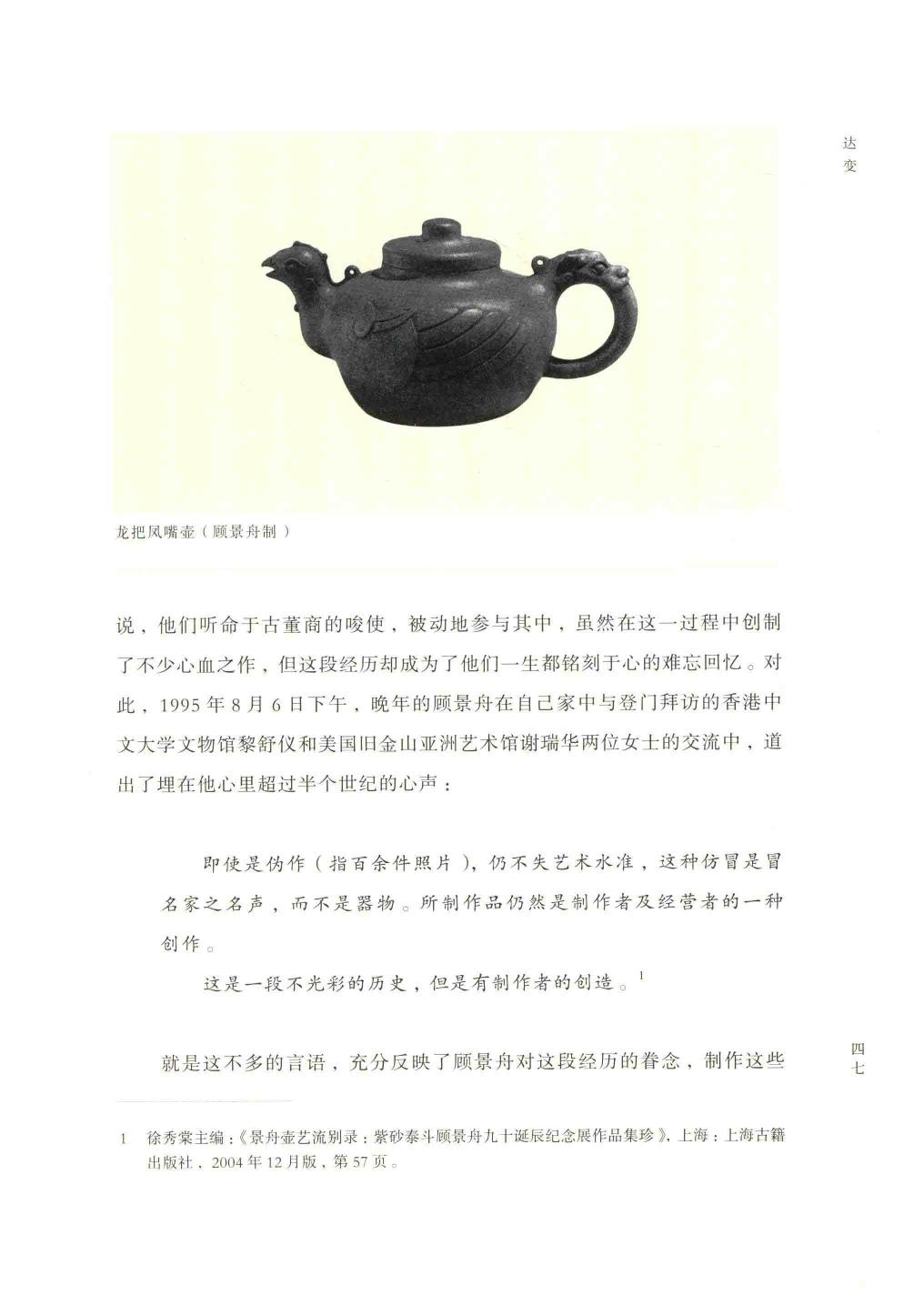
They said that they were compelled by the instigation of antique dealers and passively participated in this endeavor. Although they created many works of painstaking effort during this process, this experience became an unforgettable memory etched in their hearts for the rest of their lives. Regarding this matter, on the afternoon of August 6, 1995, the elderly Gu Jingzhou, at his home, shared with two visiting ladies—Lai Shu-yi from the Art Museum of the Chinese University of Hong Kong and Terese Tse Bartholomew from the Asian Art Museum of San Francisco—the feelings that had been buried in his heart for more than half a century:
> Even if they are forgeries (referring to the hundred-plus photographs), they still do not lose their artistic merit. This kind of imitation appropriates the reputation of famous masters, not the objects themselves. The works produced are still a form of creation by the makers and dealers.
>
> This is an inglorious chapter of history, but there is creativity from the makers.
These few words fully reflected Gu Jingzhou's attachment to this period of experience. The making of these works—
---
[1] Xu Xiutang, ed., *Jingzhou Huyi Liubielu: Zisha Taidou Gu Jingzhou Jiushi Danzhan Jinian Zhan Zuopinji Zhen* [A Record of Jingzhou's Teapot Art Lineages: Commemorative Exhibition Collection for the 90th Birthday of Purple Clay Master Gu Jingzhou] (Shanghai: Shanghai Guji Publishing House, December 2004), p. 57.
Chapter 3
达变
Adaptation
Pages 32-133
View Chapter →
English Translation
They said that they were compelled by the instigation of antique dealers and passively participated in this endeavor. Although they created many works of painstaking effort during this process, this experience became an unforgettable memory etched in their hearts for the rest of their lives. Regarding this matter, on the afternoon of August 6, 1995, the elderly Gu Jingzhou, at his home, shared with two visiting ladies—Lai Shu-yi from the Art Museum of the Chinese University of Hong Kong and Terese Tse Bartholomew from the Asian Art Museum of San Francisco—the feelings that had been buried in his heart for more than half a century:
> Even if they are forgeries (referring to the hundred-plus photographs), they still do not lose their artistic merit. This kind of imitation appropriates the reputation of famous masters, not the objects themselves. The works produced are still a form of creation by the makers and dealers.
>
> This is an inglorious chapter of history, but there is creativity from the makers.
These few words fully reflected Gu Jingzhou's attachment to this period of experience. The making of these works—
---
[1] Xu Xiutang, ed., *Jingzhou Huyi Liubielu: Zisha Taidou Gu Jingzhou Jiushi Danzhan Jinian Zhan Zuopinji Zhen* [A Record of Jingzhou's Teapot Art Lineages: Commemorative Exhibition Collection for the 90th Birthday of Purple Clay Master Gu Jingzhou] (Shanghai: Shanghai Guji Publishing House, December 2004), p. 57.
章节导航 Chapter Navigation
Chapter 1
序文
Pages 6-6
Chapter 2
引言
Pages 28-31
Chapter 3
达变
Pages 32-133
Chapter 3
开宗立派
Pages 46-66
Chapter 3
传道授业
Pages 67-98
Chapter 3
大师淳友
Pages 99-120
Chapter 3
学艺谋生
Pages 121-133
Chapter 4
化神
Pages 134-141
Chapter 5
独妙
Pages 142-405
Chapter 5
匠心独运 不苟丝毫
Pages 142-179
Chapter 5
器利善事 物尽其用
Pages 180-199
Chapter 5
紫泥春华 研精究微
Pages 200-405
Chapter 6
驾简
Pages 406-427
Chapter 6
精雕细刻 文质合一
Pages 406-410
Chapter 6
师法自然 妙趣横生
Pages 411-415
Chapter 6
丝来线去 曲尽其妙
Pages 416-427
Chapter 7
明志
Pages 463-485
Chapter 7
高山仰止 淡泊明志
Pages 463-472
Chapter 7
啜墨看茶 气定神闲
Pages 473-478
Chapter 7
齿少心锐 怡志抒情
Pages 479-485
Chapter 8
存真
Pages 428-462
Chapter 8
规圆矩方 弃伪存真
Pages 428-436
Chapter 8
有物有则 钻尖仰高
Pages 437-462
Chapter 9
心营
Pages 506-525
Chapter 9
坚守传统 艺立潮头
Pages 506-513
Chapter 9
新型师承 桃李满园
Pages 514-525
Chapter 10
附录
Pages 526-651
Chapter 10
顾景舟紫艺论文
Pages 526-535
Chapter 10
技术课备课笔记
Pages 536-543
Chapter 10
顾景舟艺术年表
Pages 544-651
Chapter 11
参考文献
Pages 652-657
Chapter 12
鸣谢
Pages 658-659