Chapter 3
达变
Adaptation
53
of 659
English Translation
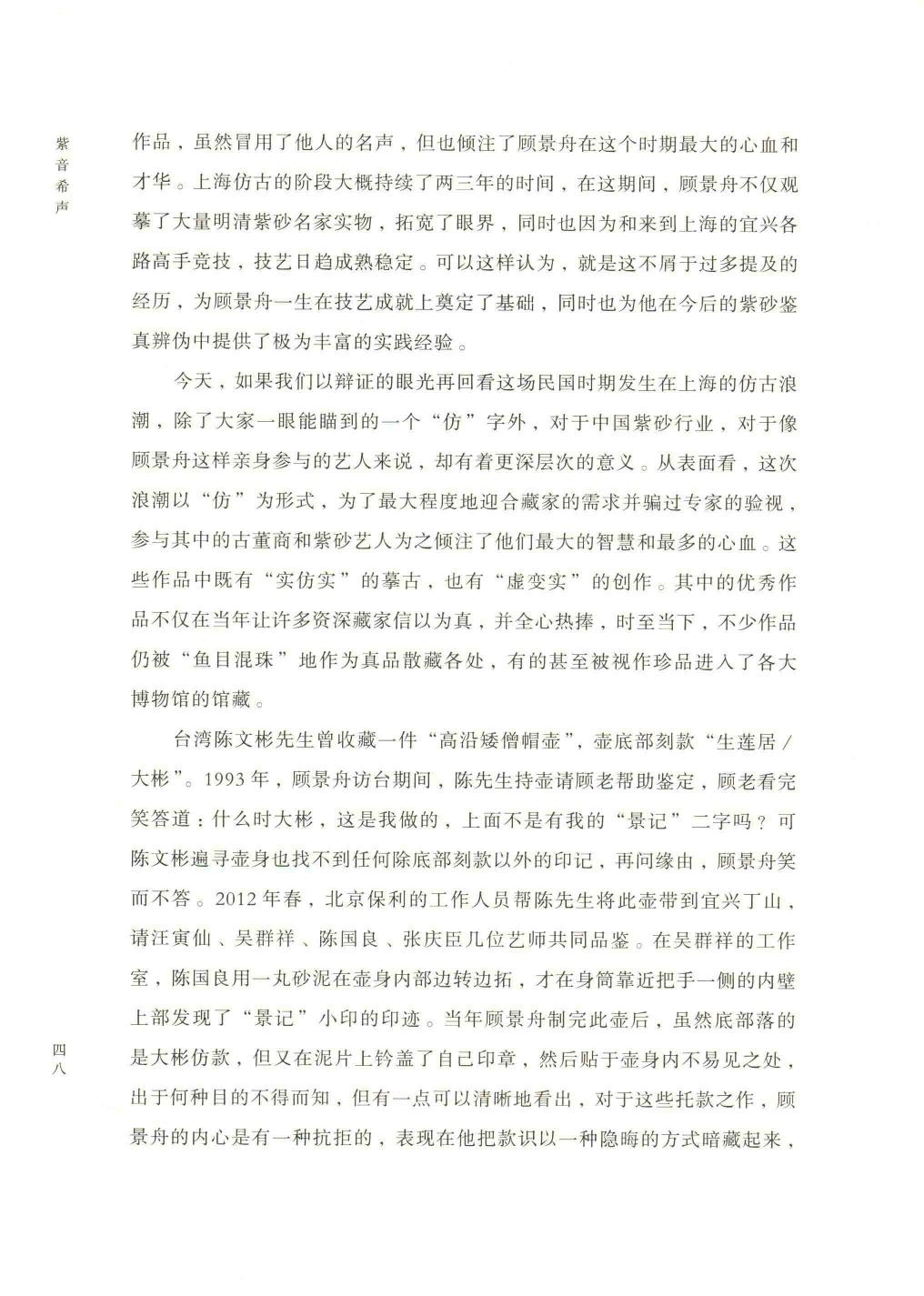
These works, though they borrowed the reputation of others, were nevertheless infused with Gu Jingzhou's greatest effort and talent during this period. The Shanghai imitation phase lasted approximately two to three years. During this time, Gu Jingzhou not only studied and copied a large number of actual works by famous Ming and Qing dynasty Yixing masters, broadening his horizons, but also competed with various Yixing masters who had come to Shanghai, causing his skills to mature and stabilize day by day. It can be said that this experience, which is not often mentioned in detail, laid the foundation for Gu Jingzhou's lifelong technical achievements, while also providing him with extremely rich practical experience for his future work in authenticating and identifying genuine Yixing pottery.
Today, if we look back at this wave of imitation that occurred in Shanghai during the Republican period with a dialectical perspective, beyond the obvious character "imitation" that everyone can see at first glance, for the Chinese Yixing pottery industry and for artisans like Gu Jingzhou who personally participated in it, there exists a deeper level of meaning. On the surface, this wave took "imitation" as its form. In order to meet collectors' demands to the greatest extent and deceive experts' scrutiny, the antique dealers and Yixing artisans who participated devoted their greatest wisdom and utmost effort. Among these works were both "real imitating real" copies of ancient pieces, as well as "imaginary becoming real" creations. The excellent works among them not only convinced many experienced collectors at the time, who enthusiastically embraced them, but even now, many works are still scattered in various collections as "fakes mixed with genuine articles," with some even regarded as treasures and entering the collections of major museums.
Mr. Chen Wenbin of Taiwan once collected a piece called "Gao Yan Ai Seng Da Bin Zeng Mao Hu" (High-rimmed Short Monk Da Bin Zeng Hat Teapot), with an inscription on the bottom reading "Shenglian Ju / Shi Da Bin" (Lotus-Born Residence / Shi Da Bin). In 1993, during Gu Jingzhou's visit to Taiwan, Mr. Chen asked Master Gu to help authenticate the piece. After examining it, Master Gu smiled and replied: "What Shi Da Bin? This was made by me. Doesn't it have my 'Jing Ji' (Jing's mark) characters on it?" But Chen Wenbin searched the entire body of the teapot and could not find any mark other than the inscription on the bottom, so he asked again for clarification. Gu Jingzhou smiled but did not answer. In the spring of 2012, staff from Beijing Poly brought this teapot to Yixing and invited Wang Xiuxian, Wu Qunxiang, Chen Guoliang, and Zhang Qingchen, several master artisans, to examine it together. In Wu Qunxiang's studio, Chen Guoliang used purple sand clay to rub and press around the interior of the teapot body, and only then discovered the imprint of a small "Jing Ji" seal on the inner wall near the handle. After Gu Jingzhou completed this teapot that year, although the bottom bore an imitation mark of Shi Da Bin, he had also stamped his own seal on the clay piece and then attached it to an inconspicuous place inside the teapot body. For what purpose this was done remains unknown, but one thing can be clearly seen: toward these works bearing false attributions, Gu Jingzhou harbored a kind of resistance in his heart, manifested in his concealing the mark in a hidden manner.
Chapter 3
达变
Adaptation
Pages 32-133
View Chapter →
English Translation
These works, though they borrowed the reputation of others, were nevertheless infused with Gu Jingzhou's greatest effort and talent during this period. The Shanghai imitation phase lasted approximately two to three years. During this time, Gu Jingzhou not only studied and copied a large number of actual works by famous Ming and Qing dynasty Yixing masters, broadening his horizons, but also competed with various Yixing masters who had come to Shanghai, causing his skills to mature and stabilize day by day. It can be said that this experience, which is not often mentioned in detail, laid the foundation for Gu Jingzhou's lifelong technical achievements, while also providing him with extremely rich practical experience for his future work in authenticating and identifying genuine Yixing pottery.
Today, if we look back at this wave of imitation that occurred in Shanghai during the Republican period with a dialectical perspective, beyond the obvious character "imitation" that everyone can see at first glance, for the Chinese Yixing pottery industry and for artisans like Gu Jingzhou who personally participated in it, there exists a deeper level of meaning. On the surface, this wave took "imitation" as its form. In order to meet collectors' demands to the greatest extent and deceive experts' scrutiny, the antique dealers and Yixing artisans who participated devoted their greatest wisdom and utmost effort. Among these works were both "real imitating real" copies of ancient pieces, as well as "imaginary becoming real" creations. The excellent works among them not only convinced many experienced collectors at the time, who enthusiastically embraced them, but even now, many works are still scattered in various collections as "fakes mixed with genuine articles," with some even regarded as treasures and entering the collections of major museums.
Mr. Chen Wenbin of Taiwan once collected a piece called "Gao Yan Ai Seng Da Bin Zeng Mao Hu" (High-rimmed Short Monk Da Bin Zeng Hat Teapot), with an inscription on the bottom reading "Shenglian Ju / Shi Da Bin" (Lotus-Born Residence / Shi Da Bin). In 1993, during Gu Jingzhou's visit to Taiwan, Mr. Chen asked Master Gu to help authenticate the piece. After examining it, Master Gu smiled and replied: "What Shi Da Bin? This was made by me. Doesn't it have my 'Jing Ji' (Jing's mark) characters on it?" But Chen Wenbin searched the entire body of the teapot and could not find any mark other than the inscription on the bottom, so he asked again for clarification. Gu Jingzhou smiled but did not answer. In the spring of 2012, staff from Beijing Poly brought this teapot to Yixing and invited Wang Xiuxian, Wu Qunxiang, Chen Guoliang, and Zhang Qingchen, several master artisans, to examine it together. In Wu Qunxiang's studio, Chen Guoliang used purple sand clay to rub and press around the interior of the teapot body, and only then discovered the imprint of a small "Jing Ji" seal on the inner wall near the handle. After Gu Jingzhou completed this teapot that year, although the bottom bore an imitation mark of Shi Da Bin, he had also stamped his own seal on the clay piece and then attached it to an inconspicuous place inside the teapot body. For what purpose this was done remains unknown, but one thing can be clearly seen: toward these works bearing false attributions, Gu Jingzhou harbored a kind of resistance in his heart, manifested in his concealing the mark in a hidden manner.
章节导航 Chapter Navigation
Chapter 1
序文
Pages 6-6
Chapter 2
引言
Pages 28-31
Chapter 3
达变
Pages 32-133
Chapter 3
开宗立派
Pages 46-66
Chapter 3
传道授业
Pages 67-98
Chapter 3
大师淳友
Pages 99-120
Chapter 3
学艺谋生
Pages 121-133
Chapter 4
化神
Pages 134-141
Chapter 5
独妙
Pages 142-405
Chapter 5
匠心独运 不苟丝毫
Pages 142-179
Chapter 5
器利善事 物尽其用
Pages 180-199
Chapter 5
紫泥春华 研精究微
Pages 200-405
Chapter 6
驾简
Pages 406-427
Chapter 6
精雕细刻 文质合一
Pages 406-410
Chapter 6
师法自然 妙趣横生
Pages 411-415
Chapter 6
丝来线去 曲尽其妙
Pages 416-427
Chapter 7
明志
Pages 463-485
Chapter 7
高山仰止 淡泊明志
Pages 463-472
Chapter 7
啜墨看茶 气定神闲
Pages 473-478
Chapter 7
齿少心锐 怡志抒情
Pages 479-485
Chapter 8
存真
Pages 428-462
Chapter 8
规圆矩方 弃伪存真
Pages 428-436
Chapter 8
有物有则 钻尖仰高
Pages 437-462
Chapter 9
心营
Pages 506-525
Chapter 9
坚守传统 艺立潮头
Pages 506-513
Chapter 9
新型师承 桃李满园
Pages 514-525
Chapter 10
附录
Pages 526-651
Chapter 10
顾景舟紫艺论文
Pages 526-535
Chapter 10
技术课备课笔记
Pages 536-543
Chapter 10
顾景舟艺术年表
Pages 544-651
Chapter 11
参考文献
Pages 652-657
Chapter 12
鸣谢
Pages 658-659