Chapter 10
附录
Appendix
546
of 659
English Translation
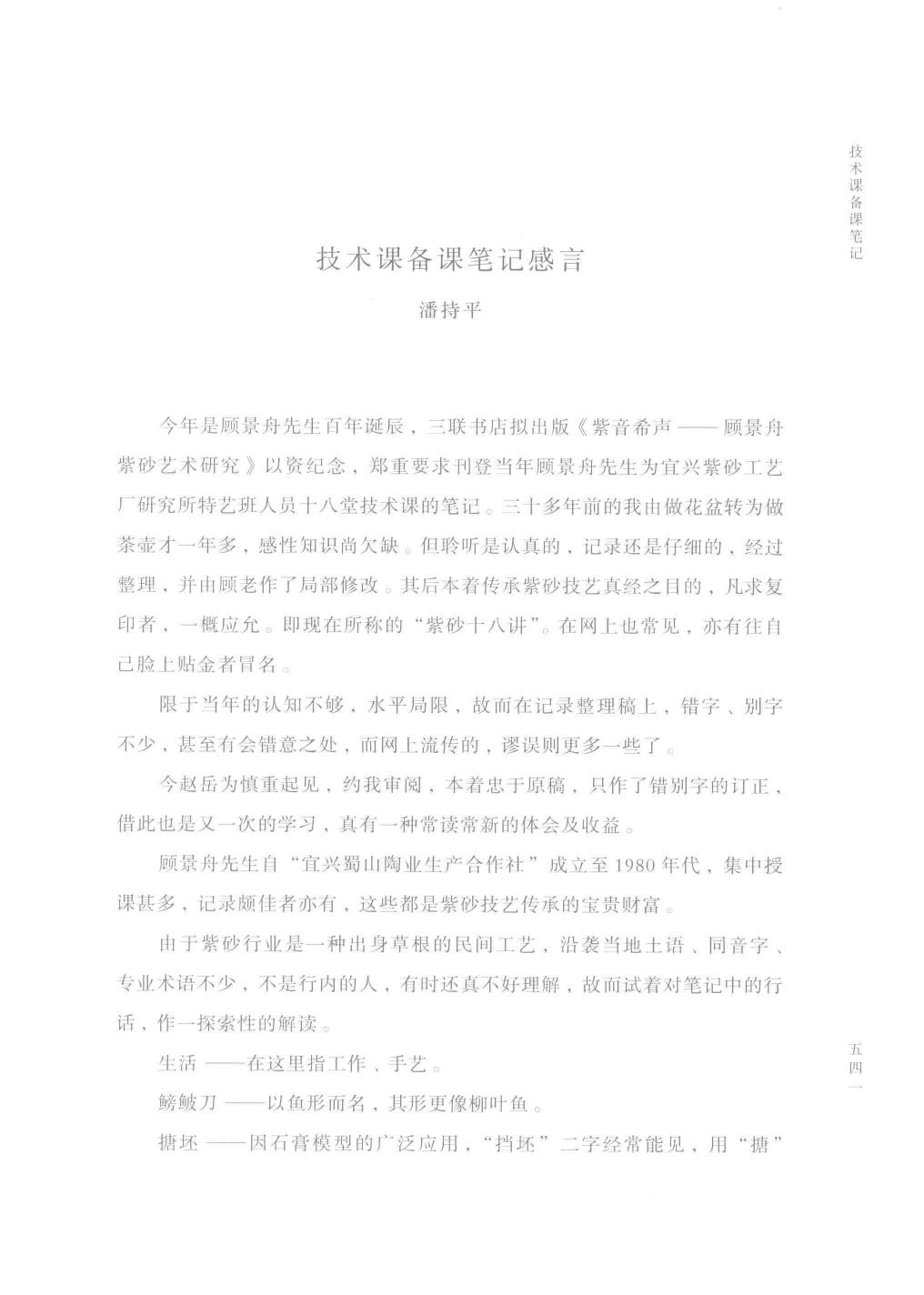
# Reflections on Technical Course Preparation Notes
Pan Chiping
This year marks the centennial exhibition of Mr. Gu Jingzhou. SDX Joint Publishing Company plans to publish *Purple Tones, Rare Sounds: Research on Gu Jingzhou's Zisha Art* as a commemoration. They have solemnly requested the publication of the notes from the eighteen technical lectures that Mr. Gu Jingzhou gave to the personnel of the special arts class at the Yixing Zisha Craft Research Institute back then. More than thirty years ago, I had only been making teapots for just over a year after transitioning from making flowerpots, and my practical knowledge was still lacking. However, I listened attentively and recorded carefully. After organizing the notes, Mr. Gu made some partial revisions. Subsequently, with the purpose of transmitting the true teachings of zisha craftsmanship, I agreed to all requests for photocopies. This is what is now called the "Eighteen Lectures on Zisha." It is also commonly seen online, and there are even those who falsely claim authorship to glorify themselves.
Due to insufficient understanding and limited skill level at that time, there were many typos and incorrect characters in the organized manuscript, and even some places where I misunderstood the meaning. The versions circulating online have even more errors.
Now, to be prudent, Zhao invited me to review it. Staying faithful to the original manuscript, I only corrected typos and incorrect characters. This has also been another opportunity for learning, and I truly have the experience and benefit of finding something new with each reading.
From the establishment of the "Yixing Dingshu Pottery Production Cooperative" until the 1980s, Mr. Gu Jingzhou gave many concentrated lectures, and there were also quite good records of these. These are all precious treasures for the transmission of zisha craftsmanship.
Because the zisha industry is a folk craft with grassroots origins, it has inherited many local dialects, homophones, and specialized terminology. For those not in the trade, it can sometimes be truly difficult to understand. Therefore, I have attempted to provide an exploratory interpretation of the jargon in the notes.
生活 (shēnghuó) — here refers to work, craft
馆饿刀 (guǎn'èdāo) — named for its fish shape, its form more closely resembles a willow leaf fish
沸坯 (fèipī) — due to the widespread application of gypsum molds, the two characters "挡坏" (dǎnghuài) are frequently seen, using "扩" (kuò)
Chapter 10
附录
Appendix
Pages 526-651
View Chapter →
English Translation
# Reflections on Technical Course Preparation Notes
Pan Chiping
This year marks the centennial exhibition of Mr. Gu Jingzhou. SDX Joint Publishing Company plans to publish *Purple Tones, Rare Sounds: Research on Gu Jingzhou's Zisha Art* as a commemoration. They have solemnly requested the publication of the notes from the eighteen technical lectures that Mr. Gu Jingzhou gave to the personnel of the special arts class at the Yixing Zisha Craft Research Institute back then. More than thirty years ago, I had only been making teapots for just over a year after transitioning from making flowerpots, and my practical knowledge was still lacking. However, I listened attentively and recorded carefully. After organizing the notes, Mr. Gu made some partial revisions. Subsequently, with the purpose of transmitting the true teachings of zisha craftsmanship, I agreed to all requests for photocopies. This is what is now called the "Eighteen Lectures on Zisha." It is also commonly seen online, and there are even those who falsely claim authorship to glorify themselves.
Due to insufficient understanding and limited skill level at that time, there were many typos and incorrect characters in the organized manuscript, and even some places where I misunderstood the meaning. The versions circulating online have even more errors.
Now, to be prudent, Zhao invited me to review it. Staying faithful to the original manuscript, I only corrected typos and incorrect characters. This has also been another opportunity for learning, and I truly have the experience and benefit of finding something new with each reading.
From the establishment of the "Yixing Dingshu Pottery Production Cooperative" until the 1980s, Mr. Gu Jingzhou gave many concentrated lectures, and there were also quite good records of these. These are all precious treasures for the transmission of zisha craftsmanship.
Because the zisha industry is a folk craft with grassroots origins, it has inherited many local dialects, homophones, and specialized terminology. For those not in the trade, it can sometimes be truly difficult to understand. Therefore, I have attempted to provide an exploratory interpretation of the jargon in the notes.
生活 (shēnghuó) — here refers to work, craft
馆饿刀 (guǎn'èdāo) — named for its fish shape, its form more closely resembles a willow leaf fish
沸坯 (fèipī) — due to the widespread application of gypsum molds, the two characters "挡坏" (dǎnghuài) are frequently seen, using "扩" (kuò)
章节导航 Chapter Navigation
Chapter 1
序文
Pages 6-6
Chapter 2
引言
Pages 28-31
Chapter 3
达变
Pages 32-133
Chapter 3
开宗立派
Pages 46-66
Chapter 3
传道授业
Pages 67-98
Chapter 3
大师淳友
Pages 99-120
Chapter 3
学艺谋生
Pages 121-133
Chapter 4
化神
Pages 134-141
Chapter 5
独妙
Pages 142-405
Chapter 5
匠心独运 不苟丝毫
Pages 142-179
Chapter 5
器利善事 物尽其用
Pages 180-199
Chapter 5
紫泥春华 研精究微
Pages 200-405
Chapter 6
驾简
Pages 406-427
Chapter 6
精雕细刻 文质合一
Pages 406-410
Chapter 6
师法自然 妙趣横生
Pages 411-415
Chapter 6
丝来线去 曲尽其妙
Pages 416-427
Chapter 7
明志
Pages 463-485
Chapter 7
高山仰止 淡泊明志
Pages 463-472
Chapter 7
啜墨看茶 气定神闲
Pages 473-478
Chapter 7
齿少心锐 怡志抒情
Pages 479-485
Chapter 8
存真
Pages 428-462
Chapter 8
规圆矩方 弃伪存真
Pages 428-436
Chapter 8
有物有则 钻尖仰高
Pages 437-462
Chapter 9
心营
Pages 506-525
Chapter 9
坚守传统 艺立潮头
Pages 506-513
Chapter 9
新型师承 桃李满园
Pages 514-525
Chapter 10
附录
Pages 526-651
Chapter 10
顾景舟紫艺论文
Pages 526-535
Chapter 10
技术课备课笔记
Pages 536-543
Chapter 10
顾景舟艺术年表
Pages 544-651
Chapter 11
参考文献
Pages 652-657
Chapter 12
鸣谢
Pages 658-659