Chapter 10
附录
Appendix
547
of 659
English Translation
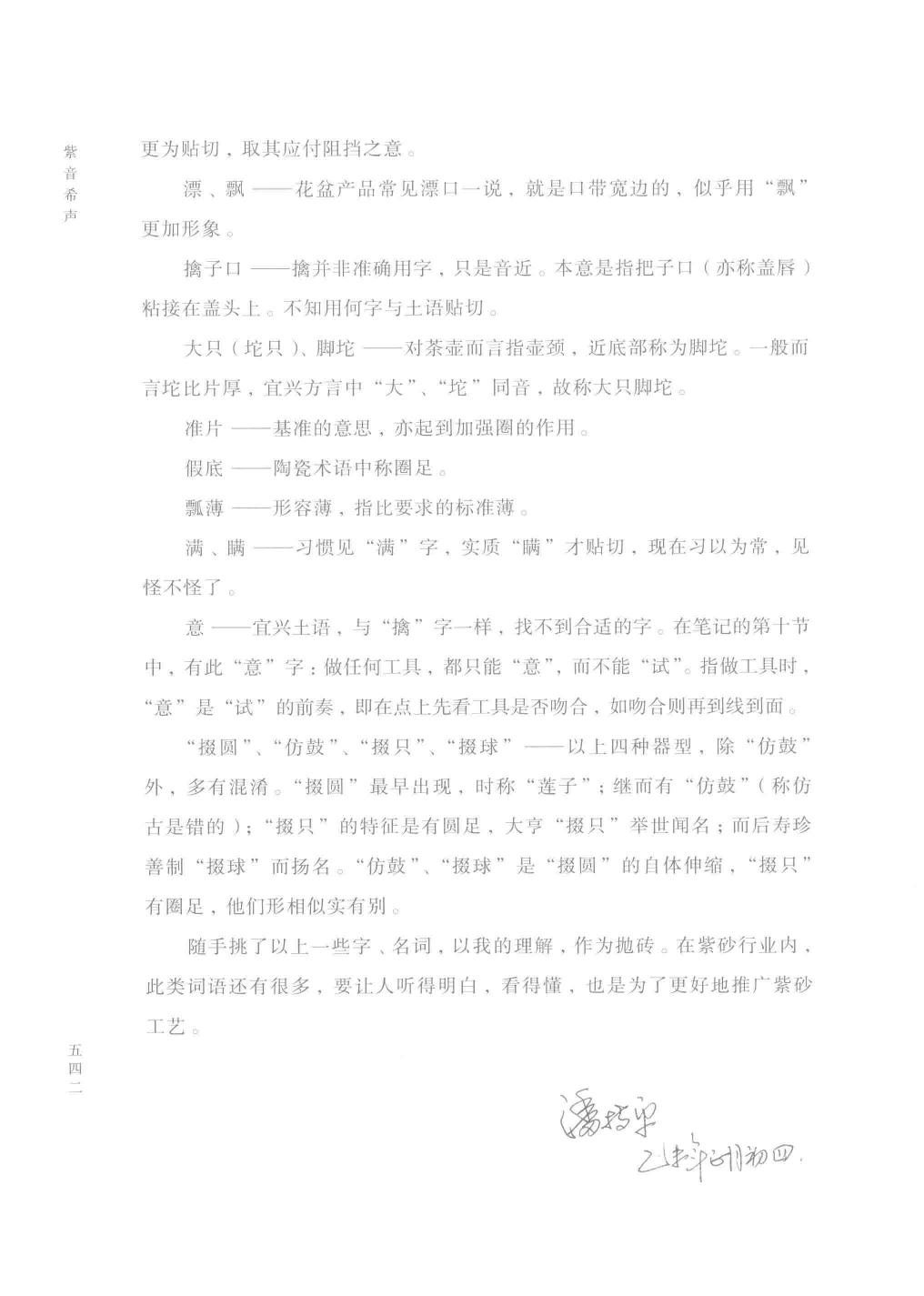
More fitting, taking the meaning of dealing with and blocking.
**Piao, Piao** — In flowerpot products, there is often mention of "piao kou" (floating rim), which refers to a rim with a wide edge. It seems that using "qiu" (ball) would be more vivid.
**Dan zi kou** — "Ba" is not an accurate character, just phonetically similar. The original meaning refers to attaching the handle opening (also called lid extension) to the lid head. I don't know which character would be appropriate for the local dialect.
**Da zhi (tuo zhi), jiao tuo** — For teapots, this refers to the pot neck; the area near the bottom is called "jiao tuo" (foot lump). Generally speaking, "tuo" is thicker than "pian" (片). In Yixing dialect, "da" (大) and "tuo" (坨) are homophones, hence the term "da zhi jiao tuo."
**Zhun pian** — Meaning "reference" or "standard," it also serves the function of a reinforcing ring.
**Jia di** — In ceramic terminology, this is called a foot ring.
**Du bao** — Describes thinness, indicating something thinner than the required standard.
**Man, Man** — Customarily we see the character "满" (full), but in reality "有瞒" (concealing) would be more appropriate. Now it has become conventional usage.
**Yi** — Yixing local dialect, similar to the character "的" (de), for which no suitable character can be found. In the tenth section of the notes, there is this character "意": when making any tool, one can only "yi" (gauge/sense), not "shi" (试, try). When making tools, "yi" is the prelude to "shi" — that is, first checking at a point whether the tool fits, and if it fits, then proceeding from line to surface.
**"She yuan," "Fang gu," "Bao zhi," "Yuan qiu"** — Of these four major types, except for "fang gu," many are confused. "She yuan" appeared earliest and was then called "lian zi" (lotus seed); subsequently there was "fang gu" (calling it "fang er" is incorrect); the characteristic of "bao zhi" is having a round foot — Daxiang's "she zhi" is world-renowned; later, Shou Zhen became famous for excelling at making "yuan qiu." "Fang gu" and "yuan qiu" are natural extensions and contractions of "she yuan," while "she zhi" has a foot ring — they appear similar in form but are actually different.
I have randomly selected the above characters and terms, offering my understanding as a starting point for discussion. Within the purple sand pottery industry, there are many more such terms. Making them audible and comprehensible is also for the better promotion of purple sand pottery craftsmanship.
Chapter 10
附录
Appendix
Pages 526-651
View Chapter →
English Translation
More fitting, taking the meaning of dealing with and blocking.
**Piao, Piao** — In flowerpot products, there is often mention of "piao kou" (floating rim), which refers to a rim with a wide edge. It seems that using "qiu" (ball) would be more vivid.
**Dan zi kou** — "Ba" is not an accurate character, just phonetically similar. The original meaning refers to attaching the handle opening (also called lid extension) to the lid head. I don't know which character would be appropriate for the local dialect.
**Da zhi (tuo zhi), jiao tuo** — For teapots, this refers to the pot neck; the area near the bottom is called "jiao tuo" (foot lump). Generally speaking, "tuo" is thicker than "pian" (片). In Yixing dialect, "da" (大) and "tuo" (坨) are homophones, hence the term "da zhi jiao tuo."
**Zhun pian** — Meaning "reference" or "standard," it also serves the function of a reinforcing ring.
**Jia di** — In ceramic terminology, this is called a foot ring.
**Du bao** — Describes thinness, indicating something thinner than the required standard.
**Man, Man** — Customarily we see the character "满" (full), but in reality "有瞒" (concealing) would be more appropriate. Now it has become conventional usage.
**Yi** — Yixing local dialect, similar to the character "的" (de), for which no suitable character can be found. In the tenth section of the notes, there is this character "意": when making any tool, one can only "yi" (gauge/sense), not "shi" (试, try). When making tools, "yi" is the prelude to "shi" — that is, first checking at a point whether the tool fits, and if it fits, then proceeding from line to surface.
**"She yuan," "Fang gu," "Bao zhi," "Yuan qiu"** — Of these four major types, except for "fang gu," many are confused. "She yuan" appeared earliest and was then called "lian zi" (lotus seed); subsequently there was "fang gu" (calling it "fang er" is incorrect); the characteristic of "bao zhi" is having a round foot — Daxiang's "she zhi" is world-renowned; later, Shou Zhen became famous for excelling at making "yuan qiu." "Fang gu" and "yuan qiu" are natural extensions and contractions of "she yuan," while "she zhi" has a foot ring — they appear similar in form but are actually different.
I have randomly selected the above characters and terms, offering my understanding as a starting point for discussion. Within the purple sand pottery industry, there are many more such terms. Making them audible and comprehensible is also for the better promotion of purple sand pottery craftsmanship.
章节导航 Chapter Navigation
Chapter 1
序文
Pages 6-6
Chapter 2
引言
Pages 28-31
Chapter 3
达变
Pages 32-133
Chapter 3
开宗立派
Pages 46-66
Chapter 3
传道授业
Pages 67-98
Chapter 3
大师淳友
Pages 99-120
Chapter 3
学艺谋生
Pages 121-133
Chapter 4
化神
Pages 134-141
Chapter 5
独妙
Pages 142-405
Chapter 5
匠心独运 不苟丝毫
Pages 142-179
Chapter 5
器利善事 物尽其用
Pages 180-199
Chapter 5
紫泥春华 研精究微
Pages 200-405
Chapter 6
驾简
Pages 406-427
Chapter 6
精雕细刻 文质合一
Pages 406-410
Chapter 6
师法自然 妙趣横生
Pages 411-415
Chapter 6
丝来线去 曲尽其妙
Pages 416-427
Chapter 7
明志
Pages 463-485
Chapter 7
高山仰止 淡泊明志
Pages 463-472
Chapter 7
啜墨看茶 气定神闲
Pages 473-478
Chapter 7
齿少心锐 怡志抒情
Pages 479-485
Chapter 8
存真
Pages 428-462
Chapter 8
规圆矩方 弃伪存真
Pages 428-436
Chapter 8
有物有则 钻尖仰高
Pages 437-462
Chapter 9
心营
Pages 506-525
Chapter 9
坚守传统 艺立潮头
Pages 506-513
Chapter 9
新型师承 桃李满园
Pages 514-525
Chapter 10
附录
Pages 526-651
Chapter 10
顾景舟紫艺论文
Pages 526-535
Chapter 10
技术课备课笔记
Pages 536-543
Chapter 10
顾景舟艺术年表
Pages 544-651
Chapter 11
参考文献
Pages 652-657
Chapter 12
鸣谢
Pages 658-659