Chapter 3
达变
Adaptation
56
of 659
English Translation
So much so that today we need to employ such exhaustive methods to comprehend even a portion of the truth.
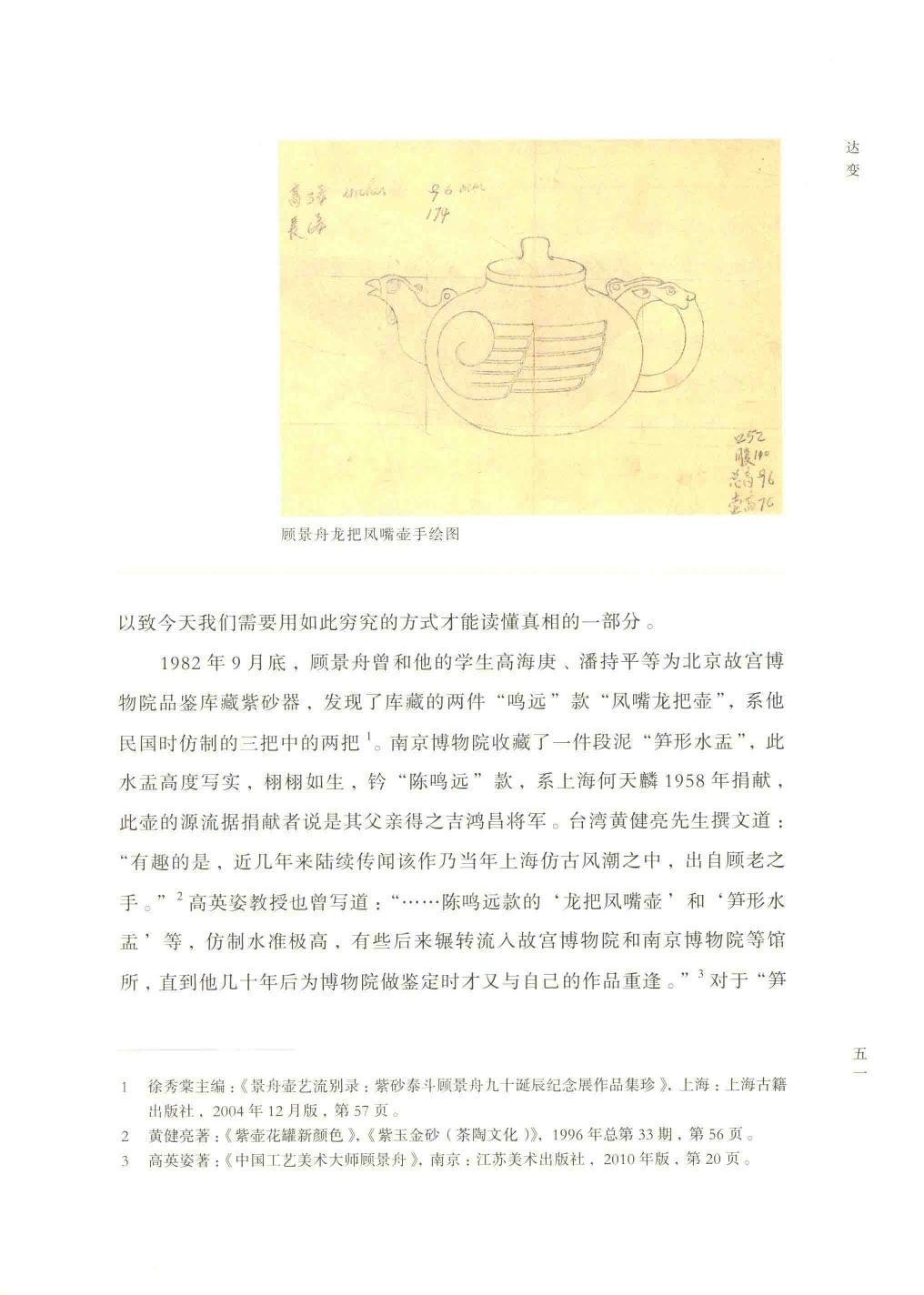
At the end of September 1982, Gu Jingzhou, together with his students Gao Haigeng and Pan Chiping, appraised the Yixing pottery collection stored at the Palace Museum in Beijing. They discovered two "Mingyuan" marked "Phoenix Spout Dragon Handle Teapots" in the collection, which were two of the three pieces he had replicated during the Republican era[1]. The Nanjing Museum houses a duan clay "Bamboo Shoot-Shaped Water Vessel." This water vessel is highly realistic, lifelike and vivid, bearing the seal "Chen Mingyuan." It was donated by He Tianlin from Shanghai in 1958. According to the donor, the provenance of this vessel traces back to his father, who obtained it from General Ji Hongchang. Mr. Huang Jianliang from Taiwan wrote: "Interestingly, in recent years there have been successive rumors that this work actually came from the hand of Master Gu during Shanghai's antique reproduction trend of that era."[2] Professor Gao Yingzi also wrote: "...The 'Dragon Handle Phoenix Spout Teapot' and 'Bamboo Shoot-Shaped Water Vessel' bearing Chen Mingyuan's mark were replicated to an extremely high standard. Some later found their way into institutions such as the Palace Museum and Nanjing Museum, and it was not until he conducted appraisals for the museums decades later that he was reunited with his own works."[3] Regarding the "enemy"
---
[1] Xu Xiutang, ed., *Jingzhou Pottery Art Lineage Record: Collection of Works from the Memorial Exhibition for the Centennial Birth of Yixing Purple Clay Master Gu Jingzhou* (Shanghai: Shanghai Classics Publishing House, December 2004), p. 57.
[2] Huang Jianliang, "New Colors in the Purple Teapot Flower Chain," *Purple Jade Golden Sand (Tea and Pottery Culture)*, Issue 33 (1996), p. 56.
[3] Gao Yingzi, *Chinese Master of Arts and Crafts Gu Jingzhou* (Nanjing: Jiangsu Fine Arts Publishing House, 2010), p. 20.
Chapter 3
达变
Adaptation
Pages 32-133
View Chapter →
English Translation
So much so that today we need to employ such exhaustive methods to comprehend even a portion of the truth.
At the end of September 1982, Gu Jingzhou, together with his students Gao Haigeng and Pan Chiping, appraised the Yixing pottery collection stored at the Palace Museum in Beijing. They discovered two "Mingyuan" marked "Phoenix Spout Dragon Handle Teapots" in the collection, which were two of the three pieces he had replicated during the Republican era[1]. The Nanjing Museum houses a duan clay "Bamboo Shoot-Shaped Water Vessel." This water vessel is highly realistic, lifelike and vivid, bearing the seal "Chen Mingyuan." It was donated by He Tianlin from Shanghai in 1958. According to the donor, the provenance of this vessel traces back to his father, who obtained it from General Ji Hongchang. Mr. Huang Jianliang from Taiwan wrote: "Interestingly, in recent years there have been successive rumors that this work actually came from the hand of Master Gu during Shanghai's antique reproduction trend of that era."[2] Professor Gao Yingzi also wrote: "...The 'Dragon Handle Phoenix Spout Teapot' and 'Bamboo Shoot-Shaped Water Vessel' bearing Chen Mingyuan's mark were replicated to an extremely high standard. Some later found their way into institutions such as the Palace Museum and Nanjing Museum, and it was not until he conducted appraisals for the museums decades later that he was reunited with his own works."[3] Regarding the "enemy"
---
[1] Xu Xiutang, ed., *Jingzhou Pottery Art Lineage Record: Collection of Works from the Memorial Exhibition for the Centennial Birth of Yixing Purple Clay Master Gu Jingzhou* (Shanghai: Shanghai Classics Publishing House, December 2004), p. 57.
[2] Huang Jianliang, "New Colors in the Purple Teapot Flower Chain," *Purple Jade Golden Sand (Tea and Pottery Culture)*, Issue 33 (1996), p. 56.
[3] Gao Yingzi, *Chinese Master of Arts and Crafts Gu Jingzhou* (Nanjing: Jiangsu Fine Arts Publishing House, 2010), p. 20.
章节导航 Chapter Navigation
Chapter 1
序文
Pages 6-6
Chapter 2
引言
Pages 28-31
Chapter 3
达变
Pages 32-133
Chapter 3
开宗立派
Pages 46-66
Chapter 3
传道授业
Pages 67-98
Chapter 3
大师淳友
Pages 99-120
Chapter 3
学艺谋生
Pages 121-133
Chapter 4
化神
Pages 134-141
Chapter 5
独妙
Pages 142-405
Chapter 5
匠心独运 不苟丝毫
Pages 142-179
Chapter 5
器利善事 物尽其用
Pages 180-199
Chapter 5
紫泥春华 研精究微
Pages 200-405
Chapter 6
驾简
Pages 406-427
Chapter 6
精雕细刻 文质合一
Pages 406-410
Chapter 6
师法自然 妙趣横生
Pages 411-415
Chapter 6
丝来线去 曲尽其妙
Pages 416-427
Chapter 7
明志
Pages 463-485
Chapter 7
高山仰止 淡泊明志
Pages 463-472
Chapter 7
啜墨看茶 气定神闲
Pages 473-478
Chapter 7
齿少心锐 怡志抒情
Pages 479-485
Chapter 8
存真
Pages 428-462
Chapter 8
规圆矩方 弃伪存真
Pages 428-436
Chapter 8
有物有则 钻尖仰高
Pages 437-462
Chapter 9
心营
Pages 506-525
Chapter 9
坚守传统 艺立潮头
Pages 506-513
Chapter 9
新型师承 桃李满园
Pages 514-525
Chapter 10
附录
Pages 526-651
Chapter 10
顾景舟紫艺论文
Pages 526-535
Chapter 10
技术课备课笔记
Pages 536-543
Chapter 10
顾景舟艺术年表
Pages 544-651
Chapter 11
参考文献
Pages 652-657
Chapter 12
鸣谢
Pages 658-659