Chapter 10
附录
Appendix
570
of 659
English Translation
## My Miscellaneous Reflections on Replicating Products
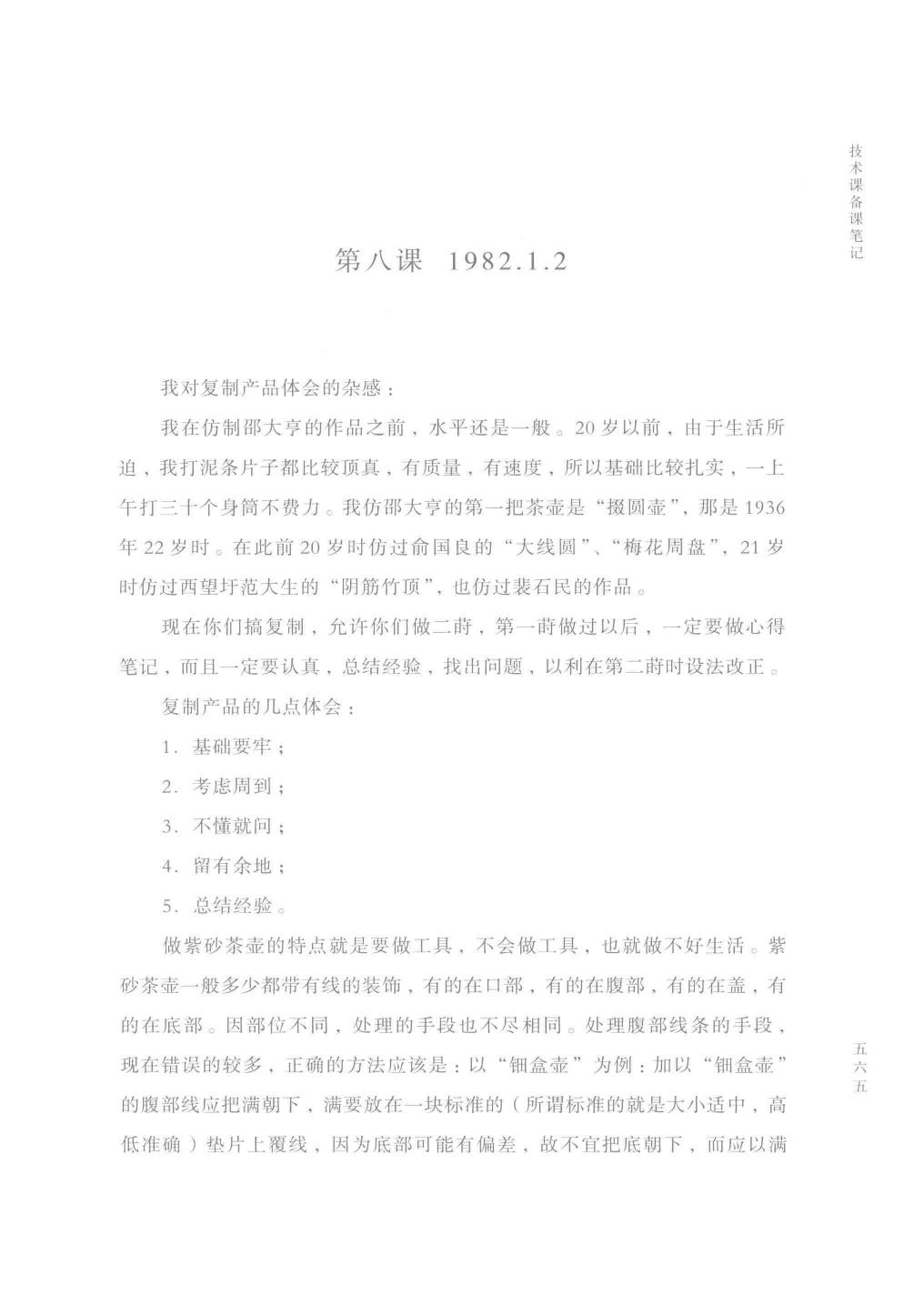
Before I began replicating the works of Shao Daheng, my skill level was still ordinary. Before the age of 20, driven by the necessities of life, I was quite meticulous in beating clay coils and slabs, maintaining both quality and speed. Therefore, my foundation was relatively solid—I could make thirty body cylinders in a single morning without difficulty. The first teapot I replicated from Shao Daheng was the "Yuanyuan Guo," which I made in 1936 when I was 22 years old. Prior to this, at age 20, I had replicated Yu Guoliang's "Daxian Yuan" and "Meihua Zhoupan," and at 21, I replicated Fan Dasheng's "Yinjin Zhuxiang" from Xiwangxu, as well as works by Pei Shimin.
Now that you are engaged in replication work, you are allowed to make two pieces. After completing the first piece, you must definitely write notes on your experience, and you must be conscientious about it. Summarize your experience, identify problems, so that you can find ways to correct them when making the second piece.
## Several Points of Experience in Replicating Products:
1. The foundation must be solid;
2. Consideration must be thorough;
3. If you don't understand, ask;
4. Leave room for adjustment;
The characteristic of making Yixing teapots is that you must make tools. If you cannot make tools, you cannot make good products. Yixing teapots generally feature linear decorations to varying degrees—some on the rim, some on the body, some on the lid, and some on the base. Because the positions differ, the methods of treatment are not entirely the same. Currently, there are many errors in the methods for treating body lines. The correct method should be: taking the "Youhe Hu" as an example—when applying lines to the body of the "Youhe Hu," the rim should face downward. The rim should be placed on a standard (so-called standard meaning appropriately sized and accurately leveled) cushion piece to apply the lines. Because the base may have deviations, it is not advisable to place the base downward; rather, one should use the rim.
Chapter 10
附录
Appendix
Pages 526-651
View Chapter →
English Translation
## My Miscellaneous Reflections on Replicating Products
Before I began replicating the works of Shao Daheng, my skill level was still ordinary. Before the age of 20, driven by the necessities of life, I was quite meticulous in beating clay coils and slabs, maintaining both quality and speed. Therefore, my foundation was relatively solid—I could make thirty body cylinders in a single morning without difficulty. The first teapot I replicated from Shao Daheng was the "Yuanyuan Guo," which I made in 1936 when I was 22 years old. Prior to this, at age 20, I had replicated Yu Guoliang's "Daxian Yuan" and "Meihua Zhoupan," and at 21, I replicated Fan Dasheng's "Yinjin Zhuxiang" from Xiwangxu, as well as works by Pei Shimin.
Now that you are engaged in replication work, you are allowed to make two pieces. After completing the first piece, you must definitely write notes on your experience, and you must be conscientious about it. Summarize your experience, identify problems, so that you can find ways to correct them when making the second piece.
## Several Points of Experience in Replicating Products:
1. The foundation must be solid;
2. Consideration must be thorough;
3. If you don't understand, ask;
4. Leave room for adjustment;
The characteristic of making Yixing teapots is that you must make tools. If you cannot make tools, you cannot make good products. Yixing teapots generally feature linear decorations to varying degrees—some on the rim, some on the body, some on the lid, and some on the base. Because the positions differ, the methods of treatment are not entirely the same. Currently, there are many errors in the methods for treating body lines. The correct method should be: taking the "Youhe Hu" as an example—when applying lines to the body of the "Youhe Hu," the rim should face downward. The rim should be placed on a standard (so-called standard meaning appropriately sized and accurately leveled) cushion piece to apply the lines. Because the base may have deviations, it is not advisable to place the base downward; rather, one should use the rim.
章节导航 Chapter Navigation
Chapter 1
序文
Pages 6-6
Chapter 2
引言
Pages 28-31
Chapter 3
达变
Pages 32-133
Chapter 3
开宗立派
Pages 46-66
Chapter 3
传道授业
Pages 67-98
Chapter 3
大师淳友
Pages 99-120
Chapter 3
学艺谋生
Pages 121-133
Chapter 4
化神
Pages 134-141
Chapter 5
独妙
Pages 142-405
Chapter 5
匠心独运 不苟丝毫
Pages 142-179
Chapter 5
器利善事 物尽其用
Pages 180-199
Chapter 5
紫泥春华 研精究微
Pages 200-405
Chapter 6
驾简
Pages 406-427
Chapter 6
精雕细刻 文质合一
Pages 406-410
Chapter 6
师法自然 妙趣横生
Pages 411-415
Chapter 6
丝来线去 曲尽其妙
Pages 416-427
Chapter 7
明志
Pages 463-485
Chapter 7
高山仰止 淡泊明志
Pages 463-472
Chapter 7
啜墨看茶 气定神闲
Pages 473-478
Chapter 7
齿少心锐 怡志抒情
Pages 479-485
Chapter 8
存真
Pages 428-462
Chapter 8
规圆矩方 弃伪存真
Pages 428-436
Chapter 8
有物有则 钻尖仰高
Pages 437-462
Chapter 9
心营
Pages 506-525
Chapter 9
坚守传统 艺立潮头
Pages 506-513
Chapter 9
新型师承 桃李满园
Pages 514-525
Chapter 10
附录
Pages 526-651
Chapter 10
顾景舟紫艺论文
Pages 526-535
Chapter 10
技术课备课笔记
Pages 536-543
Chapter 10
顾景舟艺术年表
Pages 544-651
Chapter 11
参考文献
Pages 652-657
Chapter 12
鸣谢
Pages 658-659