Chapter 10
附录
Appendix
579
of 659
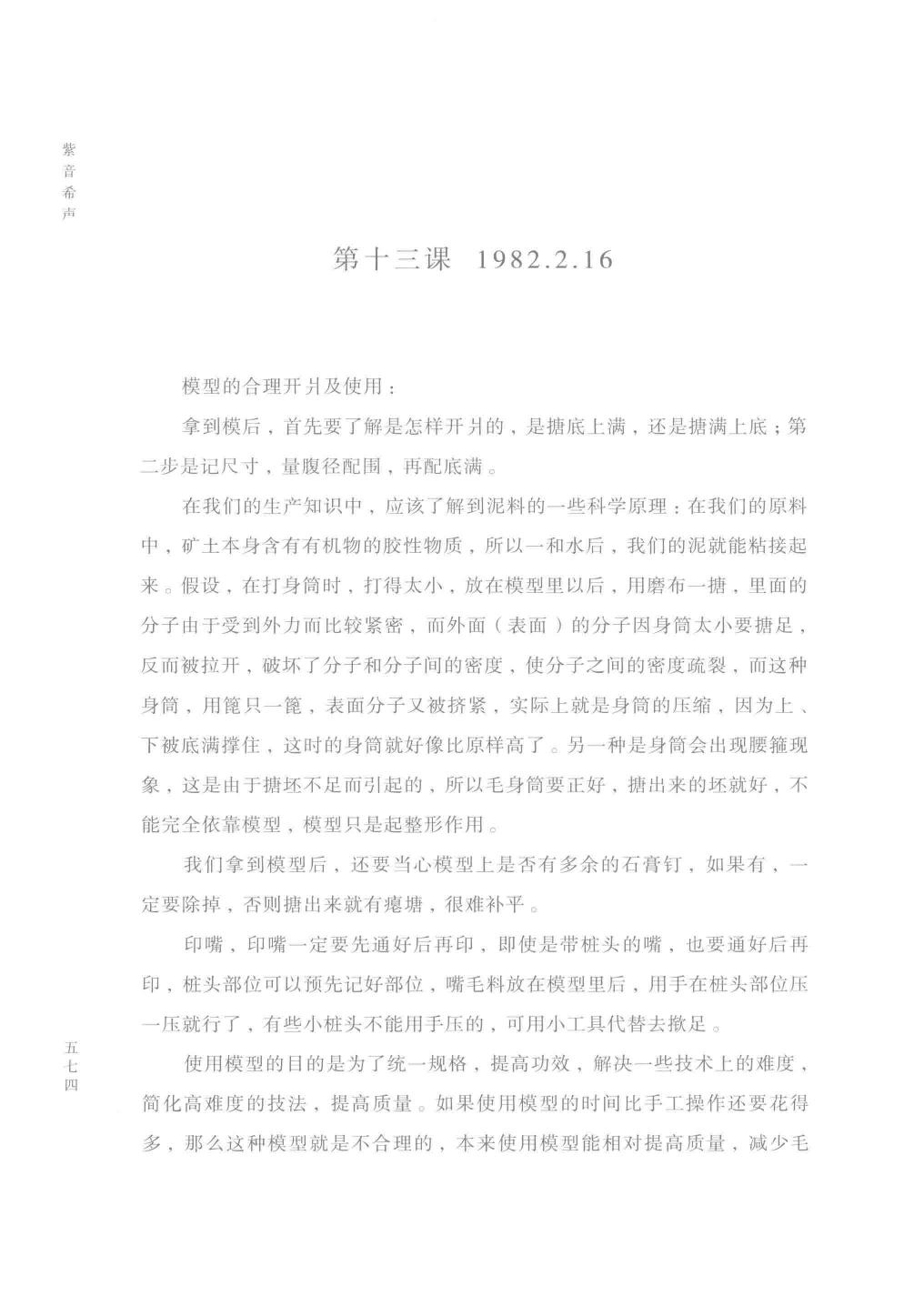
English Translation
## Lecture Thirteen, February 16, 1982
### Rational Development and Use of Molds:
After obtaining a mold, the first step is to understand how it opens—whether it squeezes the bottom onto the body, or the body onto the bottom. The second step is to record measurements: measure the belly diameter to match the body, then match the bottom and lid.
In our production knowledge, we should understand some scientific principles of clay materials: In our raw materials, the mineral clay itself contains organic colloidal substances, so once mixed with water, our clay can bond together. Suppose, when beating the body cylinder, if it is beaten too small, after placing it in the mold and squeezing with hemp cloth, the molecules inside become relatively compact due to external force, while the molecules on the outside (surface) are pulled apart because the body cylinder is too small to fill the space, destroying the density between molecules and causing the molecular density to crack. When such a body cylinder is scraped with a rib tool, the surface molecules are compressed again, which is actually the compression of the body cylinder. Because the top and bottom are held by the lid and base, the body cylinder at this point seems taller than its original form. Another phenomenon is that the body cylinder may develop a waist bulge, which is caused by insufficient expansion. Therefore, the raw body cylinder must be just right, so that the expanded piece will be good. One cannot rely entirely on the mold; the mold only serves a shaping function.
After we obtain a mold, we must also be careful whether there are excess plaster bumps on the mold. If there are, they must be removed; otherwise, the expanded piece will have depressions that are very difficult to fill smooth.
Pressing spouts: Spouts must be pierced through first before pressing. Even spouts with posts must be pierced through before pressing. The post area can be marked in advance. After placing the raw spout material in the mold, simply press with your hand at the post area. For some small posts that cannot be pressed by hand, small tools can be used as substitutes to fill the space.
The purpose of using molds is to standardize specifications, improve efficiency, solve technical difficulties, simplify high-difficulty techniques, and improve quality. If using a mold takes more time than manual operation, then such a mold is unreasonable. Originally, using molds can relatively improve quality and reduce defects—
Chapter 10
附录
Appendix
Pages 526-651
View Chapter →
English Translation
## Lecture Thirteen, February 16, 1982
### Rational Development and Use of Molds:
After obtaining a mold, the first step is to understand how it opens—whether it squeezes the bottom onto the body, or the body onto the bottom. The second step is to record measurements: measure the belly diameter to match the body, then match the bottom and lid.
In our production knowledge, we should understand some scientific principles of clay materials: In our raw materials, the mineral clay itself contains organic colloidal substances, so once mixed with water, our clay can bond together. Suppose, when beating the body cylinder, if it is beaten too small, after placing it in the mold and squeezing with hemp cloth, the molecules inside become relatively compact due to external force, while the molecules on the outside (surface) are pulled apart because the body cylinder is too small to fill the space, destroying the density between molecules and causing the molecular density to crack. When such a body cylinder is scraped with a rib tool, the surface molecules are compressed again, which is actually the compression of the body cylinder. Because the top and bottom are held by the lid and base, the body cylinder at this point seems taller than its original form. Another phenomenon is that the body cylinder may develop a waist bulge, which is caused by insufficient expansion. Therefore, the raw body cylinder must be just right, so that the expanded piece will be good. One cannot rely entirely on the mold; the mold only serves a shaping function.
After we obtain a mold, we must also be careful whether there are excess plaster bumps on the mold. If there are, they must be removed; otherwise, the expanded piece will have depressions that are very difficult to fill smooth.
Pressing spouts: Spouts must be pierced through first before pressing. Even spouts with posts must be pierced through before pressing. The post area can be marked in advance. After placing the raw spout material in the mold, simply press with your hand at the post area. For some small posts that cannot be pressed by hand, small tools can be used as substitutes to fill the space.
The purpose of using molds is to standardize specifications, improve efficiency, solve technical difficulties, simplify high-difficulty techniques, and improve quality. If using a mold takes more time than manual operation, then such a mold is unreasonable. Originally, using molds can relatively improve quality and reduce defects—
章节导航 Chapter Navigation
Chapter 1
序文
Pages 6-6
Chapter 2
引言
Pages 28-31
Chapter 3
达变
Pages 32-133
Chapter 3
开宗立派
Pages 46-66
Chapter 3
传道授业
Pages 67-98
Chapter 3
大师淳友
Pages 99-120
Chapter 3
学艺谋生
Pages 121-133
Chapter 4
化神
Pages 134-141
Chapter 5
独妙
Pages 142-405
Chapter 5
匠心独运 不苟丝毫
Pages 142-179
Chapter 5
器利善事 物尽其用
Pages 180-199
Chapter 5
紫泥春华 研精究微
Pages 200-405
Chapter 6
驾简
Pages 406-427
Chapter 6
精雕细刻 文质合一
Pages 406-410
Chapter 6
师法自然 妙趣横生
Pages 411-415
Chapter 6
丝来线去 曲尽其妙
Pages 416-427
Chapter 7
明志
Pages 463-485
Chapter 7
高山仰止 淡泊明志
Pages 463-472
Chapter 7
啜墨看茶 气定神闲
Pages 473-478
Chapter 7
齿少心锐 怡志抒情
Pages 479-485
Chapter 8
存真
Pages 428-462
Chapter 8
规圆矩方 弃伪存真
Pages 428-436
Chapter 8
有物有则 钻尖仰高
Pages 437-462
Chapter 9
心营
Pages 506-525
Chapter 9
坚守传统 艺立潮头
Pages 506-513
Chapter 9
新型师承 桃李满园
Pages 514-525
Chapter 10
附录
Pages 526-651
Chapter 10
顾景舟紫艺论文
Pages 526-535
Chapter 10
技术课备课笔记
Pages 536-543
Chapter 10
顾景舟艺术年表
Pages 544-651
Chapter 11
参考文献
Pages 652-657
Chapter 12
鸣谢
Pages 658-659