Chapter 10
附录
Appendix
581
of 659
English Translation
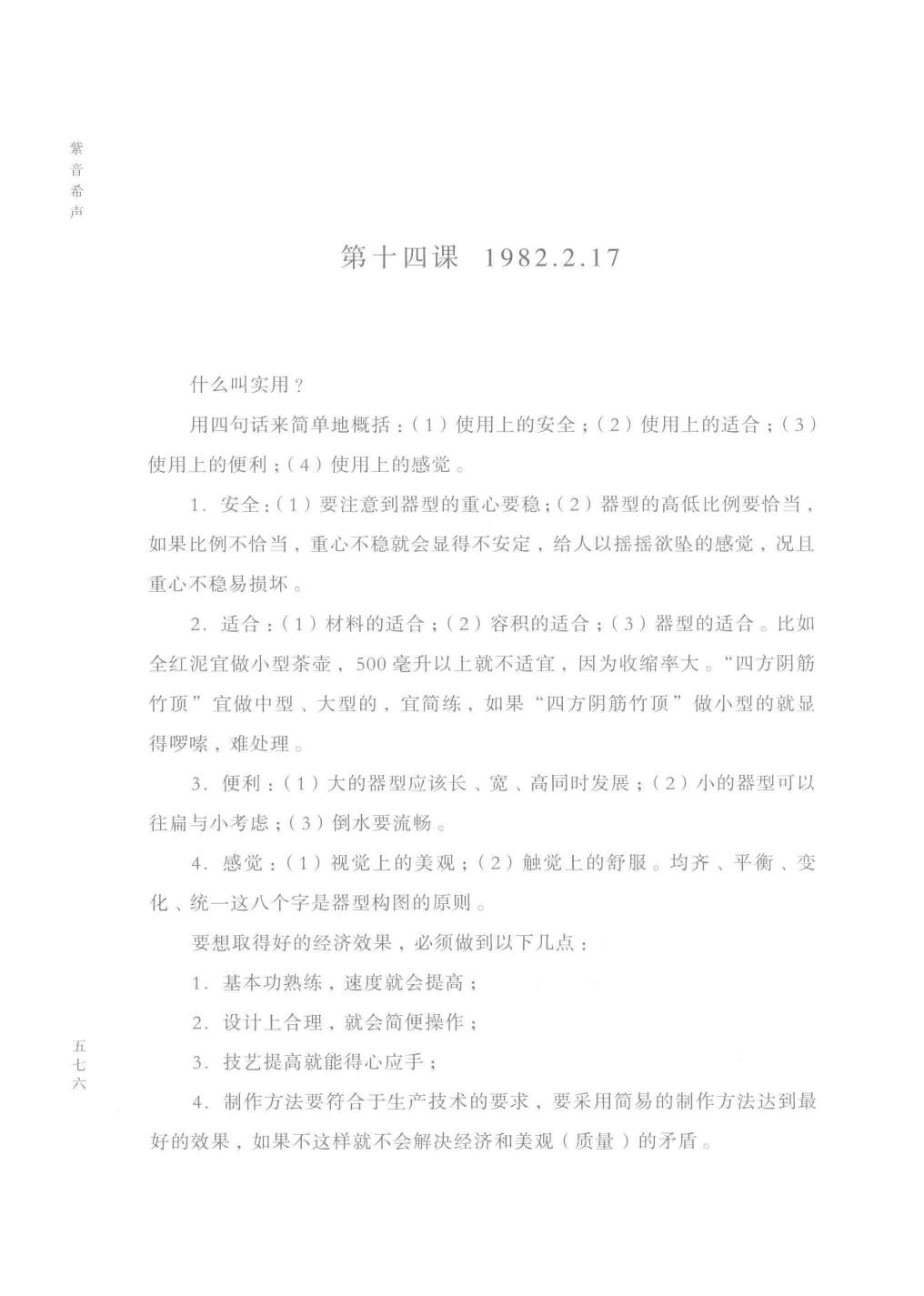
Lesson 14, February 17, 1982
## What Does "Practical" Mean?
Four simple phrases summarize it: (1) Safety in use; (2) Suitability in use; (3) Convenience in use; (4) Feel in use.
### Safety
(1) Pay attention to the stability of the vessel's center of gravity; (2) The proportions of the vessel's height and width must be appropriate. If the proportions are inappropriate and the center of gravity is unstable, it will appear unsteady, giving people a feeling that it is about to topple over. Moreover, an unstable center of gravity makes it易损坏 [易 to damage].
### Suitability
(1) Suitability of materials; (2) Suitability of capacity; (3) Suitability of vessel form. For example, pure red clay is suitable for making small teapots—above 500 milliliters is not appropriate because the shrinkage rate is high. The "square concave-ribbed bamboo top" style is suitable for medium and large sizes and should be simple and refined. If the "square concave-ribbed bamboo top" is made in a small size, it will appear cluttered and difficult to handle.
### Convenience
(1) Large vessel forms should develop simultaneously in length, width, and height; (2) Small vessel forms can be considered in terms of flatness and smallness; (3) Pouring water should be smooth and flowing.
### Feel
(1) Visual beauty; (2) Comfortable to the touch. Uniformity, balance, variation, and unity—these eight characters are the principles of vessel composition.
## Achieving Good Economic Results
To achieve good economic results, the following points must be accomplished:
1. When basic skills are proficient, speed will naturally improve;
2. When design is reasonable, operations will be simplified;
3. When craftsmanship improves, one can work with ease and mastery;
4. Production methods must conform to the requirements of manufacturing technology. Simple production methods should be adopted to achieve the best results. If this is not done, the contradiction between economy and beauty (quality) cannot be resolved.
Chapter 10
附录
Appendix
Pages 526-651
View Chapter →
English Translation
Lesson 14, February 17, 1982
## What Does "Practical" Mean?
Four simple phrases summarize it: (1) Safety in use; (2) Suitability in use; (3) Convenience in use; (4) Feel in use.
### Safety
(1) Pay attention to the stability of the vessel's center of gravity; (2) The proportions of the vessel's height and width must be appropriate. If the proportions are inappropriate and the center of gravity is unstable, it will appear unsteady, giving people a feeling that it is about to topple over. Moreover, an unstable center of gravity makes it易损坏 [易 to damage].
### Suitability
(1) Suitability of materials; (2) Suitability of capacity; (3) Suitability of vessel form. For example, pure red clay is suitable for making small teapots—above 500 milliliters is not appropriate because the shrinkage rate is high. The "square concave-ribbed bamboo top" style is suitable for medium and large sizes and should be simple and refined. If the "square concave-ribbed bamboo top" is made in a small size, it will appear cluttered and difficult to handle.
### Convenience
(1) Large vessel forms should develop simultaneously in length, width, and height; (2) Small vessel forms can be considered in terms of flatness and smallness; (3) Pouring water should be smooth and flowing.
### Feel
(1) Visual beauty; (2) Comfortable to the touch. Uniformity, balance, variation, and unity—these eight characters are the principles of vessel composition.
## Achieving Good Economic Results
To achieve good economic results, the following points must be accomplished:
1. When basic skills are proficient, speed will naturally improve;
2. When design is reasonable, operations will be simplified;
3. When craftsmanship improves, one can work with ease and mastery;
4. Production methods must conform to the requirements of manufacturing technology. Simple production methods should be adopted to achieve the best results. If this is not done, the contradiction between economy and beauty (quality) cannot be resolved.
章节导航 Chapter Navigation
Chapter 1
序文
Pages 6-6
Chapter 2
引言
Pages 28-31
Chapter 3
达变
Pages 32-133
Chapter 3
开宗立派
Pages 46-66
Chapter 3
传道授业
Pages 67-98
Chapter 3
大师淳友
Pages 99-120
Chapter 3
学艺谋生
Pages 121-133
Chapter 4
化神
Pages 134-141
Chapter 5
独妙
Pages 142-405
Chapter 5
匠心独运 不苟丝毫
Pages 142-179
Chapter 5
器利善事 物尽其用
Pages 180-199
Chapter 5
紫泥春华 研精究微
Pages 200-405
Chapter 6
驾简
Pages 406-427
Chapter 6
精雕细刻 文质合一
Pages 406-410
Chapter 6
师法自然 妙趣横生
Pages 411-415
Chapter 6
丝来线去 曲尽其妙
Pages 416-427
Chapter 7
明志
Pages 463-485
Chapter 7
高山仰止 淡泊明志
Pages 463-472
Chapter 7
啜墨看茶 气定神闲
Pages 473-478
Chapter 7
齿少心锐 怡志抒情
Pages 479-485
Chapter 8
存真
Pages 428-462
Chapter 8
规圆矩方 弃伪存真
Pages 428-436
Chapter 8
有物有则 钻尖仰高
Pages 437-462
Chapter 9
心营
Pages 506-525
Chapter 9
坚守传统 艺立潮头
Pages 506-513
Chapter 9
新型师承 桃李满园
Pages 514-525
Chapter 10
附录
Pages 526-651
Chapter 10
顾景舟紫艺论文
Pages 526-535
Chapter 10
技术课备课笔记
Pages 536-543
Chapter 10
顾景舟艺术年表
Pages 544-651
Chapter 11
参考文献
Pages 652-657
Chapter 12
鸣谢
Pages 658-659