Chapter 10
附录
Appendix
583
of 659
English Translation
## Five Eight
The connecting part of these two curves is called rhythm. The "bamboo joint cap cylinder" lacks a sense of rhythm.
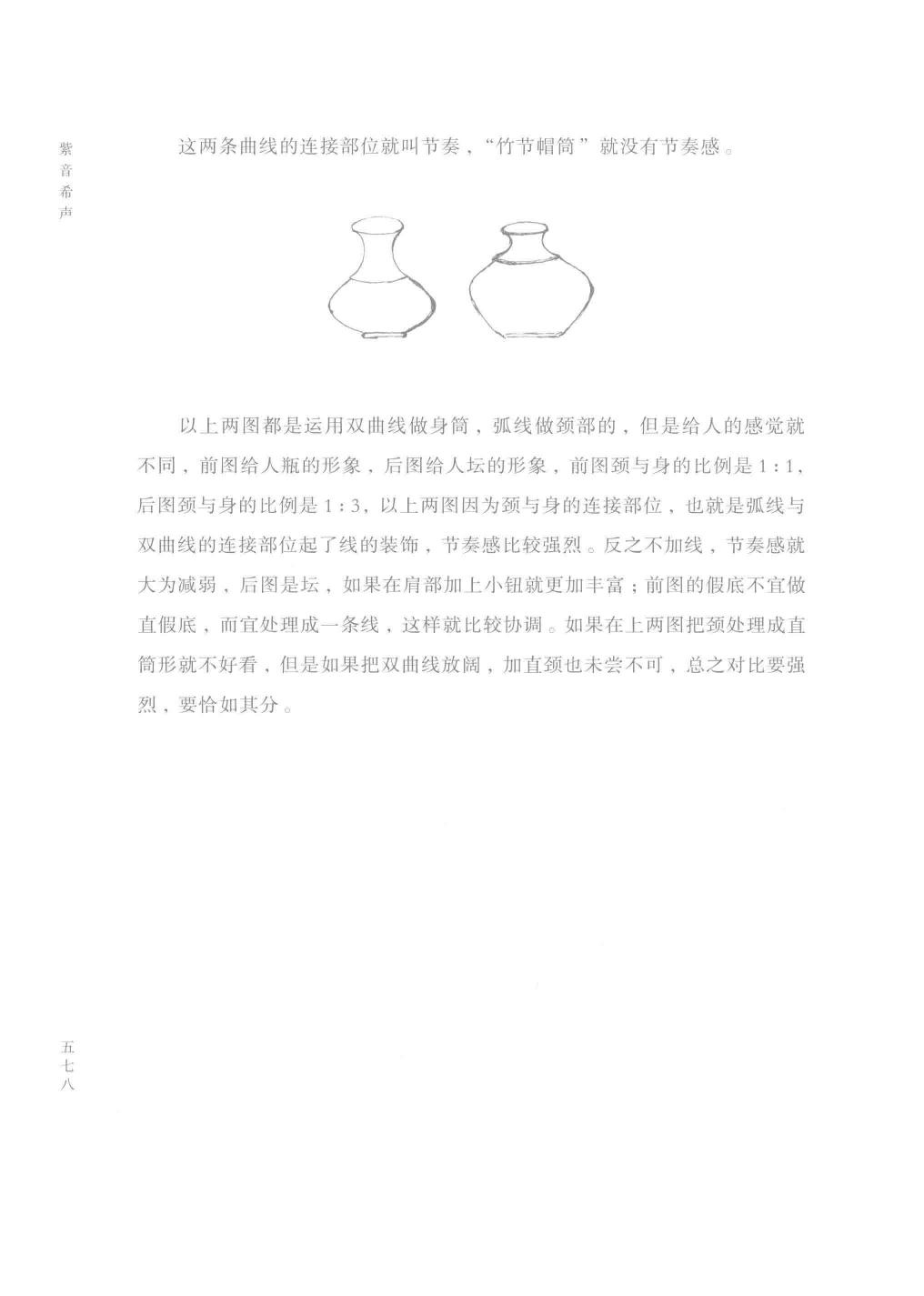
Both of the above diagrams use double curves for the body cylinder and arc lines for the neck, but they give people different impressions. The former diagram gives the image of a vase, while the latter gives the image of a jar. In the former diagram, the ratio of neck to body is 1:1, while in the latter diagram the ratio of neck to body is 1:3. In both diagrams above, because the connecting part between neck and body—that is, the connecting part of the arc lines with the double curves—creates linear decoration, the sense of rhythm is relatively strong. Conversely, if the false base in the diagram is not handled well, it will be greatly weakened. The latter diagram is a jar; if a small knob is added to the shoulder, it becomes even more enriched. The former should be treated as a single line at the appropriate place, which makes it more harmonious. If in the above two diagrams the appropriate place is treated as a straight cylinder form, it won't look good, but if the double curve is widened and a straight neck is added, it's not necessarily unworkable. In short, the contrast should be strong and intense, but must be just right.
Chapter 10
附录
Appendix
Pages 526-651
View Chapter →
English Translation
## Five Eight
The connecting part of these two curves is called rhythm. The "bamboo joint cap cylinder" lacks a sense of rhythm.
Both of the above diagrams use double curves for the body cylinder and arc lines for the neck, but they give people different impressions. The former diagram gives the image of a vase, while the latter gives the image of a jar. In the former diagram, the ratio of neck to body is 1:1, while in the latter diagram the ratio of neck to body is 1:3. In both diagrams above, because the connecting part between neck and body—that is, the connecting part of the arc lines with the double curves—creates linear decoration, the sense of rhythm is relatively strong. Conversely, if the false base in the diagram is not handled well, it will be greatly weakened. The latter diagram is a jar; if a small knob is added to the shoulder, it becomes even more enriched. The former should be treated as a single line at the appropriate place, which makes it more harmonious. If in the above two diagrams the appropriate place is treated as a straight cylinder form, it won't look good, but if the double curve is widened and a straight neck is added, it's not necessarily unworkable. In short, the contrast should be strong and intense, but must be just right.
章节导航 Chapter Navigation
Chapter 1
序文
Pages 6-6
Chapter 2
引言
Pages 28-31
Chapter 3
达变
Pages 32-133
Chapter 3
开宗立派
Pages 46-66
Chapter 3
传道授业
Pages 67-98
Chapter 3
大师淳友
Pages 99-120
Chapter 3
学艺谋生
Pages 121-133
Chapter 4
化神
Pages 134-141
Chapter 5
独妙
Pages 142-405
Chapter 5
匠心独运 不苟丝毫
Pages 142-179
Chapter 5
器利善事 物尽其用
Pages 180-199
Chapter 5
紫泥春华 研精究微
Pages 200-405
Chapter 6
驾简
Pages 406-427
Chapter 6
精雕细刻 文质合一
Pages 406-410
Chapter 6
师法自然 妙趣横生
Pages 411-415
Chapter 6
丝来线去 曲尽其妙
Pages 416-427
Chapter 7
明志
Pages 463-485
Chapter 7
高山仰止 淡泊明志
Pages 463-472
Chapter 7
啜墨看茶 气定神闲
Pages 473-478
Chapter 7
齿少心锐 怡志抒情
Pages 479-485
Chapter 8
存真
Pages 428-462
Chapter 8
规圆矩方 弃伪存真
Pages 428-436
Chapter 8
有物有则 钻尖仰高
Pages 437-462
Chapter 9
心营
Pages 506-525
Chapter 9
坚守传统 艺立潮头
Pages 506-513
Chapter 9
新型师承 桃李满园
Pages 514-525
Chapter 10
附录
Pages 526-651
Chapter 10
顾景舟紫艺论文
Pages 526-535
Chapter 10
技术课备课笔记
Pages 536-543
Chapter 10
顾景舟艺术年表
Pages 544-651
Chapter 11
参考文献
Pages 652-657
Chapter 12
鸣谢
Pages 658-659