Chapter 10
附录
Appendix
584
of 659
English Translation
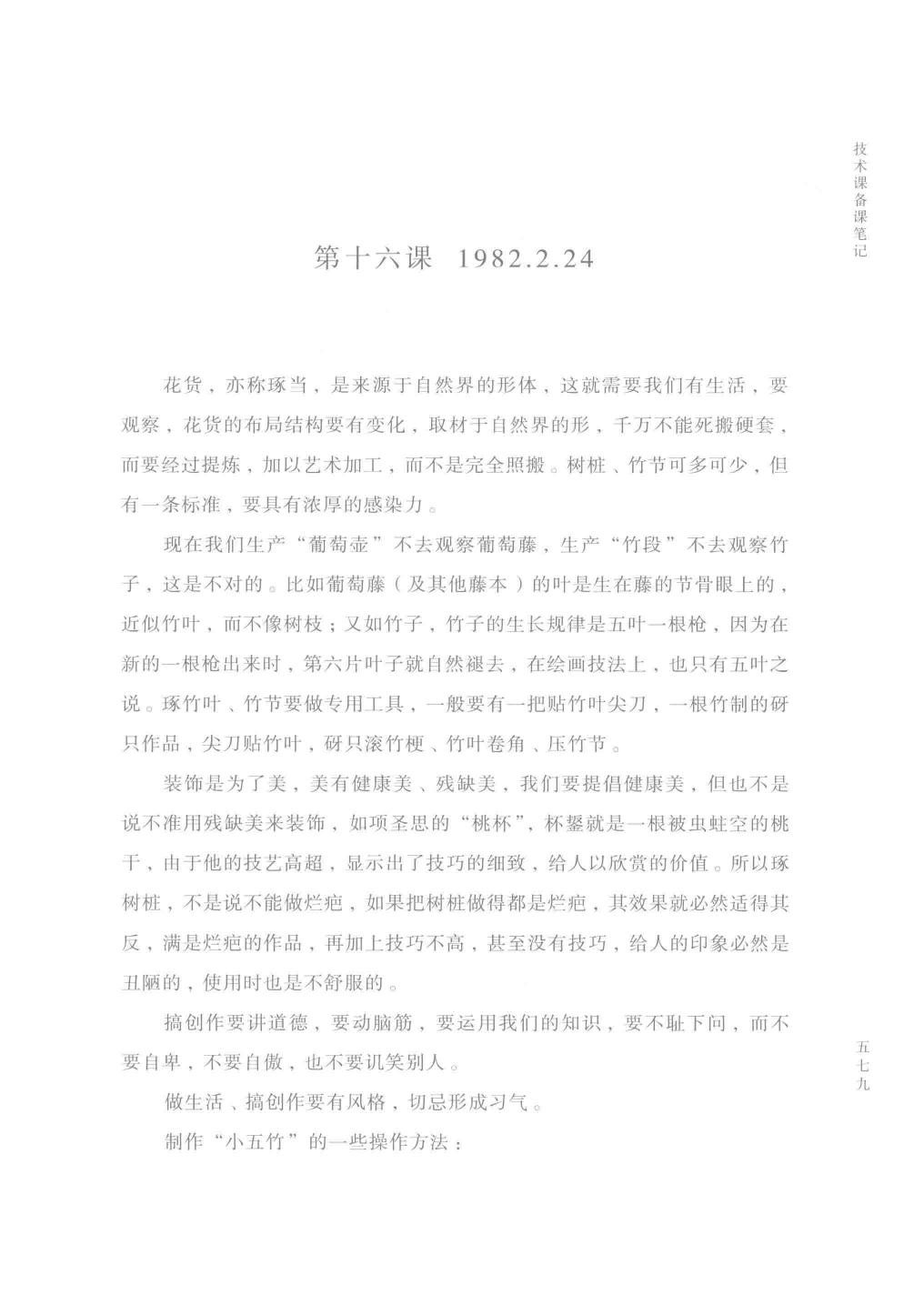
Flower ware, also called *zhuodang*, derives its forms from the natural world. This requires us to have life experience and to observe carefully. The compositional structure of flower ware must have variation. When drawing material from natural forms, we must never mechanically copy them, but rather refine them and apply artistic processing, rather than reproducing them entirely. Tree stumps and bamboo segments can be many or few, but there is one standard: they must possess strong expressive power.
Currently, when we produce "grape teapots," we don't observe grape vines; when we produce "bamboo segments," we don't observe bamboo. This is wrong. For example, the leaves of grape vines (and other vines) grow at the nodes of the vine, similar to bamboo leaves, and not like tree branches. As for bamboo, the growth pattern of bamboo is five leaves to one shoot, because when a new shoot emerges, the sixth leaf naturally falls away. In painting techniques as well, there is only the principle of five leaves. For sculpting bamboo leaves and bamboo segments, specialized tools are needed. Generally, one needs a pointed knife for applying bamboo leaves and a bamboo-made burnishing tool. For a single work, the pointed knife applies the bamboo leaves, while the burnishing tool rolls the bamboo stems, curls the bamboo leaf corners, and presses the bamboo nodes.
Decoration is for the sake of beauty. Beauty includes healthy beauty and imperfect beauty. We should advocate for healthy beauty, but this doesn't mean we cannot use imperfect beauty for decoration. For example, Xiang Sisi's "peach cup"—the cup body is a peach branch hollowed out by insects. Due to his superb skill, he demonstrates meticulous technique, giving people aesthetic value to appreciate. Therefore, when sculpting tree stumps, it's not that we cannot create decayed scars, but if we make tree stumps covered entirely in decay, the effect will inevitably be counterproductive. Works full of scars, combined with poor technique or even no technique at all, will inevitably give people an impression of ugliness and will be uncomfortable to use.
In creative work, we must maintain integrity, use our minds, apply our knowledge, and not be ashamed to ask questions. We should neither feel inferior nor arrogant, nor should we mock others.
In life and creative work, we must have style. We must avoid forming bad habits.
Some operational methods for making "Small Five Bamboo":
[The final line appears to be fragmentary notes or technical instructions that are partially illegible in the original]
Chapter 10
附录
Appendix
Pages 526-651
View Chapter →
English Translation
Flower ware, also called *zhuodang*, derives its forms from the natural world. This requires us to have life experience and to observe carefully. The compositional structure of flower ware must have variation. When drawing material from natural forms, we must never mechanically copy them, but rather refine them and apply artistic processing, rather than reproducing them entirely. Tree stumps and bamboo segments can be many or few, but there is one standard: they must possess strong expressive power.
Currently, when we produce "grape teapots," we don't observe grape vines; when we produce "bamboo segments," we don't observe bamboo. This is wrong. For example, the leaves of grape vines (and other vines) grow at the nodes of the vine, similar to bamboo leaves, and not like tree branches. As for bamboo, the growth pattern of bamboo is five leaves to one shoot, because when a new shoot emerges, the sixth leaf naturally falls away. In painting techniques as well, there is only the principle of five leaves. For sculpting bamboo leaves and bamboo segments, specialized tools are needed. Generally, one needs a pointed knife for applying bamboo leaves and a bamboo-made burnishing tool. For a single work, the pointed knife applies the bamboo leaves, while the burnishing tool rolls the bamboo stems, curls the bamboo leaf corners, and presses the bamboo nodes.
Decoration is for the sake of beauty. Beauty includes healthy beauty and imperfect beauty. We should advocate for healthy beauty, but this doesn't mean we cannot use imperfect beauty for decoration. For example, Xiang Sisi's "peach cup"—the cup body is a peach branch hollowed out by insects. Due to his superb skill, he demonstrates meticulous technique, giving people aesthetic value to appreciate. Therefore, when sculpting tree stumps, it's not that we cannot create decayed scars, but if we make tree stumps covered entirely in decay, the effect will inevitably be counterproductive. Works full of scars, combined with poor technique or even no technique at all, will inevitably give people an impression of ugliness and will be uncomfortable to use.
In creative work, we must maintain integrity, use our minds, apply our knowledge, and not be ashamed to ask questions. We should neither feel inferior nor arrogant, nor should we mock others.
In life and creative work, we must have style. We must avoid forming bad habits.
Some operational methods for making "Small Five Bamboo":
[The final line appears to be fragmentary notes or technical instructions that are partially illegible in the original]
章节导航 Chapter Navigation
Chapter 1
序文
Pages 6-6
Chapter 2
引言
Pages 28-31
Chapter 3
达变
Pages 32-133
Chapter 3
开宗立派
Pages 46-66
Chapter 3
传道授业
Pages 67-98
Chapter 3
大师淳友
Pages 99-120
Chapter 3
学艺谋生
Pages 121-133
Chapter 4
化神
Pages 134-141
Chapter 5
独妙
Pages 142-405
Chapter 5
匠心独运 不苟丝毫
Pages 142-179
Chapter 5
器利善事 物尽其用
Pages 180-199
Chapter 5
紫泥春华 研精究微
Pages 200-405
Chapter 6
驾简
Pages 406-427
Chapter 6
精雕细刻 文质合一
Pages 406-410
Chapter 6
师法自然 妙趣横生
Pages 411-415
Chapter 6
丝来线去 曲尽其妙
Pages 416-427
Chapter 7
明志
Pages 463-485
Chapter 7
高山仰止 淡泊明志
Pages 463-472
Chapter 7
啜墨看茶 气定神闲
Pages 473-478
Chapter 7
齿少心锐 怡志抒情
Pages 479-485
Chapter 8
存真
Pages 428-462
Chapter 8
规圆矩方 弃伪存真
Pages 428-436
Chapter 8
有物有则 钻尖仰高
Pages 437-462
Chapter 9
心营
Pages 506-525
Chapter 9
坚守传统 艺立潮头
Pages 506-513
Chapter 9
新型师承 桃李满园
Pages 514-525
Chapter 10
附录
Pages 526-651
Chapter 10
顾景舟紫艺论文
Pages 526-535
Chapter 10
技术课备课笔记
Pages 536-543
Chapter 10
顾景舟艺术年表
Pages 544-651
Chapter 11
参考文献
Pages 652-657
Chapter 12
鸣谢
Pages 658-659