Chapter 10
附录
Appendix
585
of 659
English Translation
Xia Bu Ling
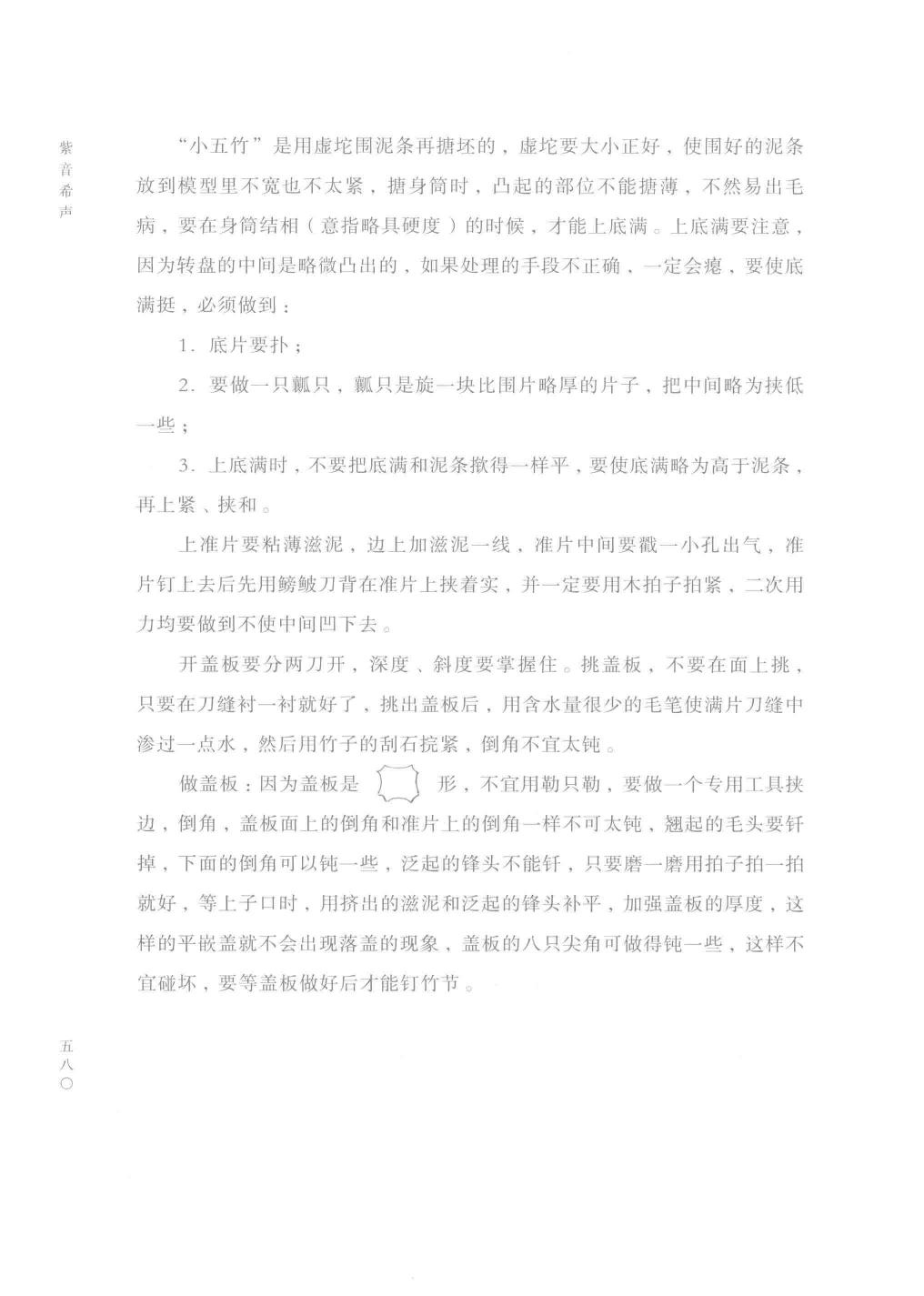
The "Small Five Bamboo" is made by coiling clay strips around a convex mold and then forming the body. The convex mold must be exactly the right size, so that the coiled clay strips placed in the mold are neither too loose nor too tight. When expanding the body cylinder, the protruding areas must not be pressed too thin, otherwise problems will easily occur. The bottom plate should only be attached when the body cylinder has reached the "jie xiang" stage (meaning it has achieved a slight degree of hardness). When attaching the bottom plate, special attention is required, because the center of the turntable is slightly convex. If the technique is not handled correctly, it will certainly warp. To make the bottom plate firm, the following must be achieved:
1. The bottom piece must be flat;
2. A "zhuang zhi" must be made. The zhuang zhi is a piece slightly thicker than the coiled piece, with the center pressed down slightly.
3. When attaching the bottom plate, do not smooth the bottom plate and clay strips to the same level. The bottom plate should be slightly higher than the clay strips, then press tight and smooth together.
When attaching the lid piece, apply thin slip. Add a line of slip around the edge. Pierce a small hole in the center of the lid piece for air release. After the lid piece is attached, first use the back of a fish gill knife to press firmly on the lid piece, and be sure to use a wooden paddle to beat it tight. Both applications of force must ensure that the center does not sink down.
Opening the lid plate should be done in two cuts, with proper control of depth and angle. When lifting the lid plate, do not lift from the surface—simply pry along the knife seam. After removing the lid plate, use a brush with very little water content to let a bit of water seep through the knife seam on the lid piece, then press tight with a bamboo scraping stone. The corners should not be too blunt.
Making the lid plate: Because the lid plate is octagonal in shape, it is not suitable to use a rib tool. A specialized tool should be made to smooth the edges and chamfer the corners. The chamfer on the lid plate surface should be the same as the chamfer on the lid piece—not too blunt. Any raised burrs should be trimmed away. The chamfer on the underside can be somewhat blunter. The raised edges that protrude cannot be trimmed; simply grind them and beat with a paddle. When attaching the mouth rim, use the squeezed-out slip and the raised edges to fill and level, strengthening the thickness of the lid plate. This way, the flush-fitting lid will not experience lid dropping. The eight pointed corners of the lid plate can be made somewhat blunter, so they are less likely to chip. Wait until the lid plate is completed before attaching the bamboo joint.
Chapter 10
附录
Appendix
Pages 526-651
View Chapter →
English Translation
Xia Bu Ling
The "Small Five Bamboo" is made by coiling clay strips around a convex mold and then forming the body. The convex mold must be exactly the right size, so that the coiled clay strips placed in the mold are neither too loose nor too tight. When expanding the body cylinder, the protruding areas must not be pressed too thin, otherwise problems will easily occur. The bottom plate should only be attached when the body cylinder has reached the "jie xiang" stage (meaning it has achieved a slight degree of hardness). When attaching the bottom plate, special attention is required, because the center of the turntable is slightly convex. If the technique is not handled correctly, it will certainly warp. To make the bottom plate firm, the following must be achieved:
1. The bottom piece must be flat;
2. A "zhuang zhi" must be made. The zhuang zhi is a piece slightly thicker than the coiled piece, with the center pressed down slightly.
3. When attaching the bottom plate, do not smooth the bottom plate and clay strips to the same level. The bottom plate should be slightly higher than the clay strips, then press tight and smooth together.
When attaching the lid piece, apply thin slip. Add a line of slip around the edge. Pierce a small hole in the center of the lid piece for air release. After the lid piece is attached, first use the back of a fish gill knife to press firmly on the lid piece, and be sure to use a wooden paddle to beat it tight. Both applications of force must ensure that the center does not sink down.
Opening the lid plate should be done in two cuts, with proper control of depth and angle. When lifting the lid plate, do not lift from the surface—simply pry along the knife seam. After removing the lid plate, use a brush with very little water content to let a bit of water seep through the knife seam on the lid piece, then press tight with a bamboo scraping stone. The corners should not be too blunt.
Making the lid plate: Because the lid plate is octagonal in shape, it is not suitable to use a rib tool. A specialized tool should be made to smooth the edges and chamfer the corners. The chamfer on the lid plate surface should be the same as the chamfer on the lid piece—not too blunt. Any raised burrs should be trimmed away. The chamfer on the underside can be somewhat blunter. The raised edges that protrude cannot be trimmed; simply grind them and beat with a paddle. When attaching the mouth rim, use the squeezed-out slip and the raised edges to fill and level, strengthening the thickness of the lid plate. This way, the flush-fitting lid will not experience lid dropping. The eight pointed corners of the lid plate can be made somewhat blunter, so they are less likely to chip. Wait until the lid plate is completed before attaching the bamboo joint.
章节导航 Chapter Navigation
Chapter 1
序文
Pages 6-6
Chapter 2
引言
Pages 28-31
Chapter 3
达变
Pages 32-133
Chapter 3
开宗立派
Pages 46-66
Chapter 3
传道授业
Pages 67-98
Chapter 3
大师淳友
Pages 99-120
Chapter 3
学艺谋生
Pages 121-133
Chapter 4
化神
Pages 134-141
Chapter 5
独妙
Pages 142-405
Chapter 5
匠心独运 不苟丝毫
Pages 142-179
Chapter 5
器利善事 物尽其用
Pages 180-199
Chapter 5
紫泥春华 研精究微
Pages 200-405
Chapter 6
驾简
Pages 406-427
Chapter 6
精雕细刻 文质合一
Pages 406-410
Chapter 6
师法自然 妙趣横生
Pages 411-415
Chapter 6
丝来线去 曲尽其妙
Pages 416-427
Chapter 7
明志
Pages 463-485
Chapter 7
高山仰止 淡泊明志
Pages 463-472
Chapter 7
啜墨看茶 气定神闲
Pages 473-478
Chapter 7
齿少心锐 怡志抒情
Pages 479-485
Chapter 8
存真
Pages 428-462
Chapter 8
规圆矩方 弃伪存真
Pages 428-436
Chapter 8
有物有则 钻尖仰高
Pages 437-462
Chapter 9
心营
Pages 506-525
Chapter 9
坚守传统 艺立潮头
Pages 506-513
Chapter 9
新型师承 桃李满园
Pages 514-525
Chapter 10
附录
Pages 526-651
Chapter 10
顾景舟紫艺论文
Pages 526-535
Chapter 10
技术课备课笔记
Pages 536-543
Chapter 10
顾景舟艺术年表
Pages 544-651
Chapter 11
参考文献
Pages 652-657
Chapter 12
鸣谢
Pages 658-659