Chapter 10
附录
Appendix
592
of 659
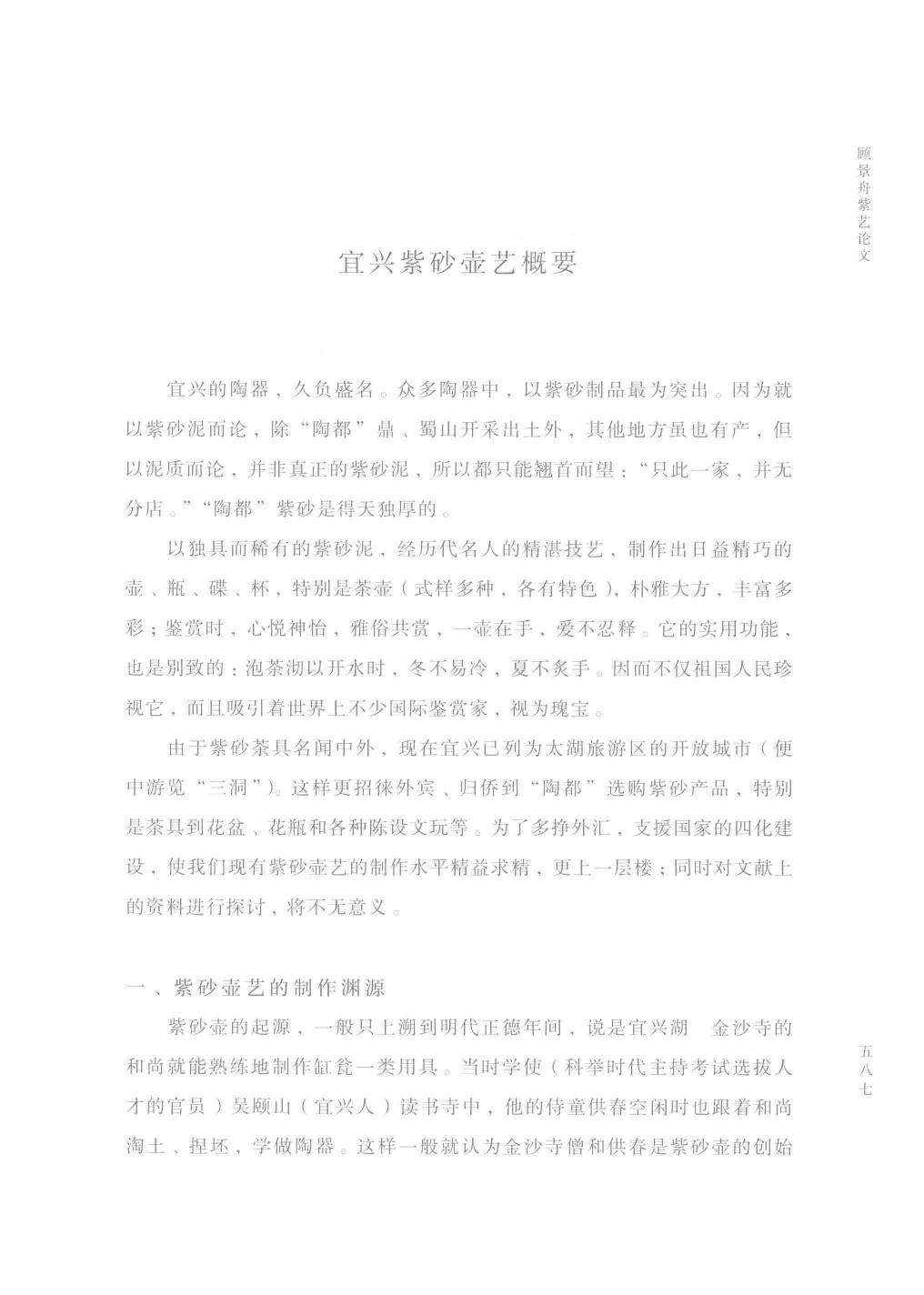
English Translation
Yixing pottery has long enjoyed a distinguished reputation. Among the many types of pottery, purple clay (*zisha*) products stand out most prominently. This is because, in terms of purple clay itself, apart from what is excavated and produced in the "Pottery Capital" of Yixing and its Dingshu Mountain, although other places also have some production, when judged by the quality of the clay, it is not truly authentic purple clay. Therefore, they can only look on with envy: "This is the one and only, with no branches elsewhere." The purple clay of the "Pottery Capital" is truly blessed by nature.
Using this unique and rare purple clay, through the exquisite craftsmanship of famous artisans throughout the ages, increasingly refined teapots, vases, dishes, and cups have been created. Particularly the teapots (with many styles, each with its own characteristics) are elegant and generous in their simplicity, rich and varied. When appreciating them, one feels delighted in heart and spirit—both refined scholars and common folk can appreciate them alike. With a teapot in hand, one cannot bear to put it down. Its practical function is distinctive: when brewing tea and pouring boiling water, in winter it does not easily cool, and in summer it does not burn the hand. Therefore, not only do the people of our motherland cherish it, but it also attracts many international connoisseurs from around the world, who regard it as a treasure.
Because purple clay tea ware is renowned both in China and abroad, Yixing has now been designated as an open city in the Taihu Lake tourism area (facilitating tours of the "Three Caves"). This further attracts overseas Chinese and returned overseas Chinese to the "Pottery Capital" to purchase purple clay products, especially tea ware, flower pots, vases, and various ornamental objects and scholarly items. In order to earn more foreign exchange and support the nation's Four Modernizations construction, we must refine the current production standards of purple clay teapot craftsmanship to an even higher level of excellence. At the same time, exploring the materials in historical documents will not be without significance.
## I. The Origins of Purple Clay Teapot Craftsmanship
The origins of purple clay teapots are generally traced back only to the Zhengde period of the Ming Dynasty. It is said that a monk at Jinsha Temple by the lake in Yixing was already skilled at making teapots and similar utensils. At that time, the Provincial Education Commissioner (an official who presided over examinations and selected talented individuals during the imperial examination era), Wu Yishan (a native of Yixing), was studying in the temple. His servant, Gong Chun, also followed the monk in his spare time to process clay, knead it, and learn to make pottery. Thus, it has been believed that the Jinsha Temple monk and Gong Chun were the founders of purple clay teapots.
Chapter 10
附录
Appendix
Pages 526-651
View Chapter →
English Translation
Yixing pottery has long enjoyed a distinguished reputation. Among the many types of pottery, purple clay (*zisha*) products stand out most prominently. This is because, in terms of purple clay itself, apart from what is excavated and produced in the "Pottery Capital" of Yixing and its Dingshu Mountain, although other places also have some production, when judged by the quality of the clay, it is not truly authentic purple clay. Therefore, they can only look on with envy: "This is the one and only, with no branches elsewhere." The purple clay of the "Pottery Capital" is truly blessed by nature.
Using this unique and rare purple clay, through the exquisite craftsmanship of famous artisans throughout the ages, increasingly refined teapots, vases, dishes, and cups have been created. Particularly the teapots (with many styles, each with its own characteristics) are elegant and generous in their simplicity, rich and varied. When appreciating them, one feels delighted in heart and spirit—both refined scholars and common folk can appreciate them alike. With a teapot in hand, one cannot bear to put it down. Its practical function is distinctive: when brewing tea and pouring boiling water, in winter it does not easily cool, and in summer it does not burn the hand. Therefore, not only do the people of our motherland cherish it, but it also attracts many international connoisseurs from around the world, who regard it as a treasure.
Because purple clay tea ware is renowned both in China and abroad, Yixing has now been designated as an open city in the Taihu Lake tourism area (facilitating tours of the "Three Caves"). This further attracts overseas Chinese and returned overseas Chinese to the "Pottery Capital" to purchase purple clay products, especially tea ware, flower pots, vases, and various ornamental objects and scholarly items. In order to earn more foreign exchange and support the nation's Four Modernizations construction, we must refine the current production standards of purple clay teapot craftsmanship to an even higher level of excellence. At the same time, exploring the materials in historical documents will not be without significance.
## I. The Origins of Purple Clay Teapot Craftsmanship
The origins of purple clay teapots are generally traced back only to the Zhengde period of the Ming Dynasty. It is said that a monk at Jinsha Temple by the lake in Yixing was already skilled at making teapots and similar utensils. At that time, the Provincial Education Commissioner (an official who presided over examinations and selected talented individuals during the imperial examination era), Wu Yishan (a native of Yixing), was studying in the temple. His servant, Gong Chun, also followed the monk in his spare time to process clay, knead it, and learn to make pottery. Thus, it has been believed that the Jinsha Temple monk and Gong Chun were the founders of purple clay teapots.
章节导航 Chapter Navigation
Chapter 1
序文
Pages 6-6
Chapter 2
引言
Pages 28-31
Chapter 3
达变
Pages 32-133
Chapter 3
开宗立派
Pages 46-66
Chapter 3
传道授业
Pages 67-98
Chapter 3
大师淳友
Pages 99-120
Chapter 3
学艺谋生
Pages 121-133
Chapter 4
化神
Pages 134-141
Chapter 5
独妙
Pages 142-405
Chapter 5
匠心独运 不苟丝毫
Pages 142-179
Chapter 5
器利善事 物尽其用
Pages 180-199
Chapter 5
紫泥春华 研精究微
Pages 200-405
Chapter 6
驾简
Pages 406-427
Chapter 6
精雕细刻 文质合一
Pages 406-410
Chapter 6
师法自然 妙趣横生
Pages 411-415
Chapter 6
丝来线去 曲尽其妙
Pages 416-427
Chapter 7
明志
Pages 463-485
Chapter 7
高山仰止 淡泊明志
Pages 463-472
Chapter 7
啜墨看茶 气定神闲
Pages 473-478
Chapter 7
齿少心锐 怡志抒情
Pages 479-485
Chapter 8
存真
Pages 428-462
Chapter 8
规圆矩方 弃伪存真
Pages 428-436
Chapter 8
有物有则 钻尖仰高
Pages 437-462
Chapter 9
心营
Pages 506-525
Chapter 9
坚守传统 艺立潮头
Pages 506-513
Chapter 9
新型师承 桃李满园
Pages 514-525
Chapter 10
附录
Pages 526-651
Chapter 10
顾景舟紫艺论文
Pages 526-535
Chapter 10
技术课备课笔记
Pages 536-543
Chapter 10
顾景舟艺术年表
Pages 544-651
Chapter 11
参考文献
Pages 652-657
Chapter 12
鸣谢
Pages 658-659