Chapter 10
附录
Appendix
593
of 659
English Translation
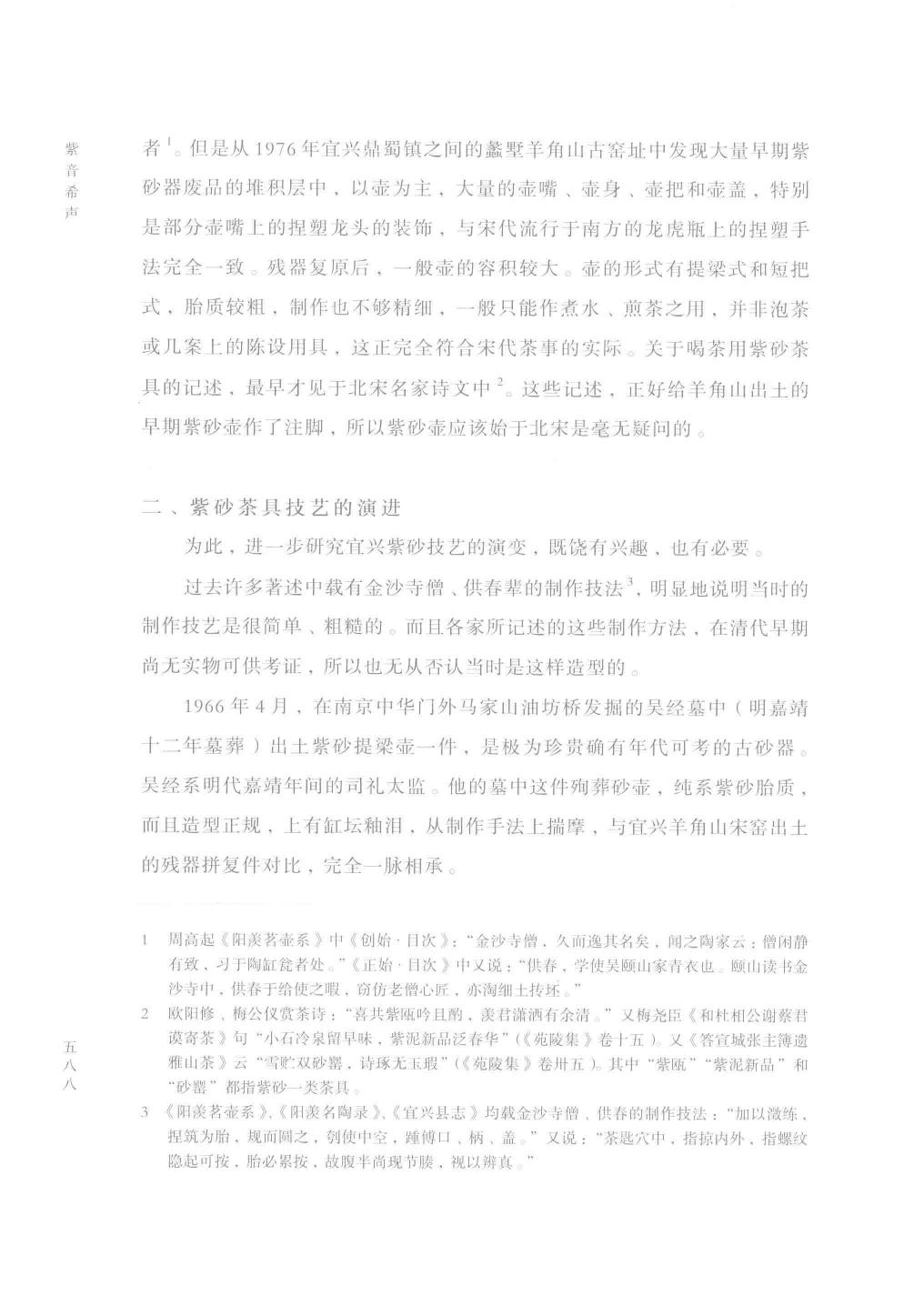
However, from the accumulation layers of large quantities of early zisha waste products discovered in 1976 at the ancient kiln site of Yangjiao Mountain in Huangdu Town, Yixing, with teapots as the main items—numerous spouts, bodies, handles, and lids, and particularly the molded dragon head decorations on some of the spouts—the molding techniques are completely consistent with those on the dragon-tiger tiles popular in southern China during the Song Dynasty. After restoration of the fragments, the capacity of the pots was generally quite large. The forms of the pots included lifting-handle style and short-handle style. The clay body was relatively coarse, and the craftsmanship was not sufficiently refined. Generally, they could only be used for boiling water or brewing coarse tea, and were not teapots for brewing fine tea or display vessels for tables and desks. This completely accords with the actual tea practices of the Song Dynasty. The earliest records of drinking tea using zisha tea wares are found in the poetry and prose of various Northern Song authors[1]. These records provide perfect annotations for the early zisha wares unearthed at Yangjiao Mountain, so there is no doubt that zisha pottery should have originated in the Northern Song Dynasty.
## II. The Evolution of Zisha Tea Ware Techniques
For this reason, further research into the evolution of Yixing zisha techniques is both interesting and necessary.
Many past writings record the production techniques of the monk of Jinsha Temple, Gong Chun, and others, clearly indicating that the production techniques of that time were very simple and crude. Moreover, the production methods recorded by various sources had no actual objects available for verification in the early Qing Dynasty, so there was no way to deny that such forms were made at that time.
In April 1966, a zisha lifting-handle pot was excavated from the tomb of Wu Jing at Youfangqiao, Majia Mountain, outside Zhonghua Gate in Nanjing (a tomb from the 12th year of the Jiajing reign of the Ming Dynasty). This is an extremely precious zisha vessel with a verifiable date. Wu Jing was a Supervisor of Ceremonies eunuch during the Jiajing period of the Ming Dynasty. This burial zisha pot from his tomb is made of pure purple clay body, and moreover, the form is regular, with glaze spots on top. Judging from the production technique and comparing it with the restored fragments of vessels unearthed from the Song kiln at Yangjiao Mountain in Yixing, they are completely in the same lineage.
---
[1] Zhou Gaoqi's *Yangxian Ming Hu Xi* states in "Chuangshi" (Origins): "In Jinsha, there was a monk skilled in pottery who lived in seclusion." In "Zhengshi" (Orthodox Beginnings), it also mentions: "In the temple, Gong Chun, while serving his master, secretly admired the old monk's devotion and also kneaded fine clay to make vessels." Ouyang Xiu and Mei Gongyi's tea appreciation poems include: "The purple clay pot is used for pouring, the remaining clarity still has lingering fragrance." Also, Mei Yaochen's "Harmonizing with the Prime Minister's Thanks for Tea Sent by Lord Cai" contains the line: "Small stone cold spring retains the true flavor, purple clay new vessel floats with spring splendor" (*Wanling Collection*, Volume 15). Also in "Reply to Zhang Zhude of Xuancheng Who Sent Tea": "Snow stored in purple clay pot, poetry carved without jade flaw" (*Wanling Collection*, Volume 15). The terms "purple pot," "purple clay new vessel," and "purple clay pot" all refer to zisha-type tea wares.
[2] *Yangxian Ming Hu Xi*, *Yangxian Ming Tao Lu*, and *Yixing County Gazetteer* all record that the monk of Jinsha Temple and Gong Chun's production techniques were: "Kneading and molding the clay body, shaping it round, making the interior hollow, then attaching the spout, handle, and lid." It also states: "The raised parts can be pressed. The body must be built up by pressing, so the belly still shows joint marks when half-finished, which can be used to distinguish authenticity." The monk lived in seclusion, and later his name was lost. The pottery makers said: "The monk was quiet and reclusive. Gong Chun was the servant of Scholar Wu Yishan. Yishan studied at Jinsha Temple, and Gong Chun, while attending to his duties, secretly admired the old monk and also kneaded fine clay to make vessels." "After refining and practicing, pointing and scraping inside and outside, fingerprint spiral patterns are hidden and raised."
Chapter 10
附录
Appendix
Pages 526-651
View Chapter →
English Translation
However, from the accumulation layers of large quantities of early zisha waste products discovered in 1976 at the ancient kiln site of Yangjiao Mountain in Huangdu Town, Yixing, with teapots as the main items—numerous spouts, bodies, handles, and lids, and particularly the molded dragon head decorations on some of the spouts—the molding techniques are completely consistent with those on the dragon-tiger tiles popular in southern China during the Song Dynasty. After restoration of the fragments, the capacity of the pots was generally quite large. The forms of the pots included lifting-handle style and short-handle style. The clay body was relatively coarse, and the craftsmanship was not sufficiently refined. Generally, they could only be used for boiling water or brewing coarse tea, and were not teapots for brewing fine tea or display vessels for tables and desks. This completely accords with the actual tea practices of the Song Dynasty. The earliest records of drinking tea using zisha tea wares are found in the poetry and prose of various Northern Song authors[1]. These records provide perfect annotations for the early zisha wares unearthed at Yangjiao Mountain, so there is no doubt that zisha pottery should have originated in the Northern Song Dynasty.
## II. The Evolution of Zisha Tea Ware Techniques
For this reason, further research into the evolution of Yixing zisha techniques is both interesting and necessary.
Many past writings record the production techniques of the monk of Jinsha Temple, Gong Chun, and others, clearly indicating that the production techniques of that time were very simple and crude. Moreover, the production methods recorded by various sources had no actual objects available for verification in the early Qing Dynasty, so there was no way to deny that such forms were made at that time.
In April 1966, a zisha lifting-handle pot was excavated from the tomb of Wu Jing at Youfangqiao, Majia Mountain, outside Zhonghua Gate in Nanjing (a tomb from the 12th year of the Jiajing reign of the Ming Dynasty). This is an extremely precious zisha vessel with a verifiable date. Wu Jing was a Supervisor of Ceremonies eunuch during the Jiajing period of the Ming Dynasty. This burial zisha pot from his tomb is made of pure purple clay body, and moreover, the form is regular, with glaze spots on top. Judging from the production technique and comparing it with the restored fragments of vessels unearthed from the Song kiln at Yangjiao Mountain in Yixing, they are completely in the same lineage.
---
[1] Zhou Gaoqi's *Yangxian Ming Hu Xi* states in "Chuangshi" (Origins): "In Jinsha, there was a monk skilled in pottery who lived in seclusion." In "Zhengshi" (Orthodox Beginnings), it also mentions: "In the temple, Gong Chun, while serving his master, secretly admired the old monk's devotion and also kneaded fine clay to make vessels." Ouyang Xiu and Mei Gongyi's tea appreciation poems include: "The purple clay pot is used for pouring, the remaining clarity still has lingering fragrance." Also, Mei Yaochen's "Harmonizing with the Prime Minister's Thanks for Tea Sent by Lord Cai" contains the line: "Small stone cold spring retains the true flavor, purple clay new vessel floats with spring splendor" (*Wanling Collection*, Volume 15). Also in "Reply to Zhang Zhude of Xuancheng Who Sent Tea": "Snow stored in purple clay pot, poetry carved without jade flaw" (*Wanling Collection*, Volume 15). The terms "purple pot," "purple clay new vessel," and "purple clay pot" all refer to zisha-type tea wares.
[2] *Yangxian Ming Hu Xi*, *Yangxian Ming Tao Lu*, and *Yixing County Gazetteer* all record that the monk of Jinsha Temple and Gong Chun's production techniques were: "Kneading and molding the clay body, shaping it round, making the interior hollow, then attaching the spout, handle, and lid." It also states: "The raised parts can be pressed. The body must be built up by pressing, so the belly still shows joint marks when half-finished, which can be used to distinguish authenticity." The monk lived in seclusion, and later his name was lost. The pottery makers said: "The monk was quiet and reclusive. Gong Chun was the servant of Scholar Wu Yishan. Yishan studied at Jinsha Temple, and Gong Chun, while attending to his duties, secretly admired the old monk and also kneaded fine clay to make vessels." "After refining and practicing, pointing and scraping inside and outside, fingerprint spiral patterns are hidden and raised."
章节导航 Chapter Navigation
Chapter 1
序文
Pages 6-6
Chapter 2
引言
Pages 28-31
Chapter 3
达变
Pages 32-133
Chapter 3
开宗立派
Pages 46-66
Chapter 3
传道授业
Pages 67-98
Chapter 3
大师淳友
Pages 99-120
Chapter 3
学艺谋生
Pages 121-133
Chapter 4
化神
Pages 134-141
Chapter 5
独妙
Pages 142-405
Chapter 5
匠心独运 不苟丝毫
Pages 142-179
Chapter 5
器利善事 物尽其用
Pages 180-199
Chapter 5
紫泥春华 研精究微
Pages 200-405
Chapter 6
驾简
Pages 406-427
Chapter 6
精雕细刻 文质合一
Pages 406-410
Chapter 6
师法自然 妙趣横生
Pages 411-415
Chapter 6
丝来线去 曲尽其妙
Pages 416-427
Chapter 7
明志
Pages 463-485
Chapter 7
高山仰止 淡泊明志
Pages 463-472
Chapter 7
啜墨看茶 气定神闲
Pages 473-478
Chapter 7
齿少心锐 怡志抒情
Pages 479-485
Chapter 8
存真
Pages 428-462
Chapter 8
规圆矩方 弃伪存真
Pages 428-436
Chapter 8
有物有则 钻尖仰高
Pages 437-462
Chapter 9
心营
Pages 506-525
Chapter 9
坚守传统 艺立潮头
Pages 506-513
Chapter 9
新型师承 桃李满园
Pages 514-525
Chapter 10
附录
Pages 526-651
Chapter 10
顾景舟紫艺论文
Pages 526-535
Chapter 10
技术课备课笔记
Pages 536-543
Chapter 10
顾景舟艺术年表
Pages 544-651
Chapter 11
参考文献
Pages 652-657
Chapter 12
鸣谢
Pages 658-659