Chapter 10
附录
Appendix
601
of 659
English Translation
## Originating from Daily Life, Coming from the Folk
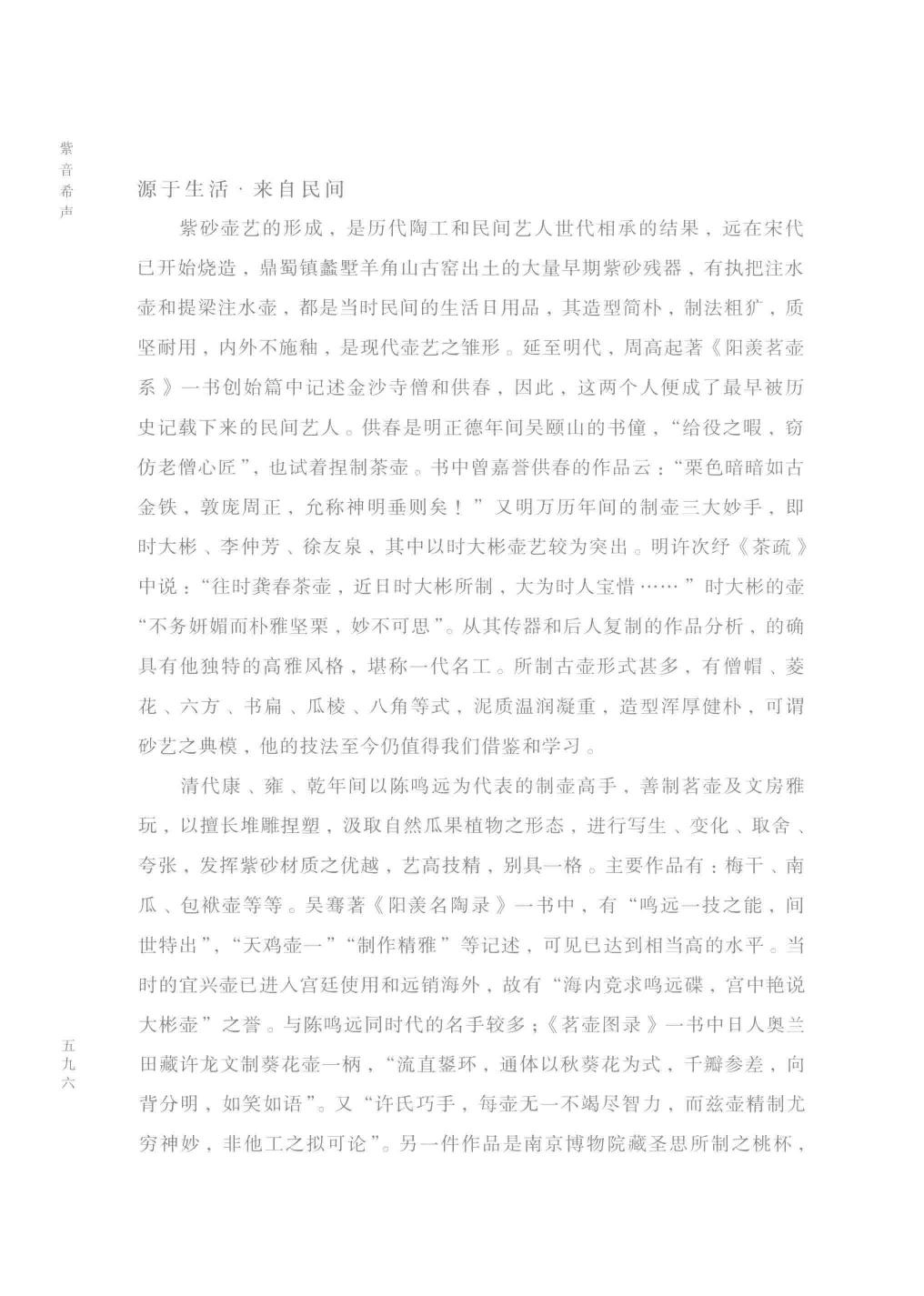
The formation of Yixing purple clay teapot art is the result of generations of potters and folk artisans passing down their craft through the ages. As early as the Song Dynasty, production had already begun. A large number of early purple clay fragments excavated from the ancient kiln site at Yangjiao Mountain in Zhishu, Dingshu Town, include handled water pitchers and handled water vessels with lifting beams. These were all everyday household items used by common people at the time. Their forms were simple and unpretentious, their construction methods crude yet durable, their quality solid and long-lasting. Unglazed both inside and out, they represent the embryonic form of modern teapot art. Extending into the Ming Dynasty, Zhou Gaoqi's book *Yangxian Minghu Xi* records in its founding chapter the monk of Jinsha Temple and Gong Chun. Thus, these two individuals became the earliest folk artisans recorded in history. Gong Chun was the book servant of Wu Yishan during the Zhengde reign of the Ming Dynasty. "While serving in his duties, he secretly imitated the old monk's craftsmanship" and also attempted to fashion teapots. The book praises Gong Chun's works, saying: "The chestnut color is dark and somber like ancient bronze, solid and upright in form—truly worthy of being called divinely inspired!" During the Wanli reign of the Ming Dynasty, there were three great masters of pottery making: Shi Dabin, Li Zhongfang, and Xu Youquan, among whom Shi Dabin's teapot artistry was particularly outstanding. Ming Dynasty writer Xu Cishu wrote in *Cha Shu*: "In former times there were Gong Chun's teapots; in recent days those made by Shi Dabin are greatly treasured as rarities by people of the time..." Shi Dabin's teapots were "not concerned with prettiness but rather simple, elegant, solid, and refined—wonderfully beyond conception." Analyzing his surviving works and later reproductions, they indeed possess his unique elegant style, worthy of being called a master craftsman of his generation. He created many ancient teapot forms, including monk's cap, imitation flower, hexagonal, folding fan, melon-ribbed, and octagonal styles. The clay quality was warm, moist, and substantial; the forms were robust, sturdy, and simple—truly exemplary models of purple clay art. His techniques remain worthy of our study and emulation to this day.
During the Kangxi, Yongzheng, and Qianlong reigns of the Qing Dynasty, master teapot makers represented by Chen Mingyuan excelled at creating teapots and elegant scholar's desk objects. Skilled in relief molding and sculptural techniques, they drew upon the forms of natural melons, fruits, and plants, engaging in sketching from life, transformation, synthesis, and exaggeration, fully exploiting the superior qualities of purple clay material with high artistry and refined technique in a distinctive style. Major works include: plum trunk, pumpkin, and Baorong teapots, among others. Wu Mei's book *Yangxian Ming Tao Lu* contains such descriptions as "Mingyuan's singular skill stands out remarkably" and "the Tianji teapot" was "crafted with refined elegance," indicating that a considerably high level had been achieved. At that time, Yixing teapots had entered the imperial court for use and were exported overseas, hence the praise: "Throughout the realm people compete to acquire Mingyuan's碟, while in the palace they speak admiringly of Dabin's teapots." There were many renowned craftsmen contemporary with Chen Mingyuan. In the book *Minghu Tulu*, the Japanese collector Okuran records a sunflower teapot made by Xu Longwen: "The spout is straight, the handle curved, the entire body fashioned in the form of an autumn sunflower, with stems and leaves arranged in varied heights, the veins clearly defined on front and back, as if smiling, as if speaking." Furthermore, "Master Xu's skillful hands—every teapot exhausts his intelligence and strength, while his imitation teapots are crafted with exquisite refinement and endless divine subtlety, not to be compared with the work of other craftsmen." Another work is the peach cup made by Sheng Si, housed in the Nanjing Museum.
Chapter 10
附录
Appendix
Pages 526-651
View Chapter →
English Translation
## Originating from Daily Life, Coming from the Folk
The formation of Yixing purple clay teapot art is the result of generations of potters and folk artisans passing down their craft through the ages. As early as the Song Dynasty, production had already begun. A large number of early purple clay fragments excavated from the ancient kiln site at Yangjiao Mountain in Zhishu, Dingshu Town, include handled water pitchers and handled water vessels with lifting beams. These were all everyday household items used by common people at the time. Their forms were simple and unpretentious, their construction methods crude yet durable, their quality solid and long-lasting. Unglazed both inside and out, they represent the embryonic form of modern teapot art. Extending into the Ming Dynasty, Zhou Gaoqi's book *Yangxian Minghu Xi* records in its founding chapter the monk of Jinsha Temple and Gong Chun. Thus, these two individuals became the earliest folk artisans recorded in history. Gong Chun was the book servant of Wu Yishan during the Zhengde reign of the Ming Dynasty. "While serving in his duties, he secretly imitated the old monk's craftsmanship" and also attempted to fashion teapots. The book praises Gong Chun's works, saying: "The chestnut color is dark and somber like ancient bronze, solid and upright in form—truly worthy of being called divinely inspired!" During the Wanli reign of the Ming Dynasty, there were three great masters of pottery making: Shi Dabin, Li Zhongfang, and Xu Youquan, among whom Shi Dabin's teapot artistry was particularly outstanding. Ming Dynasty writer Xu Cishu wrote in *Cha Shu*: "In former times there were Gong Chun's teapots; in recent days those made by Shi Dabin are greatly treasured as rarities by people of the time..." Shi Dabin's teapots were "not concerned with prettiness but rather simple, elegant, solid, and refined—wonderfully beyond conception." Analyzing his surviving works and later reproductions, they indeed possess his unique elegant style, worthy of being called a master craftsman of his generation. He created many ancient teapot forms, including monk's cap, imitation flower, hexagonal, folding fan, melon-ribbed, and octagonal styles. The clay quality was warm, moist, and substantial; the forms were robust, sturdy, and simple—truly exemplary models of purple clay art. His techniques remain worthy of our study and emulation to this day.
During the Kangxi, Yongzheng, and Qianlong reigns of the Qing Dynasty, master teapot makers represented by Chen Mingyuan excelled at creating teapots and elegant scholar's desk objects. Skilled in relief molding and sculptural techniques, they drew upon the forms of natural melons, fruits, and plants, engaging in sketching from life, transformation, synthesis, and exaggeration, fully exploiting the superior qualities of purple clay material with high artistry and refined technique in a distinctive style. Major works include: plum trunk, pumpkin, and Baorong teapots, among others. Wu Mei's book *Yangxian Ming Tao Lu* contains such descriptions as "Mingyuan's singular skill stands out remarkably" and "the Tianji teapot" was "crafted with refined elegance," indicating that a considerably high level had been achieved. At that time, Yixing teapots had entered the imperial court for use and were exported overseas, hence the praise: "Throughout the realm people compete to acquire Mingyuan's碟, while in the palace they speak admiringly of Dabin's teapots." There were many renowned craftsmen contemporary with Chen Mingyuan. In the book *Minghu Tulu*, the Japanese collector Okuran records a sunflower teapot made by Xu Longwen: "The spout is straight, the handle curved, the entire body fashioned in the form of an autumn sunflower, with stems and leaves arranged in varied heights, the veins clearly defined on front and back, as if smiling, as if speaking." Furthermore, "Master Xu's skillful hands—every teapot exhausts his intelligence and strength, while his imitation teapots are crafted with exquisite refinement and endless divine subtlety, not to be compared with the work of other craftsmen." Another work is the peach cup made by Sheng Si, housed in the Nanjing Museum.
章节导航 Chapter Navigation
Chapter 1
序文
Pages 6-6
Chapter 2
引言
Pages 28-31
Chapter 3
达变
Pages 32-133
Chapter 3
开宗立派
Pages 46-66
Chapter 3
传道授业
Pages 67-98
Chapter 3
大师淳友
Pages 99-120
Chapter 3
学艺谋生
Pages 121-133
Chapter 4
化神
Pages 134-141
Chapter 5
独妙
Pages 142-405
Chapter 5
匠心独运 不苟丝毫
Pages 142-179
Chapter 5
器利善事 物尽其用
Pages 180-199
Chapter 5
紫泥春华 研精究微
Pages 200-405
Chapter 6
驾简
Pages 406-427
Chapter 6
精雕细刻 文质合一
Pages 406-410
Chapter 6
师法自然 妙趣横生
Pages 411-415
Chapter 6
丝来线去 曲尽其妙
Pages 416-427
Chapter 7
明志
Pages 463-485
Chapter 7
高山仰止 淡泊明志
Pages 463-472
Chapter 7
啜墨看茶 气定神闲
Pages 473-478
Chapter 7
齿少心锐 怡志抒情
Pages 479-485
Chapter 8
存真
Pages 428-462
Chapter 8
规圆矩方 弃伪存真
Pages 428-436
Chapter 8
有物有则 钻尖仰高
Pages 437-462
Chapter 9
心营
Pages 506-525
Chapter 9
坚守传统 艺立潮头
Pages 506-513
Chapter 9
新型师承 桃李满园
Pages 514-525
Chapter 10
附录
Pages 526-651
Chapter 10
顾景舟紫艺论文
Pages 526-535
Chapter 10
技术课备课笔记
Pages 536-543
Chapter 10
顾景舟艺术年表
Pages 544-651
Chapter 11
参考文献
Pages 652-657
Chapter 12
鸣谢
Pages 658-659