Chapter 10
附录
Appendix
602
of 659
English Translation
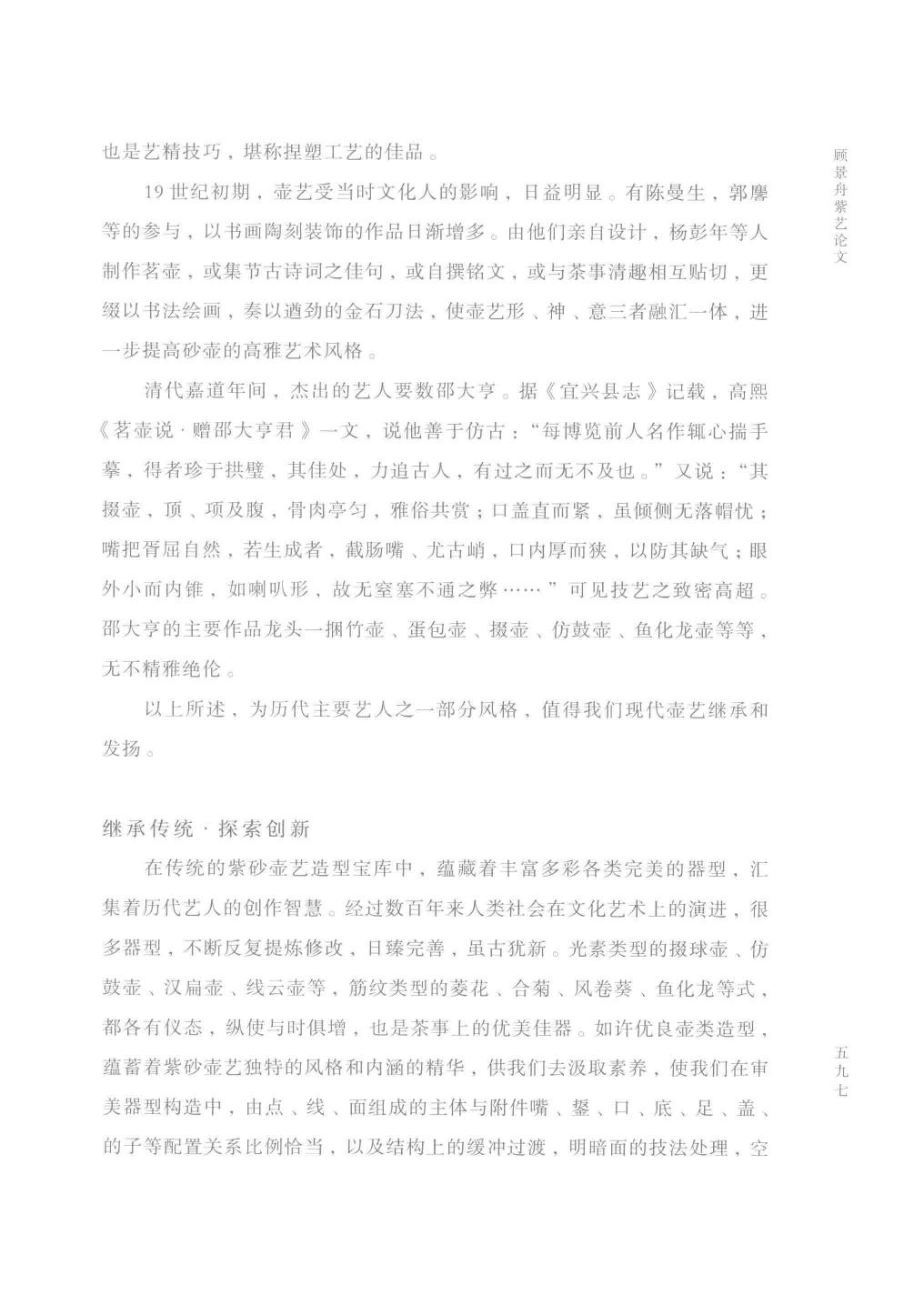
They are also exquisite in technique and skill, worthy of being called masterpieces of molding craftsmanship.
In the early 19th century, the art of teapot making was increasingly influenced by the literati of the time. With the participation of Chen Mansheng, Guo Malin, and others, works decorated with calligraphy, painting, and ceramic carving became more prevalent. They personally designed pieces that were then crafted by Yang Pengnian and others, either selecting elegant names from ancient poetry, composing their own inscriptions, or creating themes that harmonized with the refined pleasures of tea culture. Combined with calligraphy and painting, and executed with vigorous seal-carving knife techniques, these works integrated form, spirit, and meaning into a unified whole, further elevating the elegant artistic style of Yixing teapots.
During the Jiaqing and Daoguang periods of the Qing Dynasty, the most outstanding artisan was Shao Daheng. According to the *Yixing County Gazetteer*, Gao Xi's essay "On Teapots: A Gift to Mr. Shao Daheng" states that he excelled at imitating ancient works: "He extensively studied famous works of predecessors, carefully contemplating and copying them by hand. What he obtained was treasured like precious jade, and in their finest qualities, his works pursued the ancients, surpassing them rather than falling short." The text further notes: "His handles, lids, necks, and bodies are well-proportioned in structure, appreciated by both refined and common tastes; the mouth and lid fit straight and tight, so that even when tilted there is no worry of the lid falling off; the spout and handle curve naturally, as if formed by nature. The cut spout is especially ancient and elegant, thick and narrow inside the mouth to prevent air leakage; the spout is small on the outside but conical inside, shaped like a trumpet, thus avoiding the problem of blockage..." This demonstrates his meticulous and superior craftsmanship. Shao Daheng's major works include the Dragon Head Bamboo Teapot, Egg-Wrapped Teapot, Tilted Teapot, Imitation Drum Teapot, Fish Transforming into Dragon Teapot, and others, all of which are exquisitely refined and unparalleled.
The above describes a portion of the styles of major artisans throughout history, worthy of our modern teapot artists' inheritance and development.
## Inheriting Tradition, Exploring Innovation
In the treasure house of traditional Yixing teapot art forms, there lies a rich and diverse collection of perfect vessel types, gathering the creative wisdom of artisans through the ages. Through hundreds of years of evolution in human society's cultural and artistic development, many vessel forms have been continuously refined and modified through repeated iterations, becoming increasingly perfected, remaining fresh despite their antiquity. Smooth-type forms such as the Tilted Ball Teapot, Imitation Drum Teapot, Han Flat Teapot, and Xian Yun Teapot, as well as ribbed-type forms such as the Chrysanthemum Petal, Lotus Chrysanthemum, Wind-Rolled Sunflower, and Fish Transforming into Dragon styles, each possess their own distinctive character. Even as time passes, they remain beautiful and excellent vessels for tea. Such superior teapot forms embody the unique style and essential spirit of Yixing teapot art, providing us with nourishment to absorb. In our aesthetic approach to form construction, they guide us in the proper proportional relationships between the main body composed of points, lines, and planes, and the attached components of spout, handle, mouth, base, foot, lid, and knob, as well as in the transitional buffering of structure, the technical treatment of light and shadow surfaces, and spatial...
[Note: The text appears to be incomplete at the end]
Chapter 10
附录
Appendix
Pages 526-651
View Chapter →
English Translation
They are also exquisite in technique and skill, worthy of being called masterpieces of molding craftsmanship.
In the early 19th century, the art of teapot making was increasingly influenced by the literati of the time. With the participation of Chen Mansheng, Guo Malin, and others, works decorated with calligraphy, painting, and ceramic carving became more prevalent. They personally designed pieces that were then crafted by Yang Pengnian and others, either selecting elegant names from ancient poetry, composing their own inscriptions, or creating themes that harmonized with the refined pleasures of tea culture. Combined with calligraphy and painting, and executed with vigorous seal-carving knife techniques, these works integrated form, spirit, and meaning into a unified whole, further elevating the elegant artistic style of Yixing teapots.
During the Jiaqing and Daoguang periods of the Qing Dynasty, the most outstanding artisan was Shao Daheng. According to the *Yixing County Gazetteer*, Gao Xi's essay "On Teapots: A Gift to Mr. Shao Daheng" states that he excelled at imitating ancient works: "He extensively studied famous works of predecessors, carefully contemplating and copying them by hand. What he obtained was treasured like precious jade, and in their finest qualities, his works pursued the ancients, surpassing them rather than falling short." The text further notes: "His handles, lids, necks, and bodies are well-proportioned in structure, appreciated by both refined and common tastes; the mouth and lid fit straight and tight, so that even when tilted there is no worry of the lid falling off; the spout and handle curve naturally, as if formed by nature. The cut spout is especially ancient and elegant, thick and narrow inside the mouth to prevent air leakage; the spout is small on the outside but conical inside, shaped like a trumpet, thus avoiding the problem of blockage..." This demonstrates his meticulous and superior craftsmanship. Shao Daheng's major works include the Dragon Head Bamboo Teapot, Egg-Wrapped Teapot, Tilted Teapot, Imitation Drum Teapot, Fish Transforming into Dragon Teapot, and others, all of which are exquisitely refined and unparalleled.
The above describes a portion of the styles of major artisans throughout history, worthy of our modern teapot artists' inheritance and development.
## Inheriting Tradition, Exploring Innovation
In the treasure house of traditional Yixing teapot art forms, there lies a rich and diverse collection of perfect vessel types, gathering the creative wisdom of artisans through the ages. Through hundreds of years of evolution in human society's cultural and artistic development, many vessel forms have been continuously refined and modified through repeated iterations, becoming increasingly perfected, remaining fresh despite their antiquity. Smooth-type forms such as the Tilted Ball Teapot, Imitation Drum Teapot, Han Flat Teapot, and Xian Yun Teapot, as well as ribbed-type forms such as the Chrysanthemum Petal, Lotus Chrysanthemum, Wind-Rolled Sunflower, and Fish Transforming into Dragon styles, each possess their own distinctive character. Even as time passes, they remain beautiful and excellent vessels for tea. Such superior teapot forms embody the unique style and essential spirit of Yixing teapot art, providing us with nourishment to absorb. In our aesthetic approach to form construction, they guide us in the proper proportional relationships between the main body composed of points, lines, and planes, and the attached components of spout, handle, mouth, base, foot, lid, and knob, as well as in the transitional buffering of structure, the technical treatment of light and shadow surfaces, and spatial...
[Note: The text appears to be incomplete at the end]
章节导航 Chapter Navigation
Chapter 1
序文
Pages 6-6
Chapter 2
引言
Pages 28-31
Chapter 3
达变
Pages 32-133
Chapter 3
开宗立派
Pages 46-66
Chapter 3
传道授业
Pages 67-98
Chapter 3
大师淳友
Pages 99-120
Chapter 3
学艺谋生
Pages 121-133
Chapter 4
化神
Pages 134-141
Chapter 5
独妙
Pages 142-405
Chapter 5
匠心独运 不苟丝毫
Pages 142-179
Chapter 5
器利善事 物尽其用
Pages 180-199
Chapter 5
紫泥春华 研精究微
Pages 200-405
Chapter 6
驾简
Pages 406-427
Chapter 6
精雕细刻 文质合一
Pages 406-410
Chapter 6
师法自然 妙趣横生
Pages 411-415
Chapter 6
丝来线去 曲尽其妙
Pages 416-427
Chapter 7
明志
Pages 463-485
Chapter 7
高山仰止 淡泊明志
Pages 463-472
Chapter 7
啜墨看茶 气定神闲
Pages 473-478
Chapter 7
齿少心锐 怡志抒情
Pages 479-485
Chapter 8
存真
Pages 428-462
Chapter 8
规圆矩方 弃伪存真
Pages 428-436
Chapter 8
有物有则 钻尖仰高
Pages 437-462
Chapter 9
心营
Pages 506-525
Chapter 9
坚守传统 艺立潮头
Pages 506-513
Chapter 9
新型师承 桃李满园
Pages 514-525
Chapter 10
附录
Pages 526-651
Chapter 10
顾景舟紫艺论文
Pages 526-535
Chapter 10
技术课备课笔记
Pages 536-543
Chapter 10
顾景舟艺术年表
Pages 544-651
Chapter 11
参考文献
Pages 652-657
Chapter 12
鸣谢
Pages 658-659