Chapter 10
附录
Appendix
603
of 659
English Translation
> Half
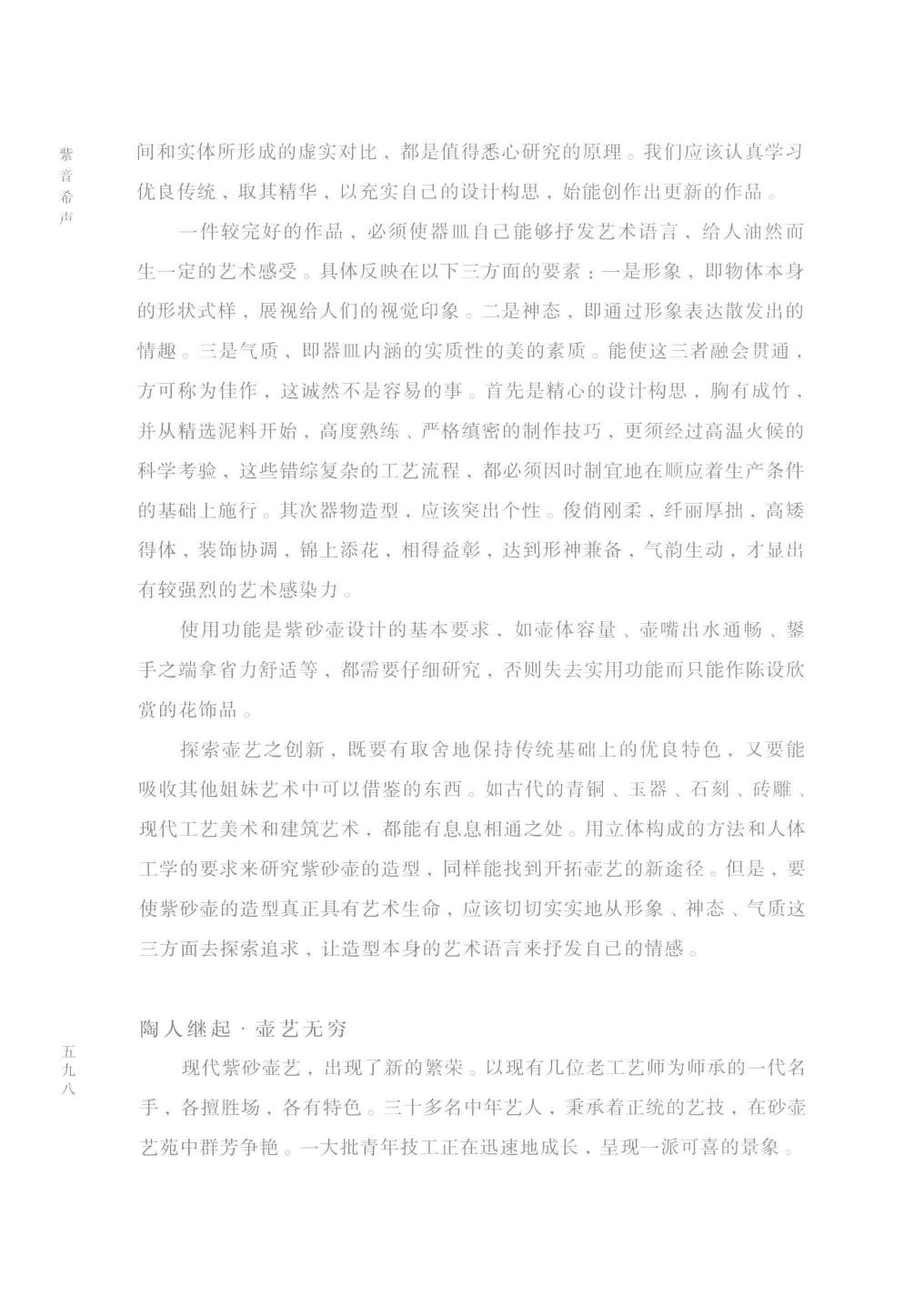
The contrast between void and solid formed by space and physical form are principles worthy of careful study. We should earnestly learn from excellent traditions, extracting their essence to enrich our design concepts, so that we can create even newer works.
A relatively complete work must allow the vessel itself to express artistic language, giving people a naturally arising artistic experience. This is concretely reflected in the following three essential elements: First is form, namely the shape and style of the object itself, the visual impression it presents to people. Second is spirit, namely the aesthetic interest expressed and emanated through form. Third is temperament, namely the substantive quality of beauty inherent within the vessel. Only when these three elements are integrated and harmonized can a work be called excellent—this is certainly not an easy matter. First comes meticulous design conception, with a clear vision in mind, beginning with careful selection of clay materials, highly skilled and strictly rigorous production techniques, and further requiring the scientific test of high-temperature firing. These intricate and complex craft processes must all be implemented in accordance with production conditions and circumstances. Secondly, the vessel's form should emphasize individuality—handsome or gentle, delicate or robust, with appropriate height and short proportions, harmonious decoration that adds finishing touches and complements each other, achieving unity of form and spirit and vivid temperament, thus displaying strong artistic appeal.
Functional utility is the basic requirement in the design of Yixing teapots. Factors such as the pot body's capacity, smooth water flow from the spout, and comfortable, effortless handling when lifting by the handle all require careful study; otherwise, losing practical function, they can only serve as decorative ornaments for display and appreciation.
In exploring innovation in teapot art, one must selectively preserve the excellent characteristics based on tradition, while also being able to absorb things from other sister arts that can be referenced. For example, ancient bronzes, jade objects, stone carvings, brick sculptures, modern craft arts, and architectural arts all have interconnected aspects. Using methods of three-dimensional composition and requirements of ergonomics to study the form of Yixing teapots can likewise find new pathways for developing teapot art. However, for the form of Yixing teapots to truly possess artistic life, one should earnestly explore and pursue from these three aspects—form, spirit, and temperament—letting the artistic language of the form itself express one's emotions.
Modern Yixing teapot art has witnessed a new flourishing. A generation of masters, inheriting from several existing senior craftsmen, each excel in their own domain with distinctive characteristics. More than thirty middle-aged artisans, carrying on orthodox artistic skills, compete in beauty within this artistic garden. A large group of young craftspeople are rapidly growing, presenting a gratifying scene.
Chapter 10
附录
Appendix
Pages 526-651
View Chapter →
English Translation
> Half
The contrast between void and solid formed by space and physical form are principles worthy of careful study. We should earnestly learn from excellent traditions, extracting their essence to enrich our design concepts, so that we can create even newer works.
A relatively complete work must allow the vessel itself to express artistic language, giving people a naturally arising artistic experience. This is concretely reflected in the following three essential elements: First is form, namely the shape and style of the object itself, the visual impression it presents to people. Second is spirit, namely the aesthetic interest expressed and emanated through form. Third is temperament, namely the substantive quality of beauty inherent within the vessel. Only when these three elements are integrated and harmonized can a work be called excellent—this is certainly not an easy matter. First comes meticulous design conception, with a clear vision in mind, beginning with careful selection of clay materials, highly skilled and strictly rigorous production techniques, and further requiring the scientific test of high-temperature firing. These intricate and complex craft processes must all be implemented in accordance with production conditions and circumstances. Secondly, the vessel's form should emphasize individuality—handsome or gentle, delicate or robust, with appropriate height and short proportions, harmonious decoration that adds finishing touches and complements each other, achieving unity of form and spirit and vivid temperament, thus displaying strong artistic appeal.
Functional utility is the basic requirement in the design of Yixing teapots. Factors such as the pot body's capacity, smooth water flow from the spout, and comfortable, effortless handling when lifting by the handle all require careful study; otherwise, losing practical function, they can only serve as decorative ornaments for display and appreciation.
In exploring innovation in teapot art, one must selectively preserve the excellent characteristics based on tradition, while also being able to absorb things from other sister arts that can be referenced. For example, ancient bronzes, jade objects, stone carvings, brick sculptures, modern craft arts, and architectural arts all have interconnected aspects. Using methods of three-dimensional composition and requirements of ergonomics to study the form of Yixing teapots can likewise find new pathways for developing teapot art. However, for the form of Yixing teapots to truly possess artistic life, one should earnestly explore and pursue from these three aspects—form, spirit, and temperament—letting the artistic language of the form itself express one's emotions.
Modern Yixing teapot art has witnessed a new flourishing. A generation of masters, inheriting from several existing senior craftsmen, each excel in their own domain with distinctive characteristics. More than thirty middle-aged artisans, carrying on orthodox artistic skills, compete in beauty within this artistic garden. A large group of young craftspeople are rapidly growing, presenting a gratifying scene.
章节导航 Chapter Navigation
Chapter 1
序文
Pages 6-6
Chapter 2
引言
Pages 28-31
Chapter 3
达变
Pages 32-133
Chapter 3
开宗立派
Pages 46-66
Chapter 3
传道授业
Pages 67-98
Chapter 3
大师淳友
Pages 99-120
Chapter 3
学艺谋生
Pages 121-133
Chapter 4
化神
Pages 134-141
Chapter 5
独妙
Pages 142-405
Chapter 5
匠心独运 不苟丝毫
Pages 142-179
Chapter 5
器利善事 物尽其用
Pages 180-199
Chapter 5
紫泥春华 研精究微
Pages 200-405
Chapter 6
驾简
Pages 406-427
Chapter 6
精雕细刻 文质合一
Pages 406-410
Chapter 6
师法自然 妙趣横生
Pages 411-415
Chapter 6
丝来线去 曲尽其妙
Pages 416-427
Chapter 7
明志
Pages 463-485
Chapter 7
高山仰止 淡泊明志
Pages 463-472
Chapter 7
啜墨看茶 气定神闲
Pages 473-478
Chapter 7
齿少心锐 怡志抒情
Pages 479-485
Chapter 8
存真
Pages 428-462
Chapter 8
规圆矩方 弃伪存真
Pages 428-436
Chapter 8
有物有则 钻尖仰高
Pages 437-462
Chapter 9
心营
Pages 506-525
Chapter 9
坚守传统 艺立潮头
Pages 506-513
Chapter 9
新型师承 桃李满园
Pages 514-525
Chapter 10
附录
Pages 526-651
Chapter 10
顾景舟紫艺论文
Pages 526-535
Chapter 10
技术课备课笔记
Pages 536-543
Chapter 10
顾景舟艺术年表
Pages 544-651
Chapter 11
参考文献
Pages 652-657
Chapter 12
鸣谢
Pages 658-659