Chapter 10
附录
Appendix
606
of 659
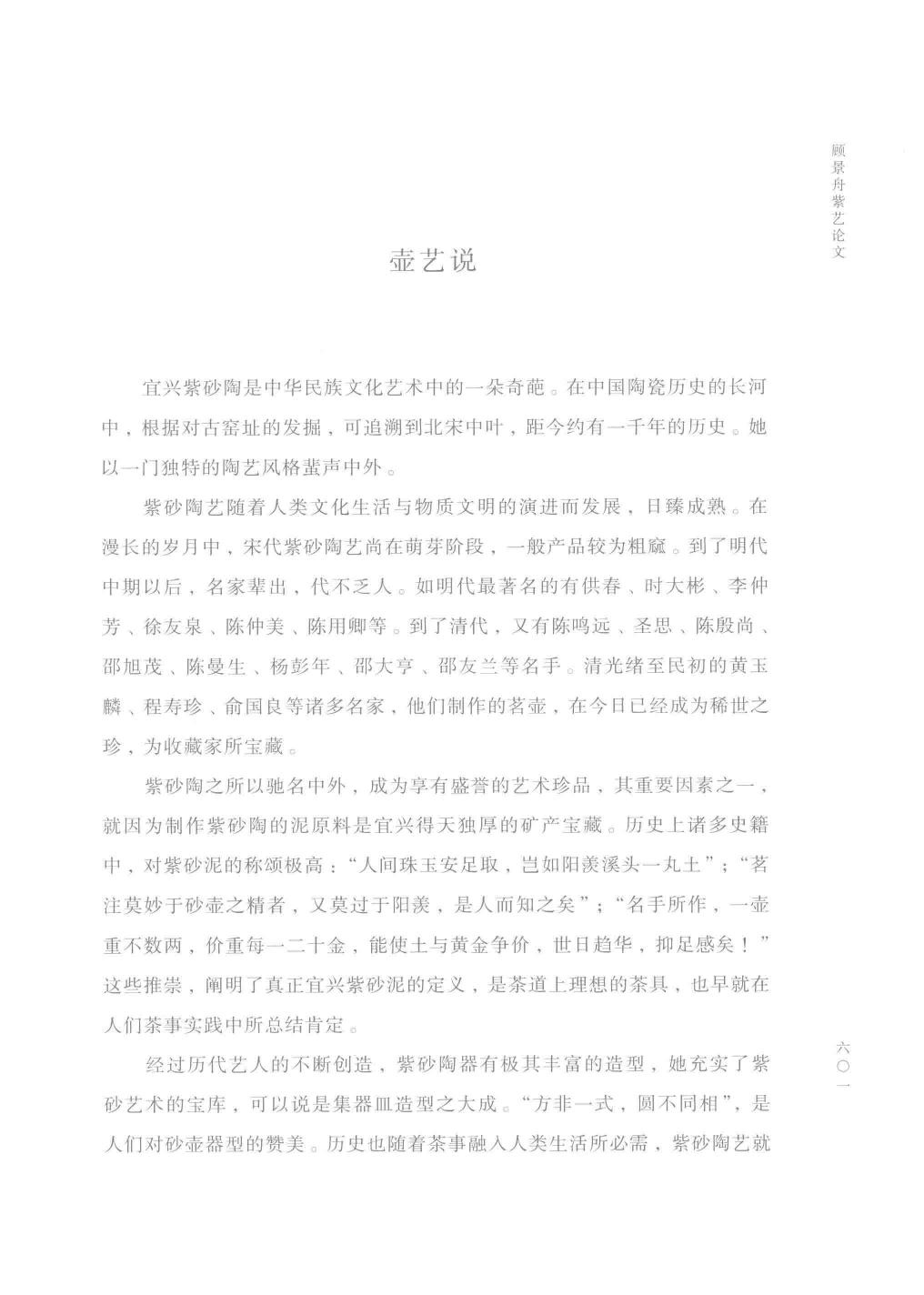
English Translation
Yixing zisha pottery is a remarkable treasure in the cultural and artistic heritage of the Chinese nation. In the long river of Chinese ceramic history, based on excavations of ancient kiln sites, it can be traced back to the mid-Northern Song Dynasty, with a history of approximately one thousand years. It has gained renown both in China and abroad for its unique ceramic art style.
The art of zisha pottery has developed alongside the evolution of human cultural life and material civilization, gradually reaching maturity. Over the long course of history, zisha pottery art in the Song Dynasty was still in its embryonic stage, with products generally being rather crude. By the mid-Ming Dynasty and thereafter, famous masters emerged in abundance, with talented artisans appearing in every generation. Notable Ming Dynasty masters include Gong Chun, Shi Dabin, Li Zhongfang, Xu Youquan, Chen Zhongmei, and Chen Yongwei. In the Qing Dynasty, there were renowned craftsmen such as Chen Mingyuan, Sheng Si, Chen Jueshang, Shao Xumao, Chen Mansheng, Yang Pengnian, Shao Daxiang, and Shao Youlan. From the Guangxu period of the Qing Dynasty to the early Republican era, many famous masters including Huang Yulin, Cheng Shouzhen, and Yu Guoliang created teapots that have become rare treasures today, cherished by collectors.
The reason why zisha pottery has gained fame both in China and abroad, becoming a highly esteemed artistic treasure, is primarily because the clay material used to make zisha pottery is a uniquely blessed mineral resource of Yixing. Throughout history, numerous historical texts have praised zisha clay in the highest terms:
> "Why seek pearls and jade among mortals, when a ball of clay from the stream at Yangxian is incomparable";
> "For tea brewing, nothing is more wonderful than fine sand pottery, and none surpasses that of Yangxian—this is known to all";
> "Works by master craftsmen, a single pot weighing no more than a few taels, can be priced at ten or twenty gold pieces, enabling clay to compete in value with gold—as the world grows increasingly prosperous, this is truly cause for lamentation!"
These accolades illuminate the true definition of authentic Yixing zisha clay as the ideal tea ware for the tea ceremony, a fact long confirmed through people's practical experience with tea.
Through the continuous creativity of artisans across generations, zisha pottery has developed an extremely rich variety of forms, enriching the treasury of zisha art. It can be said to represent the culmination of vessel modeling achievements. "No two squares are alike, no two rounds share the same appearance"—this is how people praise the forms of zisha teapots. As tea culture has become integrated into the necessities of human life throughout history, the art of zisha pottery has...
[Note: The original Chinese text appears to be incomplete at the end]
Chapter 10
附录
Appendix
Pages 526-651
View Chapter →
English Translation
Yixing zisha pottery is a remarkable treasure in the cultural and artistic heritage of the Chinese nation. In the long river of Chinese ceramic history, based on excavations of ancient kiln sites, it can be traced back to the mid-Northern Song Dynasty, with a history of approximately one thousand years. It has gained renown both in China and abroad for its unique ceramic art style.
The art of zisha pottery has developed alongside the evolution of human cultural life and material civilization, gradually reaching maturity. Over the long course of history, zisha pottery art in the Song Dynasty was still in its embryonic stage, with products generally being rather crude. By the mid-Ming Dynasty and thereafter, famous masters emerged in abundance, with talented artisans appearing in every generation. Notable Ming Dynasty masters include Gong Chun, Shi Dabin, Li Zhongfang, Xu Youquan, Chen Zhongmei, and Chen Yongwei. In the Qing Dynasty, there were renowned craftsmen such as Chen Mingyuan, Sheng Si, Chen Jueshang, Shao Xumao, Chen Mansheng, Yang Pengnian, Shao Daxiang, and Shao Youlan. From the Guangxu period of the Qing Dynasty to the early Republican era, many famous masters including Huang Yulin, Cheng Shouzhen, and Yu Guoliang created teapots that have become rare treasures today, cherished by collectors.
The reason why zisha pottery has gained fame both in China and abroad, becoming a highly esteemed artistic treasure, is primarily because the clay material used to make zisha pottery is a uniquely blessed mineral resource of Yixing. Throughout history, numerous historical texts have praised zisha clay in the highest terms:
> "Why seek pearls and jade among mortals, when a ball of clay from the stream at Yangxian is incomparable";
> "For tea brewing, nothing is more wonderful than fine sand pottery, and none surpasses that of Yangxian—this is known to all";
> "Works by master craftsmen, a single pot weighing no more than a few taels, can be priced at ten or twenty gold pieces, enabling clay to compete in value with gold—as the world grows increasingly prosperous, this is truly cause for lamentation!"
These accolades illuminate the true definition of authentic Yixing zisha clay as the ideal tea ware for the tea ceremony, a fact long confirmed through people's practical experience with tea.
Through the continuous creativity of artisans across generations, zisha pottery has developed an extremely rich variety of forms, enriching the treasury of zisha art. It can be said to represent the culmination of vessel modeling achievements. "No two squares are alike, no two rounds share the same appearance"—this is how people praise the forms of zisha teapots. As tea culture has become integrated into the necessities of human life throughout history, the art of zisha pottery has...
[Note: The original Chinese text appears to be incomplete at the end]
章节导航 Chapter Navigation
Chapter 1
序文
Pages 6-6
Chapter 2
引言
Pages 28-31
Chapter 3
达变
Pages 32-133
Chapter 3
开宗立派
Pages 46-66
Chapter 3
传道授业
Pages 67-98
Chapter 3
大师淳友
Pages 99-120
Chapter 3
学艺谋生
Pages 121-133
Chapter 4
化神
Pages 134-141
Chapter 5
独妙
Pages 142-405
Chapter 5
匠心独运 不苟丝毫
Pages 142-179
Chapter 5
器利善事 物尽其用
Pages 180-199
Chapter 5
紫泥春华 研精究微
Pages 200-405
Chapter 6
驾简
Pages 406-427
Chapter 6
精雕细刻 文质合一
Pages 406-410
Chapter 6
师法自然 妙趣横生
Pages 411-415
Chapter 6
丝来线去 曲尽其妙
Pages 416-427
Chapter 7
明志
Pages 463-485
Chapter 7
高山仰止 淡泊明志
Pages 463-472
Chapter 7
啜墨看茶 气定神闲
Pages 473-478
Chapter 7
齿少心锐 怡志抒情
Pages 479-485
Chapter 8
存真
Pages 428-462
Chapter 8
规圆矩方 弃伪存真
Pages 428-436
Chapter 8
有物有则 钻尖仰高
Pages 437-462
Chapter 9
心营
Pages 506-525
Chapter 9
坚守传统 艺立潮头
Pages 506-513
Chapter 9
新型师承 桃李满园
Pages 514-525
Chapter 10
附录
Pages 526-651
Chapter 10
顾景舟紫艺论文
Pages 526-535
Chapter 10
技术课备课笔记
Pages 536-543
Chapter 10
顾景舟艺术年表
Pages 544-651
Chapter 11
参考文献
Pages 652-657
Chapter 12
鸣谢
Pages 658-659