Chapter 10
附录
Appendix
608
of 659
English Translation
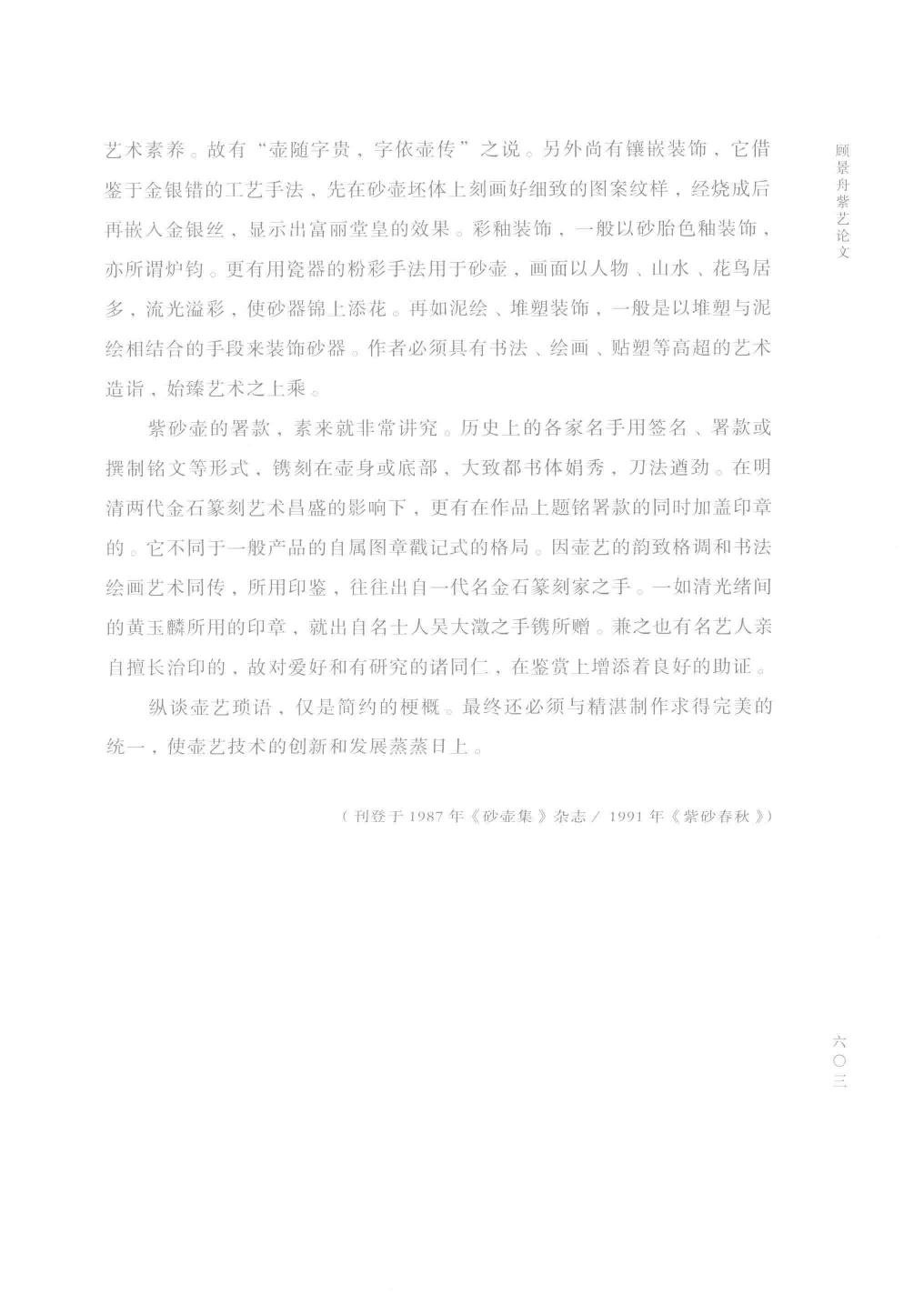
There is a saying: "The teapot gains value through calligraphy, and calligraphy is transmitted through the teapot." Additionally, there is inlay decoration, which draws upon the techniques of gold and silver inlay craftsmanship. First, delicate patterns are carved onto the body of the clay teapot, and after firing, gold and silver threads are inlaid, displaying a magnificent and splendid effect. Colored glaze decoration generally employs clay body with colored glaze decoration, also known as furnace transmutation glaze. There is also the use of porcelain *fencai* (famille rose) techniques applied to clay teapots, with paintings predominantly featuring figures, landscapes, and flowers and birds. The flowing colors and brilliant hues make the clay teapots even more resplendent. Furthermore, techniques such as clay painting and relief decoration generally combine relief sculpture with clay painting to decorate the vessels. The artist must possess superior artistic attainment in calligraphy, painting, and applied sculpture to achieve the highest level of artistry.
The signatures on Yixing teapots have always been highly regarded. Throughout history, master craftsmen have used signatures, inscriptions, or engraved texts on the body or bottom of teapots. Generally, the calligraphy is elegant and refined, and the knife work is exquisite. Under the influence of the flourishing art of seal carving during the Ming and Qing dynasties, some works feature seal impressions in addition to inscribed signatures. This differs from the ordinary product trademark stamp format. Because the charm and refinement of teapot art are transmitted together with the arts of calligraphy and painting, the seals used often come from the hands of renowned seal carvers of the era. For example, the seals used by Huang Yulin during the Guangxu period of the Qing dynasty were gifts carved by the famous scholar Wu Dacheng. Moreover, some renowned artisans were not skilled in seal carving themselves, so for enthusiasts and researchers, this provides valuable supporting evidence in authentication and appreciation.
This brief discussion of teapot artistry is merely a concise outline. Ultimately, one must still seek perfection through exquisite craftsmanship.
---
*(Published in* Shahu Ji *magazine, 1987 /* Zisha Chunqiu*, 1991)*
Gu Jingzhou
Chapter 10
附录
Appendix
Pages 526-651
View Chapter →
English Translation
There is a saying: "The teapot gains value through calligraphy, and calligraphy is transmitted through the teapot." Additionally, there is inlay decoration, which draws upon the techniques of gold and silver inlay craftsmanship. First, delicate patterns are carved onto the body of the clay teapot, and after firing, gold and silver threads are inlaid, displaying a magnificent and splendid effect. Colored glaze decoration generally employs clay body with colored glaze decoration, also known as furnace transmutation glaze. There is also the use of porcelain *fencai* (famille rose) techniques applied to clay teapots, with paintings predominantly featuring figures, landscapes, and flowers and birds. The flowing colors and brilliant hues make the clay teapots even more resplendent. Furthermore, techniques such as clay painting and relief decoration generally combine relief sculpture with clay painting to decorate the vessels. The artist must possess superior artistic attainment in calligraphy, painting, and applied sculpture to achieve the highest level of artistry.
The signatures on Yixing teapots have always been highly regarded. Throughout history, master craftsmen have used signatures, inscriptions, or engraved texts on the body or bottom of teapots. Generally, the calligraphy is elegant and refined, and the knife work is exquisite. Under the influence of the flourishing art of seal carving during the Ming and Qing dynasties, some works feature seal impressions in addition to inscribed signatures. This differs from the ordinary product trademark stamp format. Because the charm and refinement of teapot art are transmitted together with the arts of calligraphy and painting, the seals used often come from the hands of renowned seal carvers of the era. For example, the seals used by Huang Yulin during the Guangxu period of the Qing dynasty were gifts carved by the famous scholar Wu Dacheng. Moreover, some renowned artisans were not skilled in seal carving themselves, so for enthusiasts and researchers, this provides valuable supporting evidence in authentication and appreciation.
This brief discussion of teapot artistry is merely a concise outline. Ultimately, one must still seek perfection through exquisite craftsmanship.
---
*(Published in* Shahu Ji *magazine, 1987 /* Zisha Chunqiu*, 1991)*
Gu Jingzhou
章节导航 Chapter Navigation
Chapter 1
序文
Pages 6-6
Chapter 2
引言
Pages 28-31
Chapter 3
达变
Pages 32-133
Chapter 3
开宗立派
Pages 46-66
Chapter 3
传道授业
Pages 67-98
Chapter 3
大师淳友
Pages 99-120
Chapter 3
学艺谋生
Pages 121-133
Chapter 4
化神
Pages 134-141
Chapter 5
独妙
Pages 142-405
Chapter 5
匠心独运 不苟丝毫
Pages 142-179
Chapter 5
器利善事 物尽其用
Pages 180-199
Chapter 5
紫泥春华 研精究微
Pages 200-405
Chapter 6
驾简
Pages 406-427
Chapter 6
精雕细刻 文质合一
Pages 406-410
Chapter 6
师法自然 妙趣横生
Pages 411-415
Chapter 6
丝来线去 曲尽其妙
Pages 416-427
Chapter 7
明志
Pages 463-485
Chapter 7
高山仰止 淡泊明志
Pages 463-472
Chapter 7
啜墨看茶 气定神闲
Pages 473-478
Chapter 7
齿少心锐 怡志抒情
Pages 479-485
Chapter 8
存真
Pages 428-462
Chapter 8
规圆矩方 弃伪存真
Pages 428-436
Chapter 8
有物有则 钻尖仰高
Pages 437-462
Chapter 9
心营
Pages 506-525
Chapter 9
坚守传统 艺立潮头
Pages 506-513
Chapter 9
新型师承 桃李满园
Pages 514-525
Chapter 10
附录
Pages 526-651
Chapter 10
顾景舟紫艺论文
Pages 526-535
Chapter 10
技术课备课笔记
Pages 536-543
Chapter 10
顾景舟艺术年表
Pages 544-651
Chapter 11
参考文献
Pages 652-657
Chapter 12
鸣谢
Pages 658-659