Chapter 10
附录
Appendix
616
of 659
English Translation
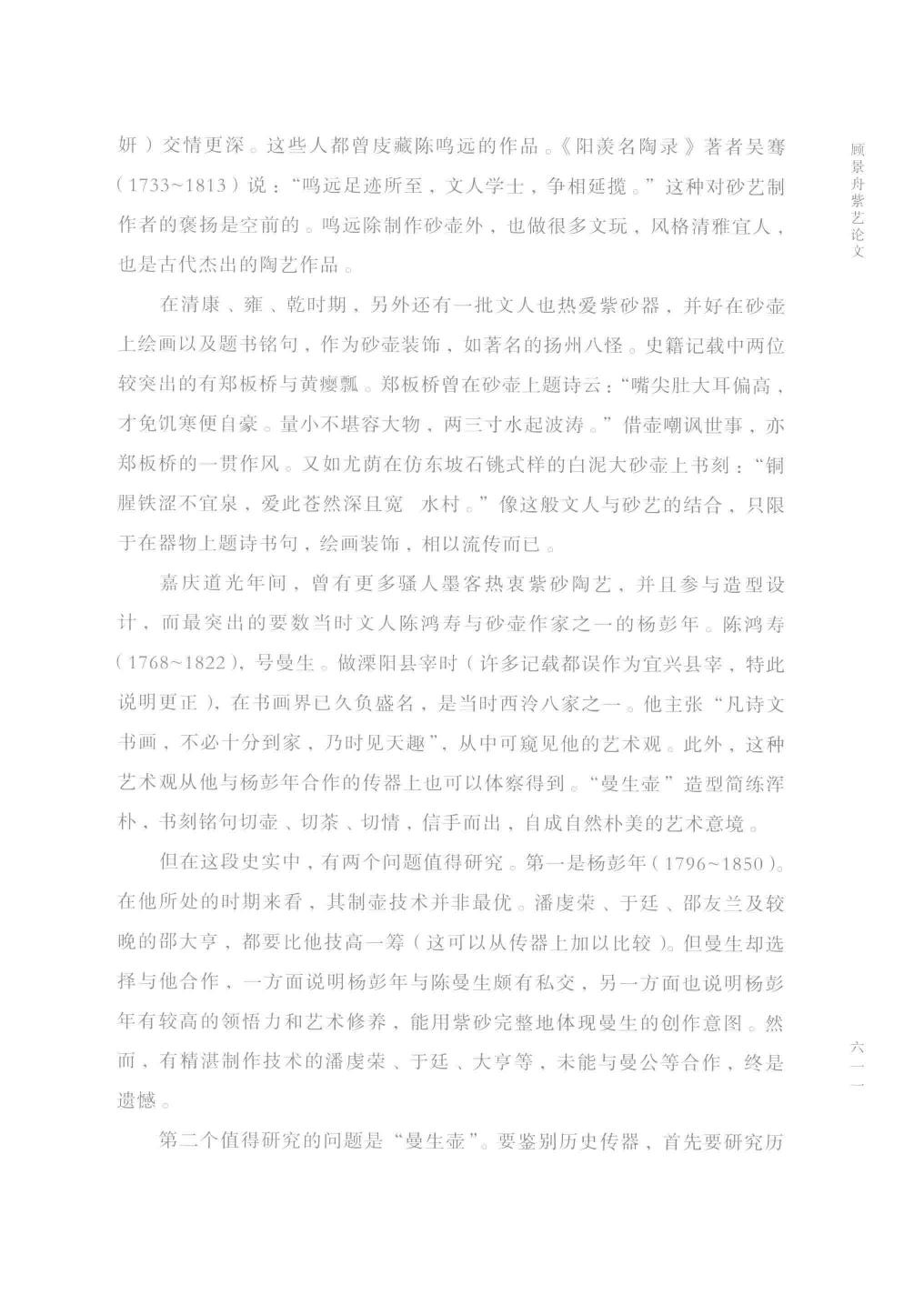
...these individuals all once collected works by Chen Mingyuan. Wu Sai (1733-1813), author of *Yangxian Ming Tao Lu* (*Record of Famous Pottery from Yangxian*), said: "Wherever Mingyuan's footsteps reached, literati and scholars competed to engage him." This kind of praise for a pottery maker was unprecedented. Besides making teapots, Mingyuan also created many scholar's objects, with an elegant and pleasing style—these too are outstanding ceramic works from ancient times.
During the Kangxi, Yongzheng, and Qianlong periods of the Qing dynasty, there was also a group of literati who loved Yixing pottery and enjoyed painting on teapots as well as inscribing poems and phrases as decorative elements. The famous Yangzhou eccentrics are one example. Among those more prominently recorded in historical documents are Zheng Banqiao and Huang Shenshou. Zheng Banqiao once inscribed a poem on a teapot: "Pointed spout, large belly, handle set high / Barely free from hunger and cold, yet already proud / Small capacity cannot contain great things / Two or three inches of water stir up waves." Using the teapot to satirize worldly affairs was very much Zheng Banqiao's style. Another example is You Yin, who inscribed on a large white clay teapot imitating Dongpo's stone ladle style: "Bronze's fishy smell and iron's astringency are unsuitable for tea / I love this one, gray-green, deep and capacious..." This kind of combination of literati and pottery art was limited to inscribing poems, signing names, and painting decorations on vessels, simply for the sake of circulation and transmission.
During the Jiaqing and Daoguang periods, even more poets and scholars became enthusiastic about Yixing pottery and participated in design. The most outstanding was the literatus Chen Hongshou and one of the teapot makers, Yang Pengnian. Chen Hongshou (1768-1822), styled Mansheng, was already renowned in calligraphy and painting circles when he served as magistrate of Liyang County (many records mistakenly state he was magistrate of Yixing County; this is noted here for correction). He was one of the Eight Masters of Xiling at the time. He advocated that "poetry, prose, calligraphy, and painting need not be perfectly accomplished, but should occasionally reveal natural charm"—from this we can glimpse his artistic philosophy. Moreover, this artistic philosophy can also be perceived from the vessels he created in collaboration with Yang Pengnian. "Mansheng teapots" have simple and robust forms, with inscribed phrases that relate to the teapot, to tea, and to sentiment, flowing naturally from the hand, creating an artistic realm of natural and unadorned beauty.
However, in this historical account, two issues are worth studying. The first concerns Yang Pengnian (1796-1850). Considering his era, his teapot-making technique was not the finest. Pan Qinrong, Yu Ting, Shao Youlan, and the somewhat later Shao Daheng were all technically superior to him (this can be compared through examining surviving works). Yet Mansheng chose to collaborate with him, which on one hand indicates that Yang Pengnian had a personal friendship with Chen Mansheng, and on the other hand shows that Yang Pengnian possessed considerable comprehension and artistic cultivation, able to fully embody Mansheng's creative intentions in Yixing clay. However, it remains regrettable that those with exquisite craftsmanship—Pan Qinrong, Yu Ting, Daheng, and others—were unable to collaborate with Mansheng and his peers.
The second issue worth studying is the "Mansheng teapot." To authenticate historical vessels, one must first study the history...
[Text appears to continue but is cut off in the provided image]
Chapter 10
附录
Appendix
Pages 526-651
View Chapter →
English Translation
...these individuals all once collected works by Chen Mingyuan. Wu Sai (1733-1813), author of *Yangxian Ming Tao Lu* (*Record of Famous Pottery from Yangxian*), said: "Wherever Mingyuan's footsteps reached, literati and scholars competed to engage him." This kind of praise for a pottery maker was unprecedented. Besides making teapots, Mingyuan also created many scholar's objects, with an elegant and pleasing style—these too are outstanding ceramic works from ancient times.
During the Kangxi, Yongzheng, and Qianlong periods of the Qing dynasty, there was also a group of literati who loved Yixing pottery and enjoyed painting on teapots as well as inscribing poems and phrases as decorative elements. The famous Yangzhou eccentrics are one example. Among those more prominently recorded in historical documents are Zheng Banqiao and Huang Shenshou. Zheng Banqiao once inscribed a poem on a teapot: "Pointed spout, large belly, handle set high / Barely free from hunger and cold, yet already proud / Small capacity cannot contain great things / Two or three inches of water stir up waves." Using the teapot to satirize worldly affairs was very much Zheng Banqiao's style. Another example is You Yin, who inscribed on a large white clay teapot imitating Dongpo's stone ladle style: "Bronze's fishy smell and iron's astringency are unsuitable for tea / I love this one, gray-green, deep and capacious..." This kind of combination of literati and pottery art was limited to inscribing poems, signing names, and painting decorations on vessels, simply for the sake of circulation and transmission.
During the Jiaqing and Daoguang periods, even more poets and scholars became enthusiastic about Yixing pottery and participated in design. The most outstanding was the literatus Chen Hongshou and one of the teapot makers, Yang Pengnian. Chen Hongshou (1768-1822), styled Mansheng, was already renowned in calligraphy and painting circles when he served as magistrate of Liyang County (many records mistakenly state he was magistrate of Yixing County; this is noted here for correction). He was one of the Eight Masters of Xiling at the time. He advocated that "poetry, prose, calligraphy, and painting need not be perfectly accomplished, but should occasionally reveal natural charm"—from this we can glimpse his artistic philosophy. Moreover, this artistic philosophy can also be perceived from the vessels he created in collaboration with Yang Pengnian. "Mansheng teapots" have simple and robust forms, with inscribed phrases that relate to the teapot, to tea, and to sentiment, flowing naturally from the hand, creating an artistic realm of natural and unadorned beauty.
However, in this historical account, two issues are worth studying. The first concerns Yang Pengnian (1796-1850). Considering his era, his teapot-making technique was not the finest. Pan Qinrong, Yu Ting, Shao Youlan, and the somewhat later Shao Daheng were all technically superior to him (this can be compared through examining surviving works). Yet Mansheng chose to collaborate with him, which on one hand indicates that Yang Pengnian had a personal friendship with Chen Mansheng, and on the other hand shows that Yang Pengnian possessed considerable comprehension and artistic cultivation, able to fully embody Mansheng's creative intentions in Yixing clay. However, it remains regrettable that those with exquisite craftsmanship—Pan Qinrong, Yu Ting, Daheng, and others—were unable to collaborate with Mansheng and his peers.
The second issue worth studying is the "Mansheng teapot." To authenticate historical vessels, one must first study the history...
[Text appears to continue but is cut off in the provided image]
章节导航 Chapter Navigation
Chapter 1
序文
Pages 6-6
Chapter 2
引言
Pages 28-31
Chapter 3
达变
Pages 32-133
Chapter 3
开宗立派
Pages 46-66
Chapter 3
传道授业
Pages 67-98
Chapter 3
大师淳友
Pages 99-120
Chapter 3
学艺谋生
Pages 121-133
Chapter 4
化神
Pages 134-141
Chapter 5
独妙
Pages 142-405
Chapter 5
匠心独运 不苟丝毫
Pages 142-179
Chapter 5
器利善事 物尽其用
Pages 180-199
Chapter 5
紫泥春华 研精究微
Pages 200-405
Chapter 6
驾简
Pages 406-427
Chapter 6
精雕细刻 文质合一
Pages 406-410
Chapter 6
师法自然 妙趣横生
Pages 411-415
Chapter 6
丝来线去 曲尽其妙
Pages 416-427
Chapter 7
明志
Pages 463-485
Chapter 7
高山仰止 淡泊明志
Pages 463-472
Chapter 7
啜墨看茶 气定神闲
Pages 473-478
Chapter 7
齿少心锐 怡志抒情
Pages 479-485
Chapter 8
存真
Pages 428-462
Chapter 8
规圆矩方 弃伪存真
Pages 428-436
Chapter 8
有物有则 钻尖仰高
Pages 437-462
Chapter 9
心营
Pages 506-525
Chapter 9
坚守传统 艺立潮头
Pages 506-513
Chapter 9
新型师承 桃李满园
Pages 514-525
Chapter 10
附录
Pages 526-651
Chapter 10
顾景舟紫艺论文
Pages 526-535
Chapter 10
技术课备课笔记
Pages 536-543
Chapter 10
顾景舟艺术年表
Pages 544-651
Chapter 11
参考文献
Pages 652-657
Chapter 12
鸣谢
Pages 658-659