Chapter 10
附录
Appendix
615
of 659
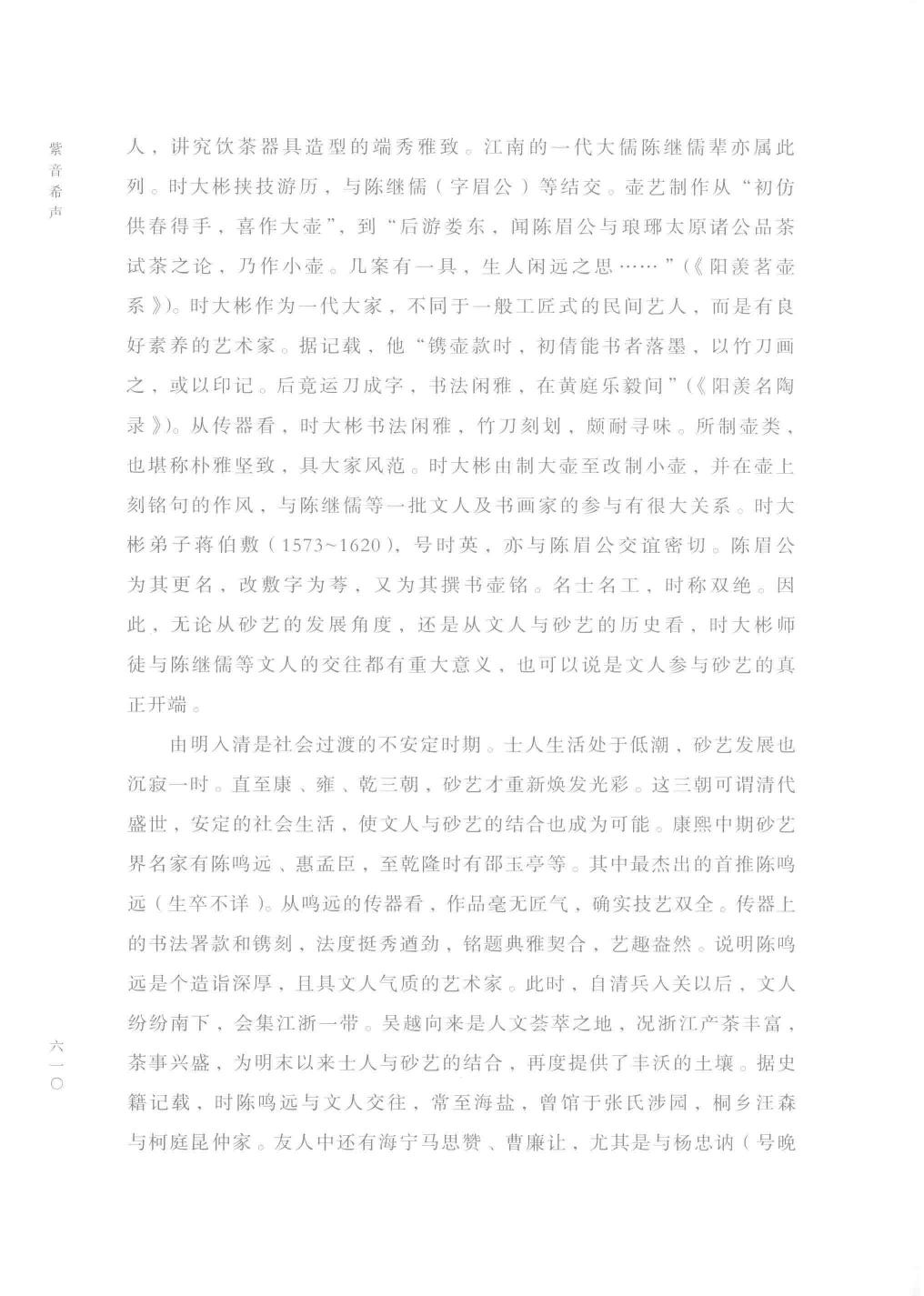
English Translation
...who valued the elegant and refined form of tea-drinking vessels. The great Jiangnan scholar Chen Jiru and his contemporaries belonged to this circle. Shi Dabin traveled with his craft and befriended Chen Jiru (styled Meigong) and others. His teapot-making evolved from "initially imitating Gong Chun with success, favoring large pots," to later, "after traveling to Loudong and hearing Chen Meigong, Lang Ban, and the gentlemen of Taiyuan discuss tea tasting and tea testing, he began making small pots. Having one on a desk evokes thoughts of leisure and distance" (*Yangxian Minghu Xi*). As a master of his generation, Shi Dabin differed from ordinary craftsmen-artisans; he was an artist of refined cultivation. According to records, "when inscribing pots, he initially hired skilled calligraphers to write in ink, then carved with a bamboo knife, or used seal marks. Later he wielded the knife to form characters himself; his calligraphy was elegant and refined, comparable to the *Huangting* and *Yueyi* styles" (*Yangxian Mingtao Lu*). Judging from surviving pieces, Shi Dabin's calligraphy was leisurely and elegant, carved with bamboo knife, quite worthy of contemplation. The various types he created can also be called simple, elegant, firm, and solid, possessing the manner of a great master. Shi Dabin's shift from making large pots to small ones, and his practice of inscribing poems on pots, had much to do with the participation of Chen Jiru and other literati, scholars, and painters. Shi Dabin's disciple Xu Youquan (1573-1620), styled Shiying, also maintained close friendship with Chen Meigong. Chen Meigong renamed him, changing the character "Quan" to "Ku," and also inscribed pot inscriptions for him. The famous scholar and famous craftsman were called a "double excellence" at the time. Therefore, whether from the perspective of the development of Yixing pottery or from the history of literati and pottery art, the interactions between Shi Dabin and his disciples with Chen Jiru and other literati held great significance, and can be said to mark the true beginning of literati participation in pottery art.
The transition from Ming to Qing was an unstable period of social change. Scholar life was at a low ebb, and pottery art development also fell silent for a time. Not until the Kangxi, Yongzheng, and Qianlong reigns did pottery art regain its brilliance. These three reigns can be called the golden age of the Qing dynasty; stable social life made the combination of literati and pottery art possible once again. Famous pottery masters of the mid-Kangxi period included Chen Mingyuan and Hui Mengchen, and by the Qianlong period there was Shao Yuting and others. Among them, the most outstanding was undoubtedly Chen Mingyuan (dates unknown). Judging from Chen Mingyuan's surviving works, his pieces were completely free of craftsman's vulgarity, truly possessing both skill and artistry. The calligraphic signatures and inscriptions on surviving pieces show upright, vigorous, and elegant technique, with refined and harmonious poetic inscriptions, revealing artistic interest. This indicates that Chen Mingyuan was an artist of deep cultivation who possessed literati temperament. At this time, after the Qing troops entered the pass, literati flocked southward, gathering in the Jiangsu and Zhejiang regions. Wu and Yue had always been lands of flourishing culture; moreover, Zhejiang's abundant tea production and thriving tea culture provided fertile soil once again for the combination of scholars and pottery art that had begun in the late Ming. According to historical records, Chen Mingyuan associated with literati, often visiting Haiyan, staying at the Zhang family's Sheyuan, and at the homes of Wang Sen and the Ke brothers in Tongxiang. Among his friends were also Ma Sizan and Cao Lianrang of Haining, and especially Yang Zhongshu (styled Wan...
Chapter 10
附录
Appendix
Pages 526-651
View Chapter →
English Translation
...who valued the elegant and refined form of tea-drinking vessels. The great Jiangnan scholar Chen Jiru and his contemporaries belonged to this circle. Shi Dabin traveled with his craft and befriended Chen Jiru (styled Meigong) and others. His teapot-making evolved from "initially imitating Gong Chun with success, favoring large pots," to later, "after traveling to Loudong and hearing Chen Meigong, Lang Ban, and the gentlemen of Taiyuan discuss tea tasting and tea testing, he began making small pots. Having one on a desk evokes thoughts of leisure and distance" (*Yangxian Minghu Xi*). As a master of his generation, Shi Dabin differed from ordinary craftsmen-artisans; he was an artist of refined cultivation. According to records, "when inscribing pots, he initially hired skilled calligraphers to write in ink, then carved with a bamboo knife, or used seal marks. Later he wielded the knife to form characters himself; his calligraphy was elegant and refined, comparable to the *Huangting* and *Yueyi* styles" (*Yangxian Mingtao Lu*). Judging from surviving pieces, Shi Dabin's calligraphy was leisurely and elegant, carved with bamboo knife, quite worthy of contemplation. The various types he created can also be called simple, elegant, firm, and solid, possessing the manner of a great master. Shi Dabin's shift from making large pots to small ones, and his practice of inscribing poems on pots, had much to do with the participation of Chen Jiru and other literati, scholars, and painters. Shi Dabin's disciple Xu Youquan (1573-1620), styled Shiying, also maintained close friendship with Chen Meigong. Chen Meigong renamed him, changing the character "Quan" to "Ku," and also inscribed pot inscriptions for him. The famous scholar and famous craftsman were called a "double excellence" at the time. Therefore, whether from the perspective of the development of Yixing pottery or from the history of literati and pottery art, the interactions between Shi Dabin and his disciples with Chen Jiru and other literati held great significance, and can be said to mark the true beginning of literati participation in pottery art.
The transition from Ming to Qing was an unstable period of social change. Scholar life was at a low ebb, and pottery art development also fell silent for a time. Not until the Kangxi, Yongzheng, and Qianlong reigns did pottery art regain its brilliance. These three reigns can be called the golden age of the Qing dynasty; stable social life made the combination of literati and pottery art possible once again. Famous pottery masters of the mid-Kangxi period included Chen Mingyuan and Hui Mengchen, and by the Qianlong period there was Shao Yuting and others. Among them, the most outstanding was undoubtedly Chen Mingyuan (dates unknown). Judging from Chen Mingyuan's surviving works, his pieces were completely free of craftsman's vulgarity, truly possessing both skill and artistry. The calligraphic signatures and inscriptions on surviving pieces show upright, vigorous, and elegant technique, with refined and harmonious poetic inscriptions, revealing artistic interest. This indicates that Chen Mingyuan was an artist of deep cultivation who possessed literati temperament. At this time, after the Qing troops entered the pass, literati flocked southward, gathering in the Jiangsu and Zhejiang regions. Wu and Yue had always been lands of flourishing culture; moreover, Zhejiang's abundant tea production and thriving tea culture provided fertile soil once again for the combination of scholars and pottery art that had begun in the late Ming. According to historical records, Chen Mingyuan associated with literati, often visiting Haiyan, staying at the Zhang family's Sheyuan, and at the homes of Wang Sen and the Ke brothers in Tongxiang. Among his friends were also Ma Sizan and Cao Lianrang of Haining, and especially Yang Zhongshu (styled Wan...
章节导航 Chapter Navigation
Chapter 1
序文
Pages 6-6
Chapter 2
引言
Pages 28-31
Chapter 3
达变
Pages 32-133
Chapter 3
开宗立派
Pages 46-66
Chapter 3
传道授业
Pages 67-98
Chapter 3
大师淳友
Pages 99-120
Chapter 3
学艺谋生
Pages 121-133
Chapter 4
化神
Pages 134-141
Chapter 5
独妙
Pages 142-405
Chapter 5
匠心独运 不苟丝毫
Pages 142-179
Chapter 5
器利善事 物尽其用
Pages 180-199
Chapter 5
紫泥春华 研精究微
Pages 200-405
Chapter 6
驾简
Pages 406-427
Chapter 6
精雕细刻 文质合一
Pages 406-410
Chapter 6
师法自然 妙趣横生
Pages 411-415
Chapter 6
丝来线去 曲尽其妙
Pages 416-427
Chapter 7
明志
Pages 463-485
Chapter 7
高山仰止 淡泊明志
Pages 463-472
Chapter 7
啜墨看茶 气定神闲
Pages 473-478
Chapter 7
齿少心锐 怡志抒情
Pages 479-485
Chapter 8
存真
Pages 428-462
Chapter 8
规圆矩方 弃伪存真
Pages 428-436
Chapter 8
有物有则 钻尖仰高
Pages 437-462
Chapter 9
心营
Pages 506-525
Chapter 9
坚守传统 艺立潮头
Pages 506-513
Chapter 9
新型师承 桃李满园
Pages 514-525
Chapter 10
附录
Pages 526-651
Chapter 10
顾景舟紫艺论文
Pages 526-535
Chapter 10
技术课备课笔记
Pages 536-543
Chapter 10
顾景舟艺术年表
Pages 544-651
Chapter 11
参考文献
Pages 652-657
Chapter 12
鸣谢
Pages 658-659