Chapter 10
附录
Appendix
624
of 659
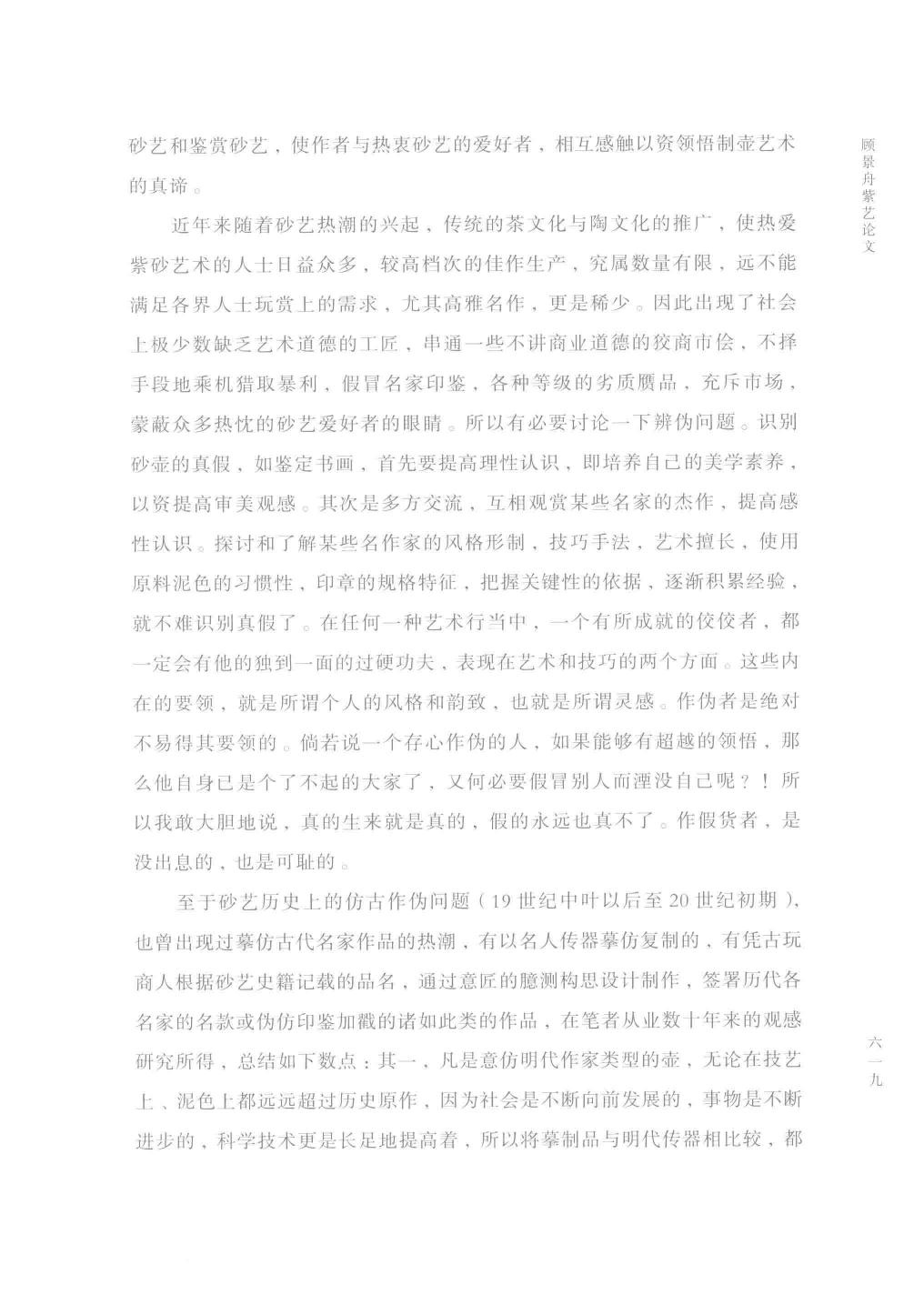
English Translation
The art of Yixing pottery and its appreciation allow the author and enthusiasts devoted to this craft to share their insights and deepen their understanding of the true essence of teapot-making artistry.
In recent years, with the rise of enthusiasm for Yixing pottery and the promotion of traditional tea culture and ceramic culture, the number of people who love the art of purple clay has grown increasingly. However, the production of higher-quality masterpieces is limited in quantity and far from meeting the demand for appreciation among people from all walks of life. Elegant and renowned works are especially rare. Consequently, a very small number of craftsmen lacking artistic ethics have appeared in society, colluding with some unscrupulous merchants who disregard commercial morality. They seize the opportunity to reap enormous profits through unscrupulous means, forging the seals of famous artists. Counterfeit products of various grades flood the market, deceiving the eyes of many earnest pottery enthusiasts. Therefore, it is necessary to discuss the issue of authentication. Identifying the authenticity of Yixing teapots, like authenticating calligraphy and painting, first requires improving one's rational understanding—that is, cultivating one's aesthetic literacy to enhance aesthetic perception. Secondly, one should engage in extensive exchanges and mutual appreciation of masterpieces by certain famous artists to improve perceptual understanding. By exploring and understanding the stylistic forms, technical methods, artistic strengths, habitual use of clay materials and colors, and the specifications and characteristics of seals of certain renowned artists, and by grasping key evidence and gradually accumulating experience, it becomes not difficult to distinguish the authentic from the fake. In any artistic field, an outstanding achiever must possess exceptional skills that are uniquely their own, manifested in both artistic and technical aspects. These intrinsic essentials constitute what is called personal style and charm, or what is known as inspiration. Forgers absolutely cannot easily grasp these essentials. If someone intent on forgery could possess transcendent understanding, then they themselves would already be a remarkable master—why would they need to impersonate others and thereby obscure themselves?! Therefore, I dare to boldly say: what is genuine is born genuine, and what is fake can never become real. Those who make counterfeits are without promise and are also pitiable.
As for the issue of imitation and forgery in the history of Yixing pottery (from the mid-19th century to the early 20th century), there was a wave of imitating works from previous generations and famous artists. Some reproduced and replicated vessels passed down by famous people, while antique dealers, based on product names recorded in historical texts on Yixing pottery, designed and created works through speculative conceptualization, signing the names of various famous artists from different dynasties or affixing forged seals. Based on the author's decades of professional observation and research, the following points can be summarized: First, all imitations of Ming dynasty artist types, whether in terms of technique or clay color, far surpass the historical originals, because society continuously develops forward, things continuously progress, and scientific technology advances by leaps and bounds. Therefore, when comparing reproductions with Ming dynasty transmitted vessels, they all [exceed the originals in quality].
Chapter 10
附录
Appendix
Pages 526-651
View Chapter →
English Translation
The art of Yixing pottery and its appreciation allow the author and enthusiasts devoted to this craft to share their insights and deepen their understanding of the true essence of teapot-making artistry.
In recent years, with the rise of enthusiasm for Yixing pottery and the promotion of traditional tea culture and ceramic culture, the number of people who love the art of purple clay has grown increasingly. However, the production of higher-quality masterpieces is limited in quantity and far from meeting the demand for appreciation among people from all walks of life. Elegant and renowned works are especially rare. Consequently, a very small number of craftsmen lacking artistic ethics have appeared in society, colluding with some unscrupulous merchants who disregard commercial morality. They seize the opportunity to reap enormous profits through unscrupulous means, forging the seals of famous artists. Counterfeit products of various grades flood the market, deceiving the eyes of many earnest pottery enthusiasts. Therefore, it is necessary to discuss the issue of authentication. Identifying the authenticity of Yixing teapots, like authenticating calligraphy and painting, first requires improving one's rational understanding—that is, cultivating one's aesthetic literacy to enhance aesthetic perception. Secondly, one should engage in extensive exchanges and mutual appreciation of masterpieces by certain famous artists to improve perceptual understanding. By exploring and understanding the stylistic forms, technical methods, artistic strengths, habitual use of clay materials and colors, and the specifications and characteristics of seals of certain renowned artists, and by grasping key evidence and gradually accumulating experience, it becomes not difficult to distinguish the authentic from the fake. In any artistic field, an outstanding achiever must possess exceptional skills that are uniquely their own, manifested in both artistic and technical aspects. These intrinsic essentials constitute what is called personal style and charm, or what is known as inspiration. Forgers absolutely cannot easily grasp these essentials. If someone intent on forgery could possess transcendent understanding, then they themselves would already be a remarkable master—why would they need to impersonate others and thereby obscure themselves?! Therefore, I dare to boldly say: what is genuine is born genuine, and what is fake can never become real. Those who make counterfeits are without promise and are also pitiable.
As for the issue of imitation and forgery in the history of Yixing pottery (from the mid-19th century to the early 20th century), there was a wave of imitating works from previous generations and famous artists. Some reproduced and replicated vessels passed down by famous people, while antique dealers, based on product names recorded in historical texts on Yixing pottery, designed and created works through speculative conceptualization, signing the names of various famous artists from different dynasties or affixing forged seals. Based on the author's decades of professional observation and research, the following points can be summarized: First, all imitations of Ming dynasty artist types, whether in terms of technique or clay color, far surpass the historical originals, because society continuously develops forward, things continuously progress, and scientific technology advances by leaps and bounds. Therefore, when comparing reproductions with Ming dynasty transmitted vessels, they all [exceed the originals in quality].
章节导航 Chapter Navigation
Chapter 1
序文
Pages 6-6
Chapter 2
引言
Pages 28-31
Chapter 3
达变
Pages 32-133
Chapter 3
开宗立派
Pages 46-66
Chapter 3
传道授业
Pages 67-98
Chapter 3
大师淳友
Pages 99-120
Chapter 3
学艺谋生
Pages 121-133
Chapter 4
化神
Pages 134-141
Chapter 5
独妙
Pages 142-405
Chapter 5
匠心独运 不苟丝毫
Pages 142-179
Chapter 5
器利善事 物尽其用
Pages 180-199
Chapter 5
紫泥春华 研精究微
Pages 200-405
Chapter 6
驾简
Pages 406-427
Chapter 6
精雕细刻 文质合一
Pages 406-410
Chapter 6
师法自然 妙趣横生
Pages 411-415
Chapter 6
丝来线去 曲尽其妙
Pages 416-427
Chapter 7
明志
Pages 463-485
Chapter 7
高山仰止 淡泊明志
Pages 463-472
Chapter 7
啜墨看茶 气定神闲
Pages 473-478
Chapter 7
齿少心锐 怡志抒情
Pages 479-485
Chapter 8
存真
Pages 428-462
Chapter 8
规圆矩方 弃伪存真
Pages 428-436
Chapter 8
有物有则 钻尖仰高
Pages 437-462
Chapter 9
心营
Pages 506-525
Chapter 9
坚守传统 艺立潮头
Pages 506-513
Chapter 9
新型师承 桃李满园
Pages 514-525
Chapter 10
附录
Pages 526-651
Chapter 10
顾景舟紫艺论文
Pages 526-535
Chapter 10
技术课备课笔记
Pages 536-543
Chapter 10
顾景舟艺术年表
Pages 544-651
Chapter 11
参考文献
Pages 652-657
Chapter 12
鸣谢
Pages 658-659