Chapter 10
附录
Appendix
625
of 659
English Translation
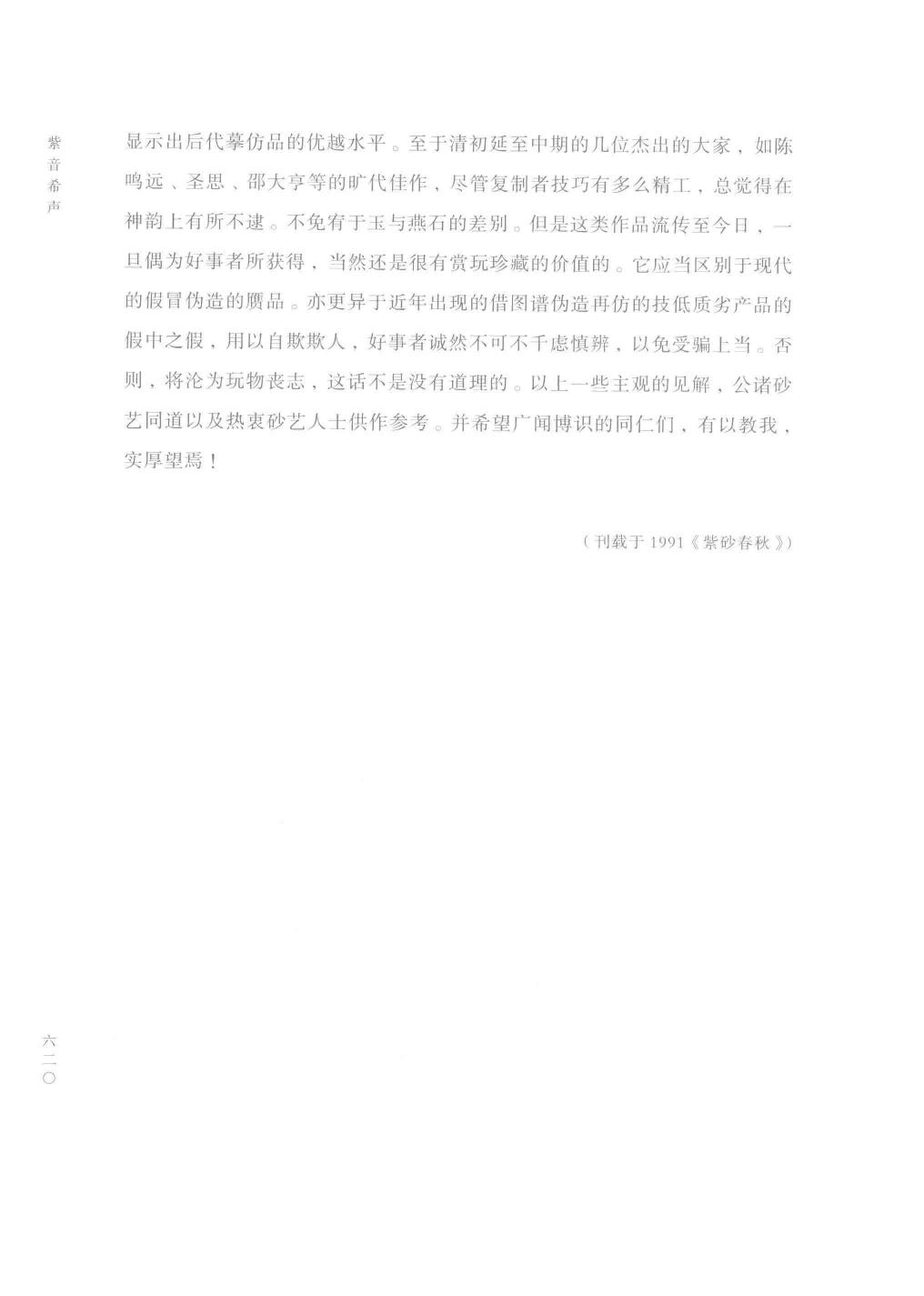
These works demonstrate the superior level achieved by later generations of imitators. As for the outstanding masters from the early to mid-Qing period, such as Chen Mingyuan, Sheng Si, and Shao Daheng, no matter how exquisite the technical skill of those who replicate their masterpieces, one always feels that something is lacking in spirit. This inevitably falls into the distinction between jade and common stone. However, when such works have survived to the present day and are occasionally acquired by enthusiasts, they naturally still possess considerable value for appreciation and collection. They should be distinguished from modern counterfeits and forgeries. They are even more different from the recently emerged fakes-of-fakes—inferior quality products that use illustrated catalogues to create secondary forgeries—which are used to deceive oneself and others. Enthusiasts truly must exercise extreme caution and careful discernment to avoid being deceived and cheated. Otherwise, one may fall into the trap of becoming so obsessed with objects that one loses one's purpose—a warning that is not without merit. The above subjective observations are presented to fellow practitioners of the pottery art and those passionate about it for reference. I sincerely hope that knowledgeable colleagues will offer their guidance and instruction. This is my earnest wish!
(Published in *Zisha Chunqiu* [*Annals of Purple Clay*], 1991)
Chapter 10
附录
Appendix
Pages 526-651
View Chapter →
English Translation
These works demonstrate the superior level achieved by later generations of imitators. As for the outstanding masters from the early to mid-Qing period, such as Chen Mingyuan, Sheng Si, and Shao Daheng, no matter how exquisite the technical skill of those who replicate their masterpieces, one always feels that something is lacking in spirit. This inevitably falls into the distinction between jade and common stone. However, when such works have survived to the present day and are occasionally acquired by enthusiasts, they naturally still possess considerable value for appreciation and collection. They should be distinguished from modern counterfeits and forgeries. They are even more different from the recently emerged fakes-of-fakes—inferior quality products that use illustrated catalogues to create secondary forgeries—which are used to deceive oneself and others. Enthusiasts truly must exercise extreme caution and careful discernment to avoid being deceived and cheated. Otherwise, one may fall into the trap of becoming so obsessed with objects that one loses one's purpose—a warning that is not without merit. The above subjective observations are presented to fellow practitioners of the pottery art and those passionate about it for reference. I sincerely hope that knowledgeable colleagues will offer their guidance and instruction. This is my earnest wish!
(Published in *Zisha Chunqiu* [*Annals of Purple Clay*], 1991)
章节导航 Chapter Navigation
Chapter 1
序文
Pages 6-6
Chapter 2
引言
Pages 28-31
Chapter 3
达变
Pages 32-133
Chapter 3
开宗立派
Pages 46-66
Chapter 3
传道授业
Pages 67-98
Chapter 3
大师淳友
Pages 99-120
Chapter 3
学艺谋生
Pages 121-133
Chapter 4
化神
Pages 134-141
Chapter 5
独妙
Pages 142-405
Chapter 5
匠心独运 不苟丝毫
Pages 142-179
Chapter 5
器利善事 物尽其用
Pages 180-199
Chapter 5
紫泥春华 研精究微
Pages 200-405
Chapter 6
驾简
Pages 406-427
Chapter 6
精雕细刻 文质合一
Pages 406-410
Chapter 6
师法自然 妙趣横生
Pages 411-415
Chapter 6
丝来线去 曲尽其妙
Pages 416-427
Chapter 7
明志
Pages 463-485
Chapter 7
高山仰止 淡泊明志
Pages 463-472
Chapter 7
啜墨看茶 气定神闲
Pages 473-478
Chapter 7
齿少心锐 怡志抒情
Pages 479-485
Chapter 8
存真
Pages 428-462
Chapter 8
规圆矩方 弃伪存真
Pages 428-436
Chapter 8
有物有则 钻尖仰高
Pages 437-462
Chapter 9
心营
Pages 506-525
Chapter 9
坚守传统 艺立潮头
Pages 506-513
Chapter 9
新型师承 桃李满园
Pages 514-525
Chapter 10
附录
Pages 526-651
Chapter 10
顾景舟紫艺论文
Pages 526-535
Chapter 10
技术课备课笔记
Pages 536-543
Chapter 10
顾景舟艺术年表
Pages 544-651
Chapter 11
参考文献
Pages 652-657
Chapter 12
鸣谢
Pages 658-659