Chapter 10
附录
Appendix
633
of 659
English Translation
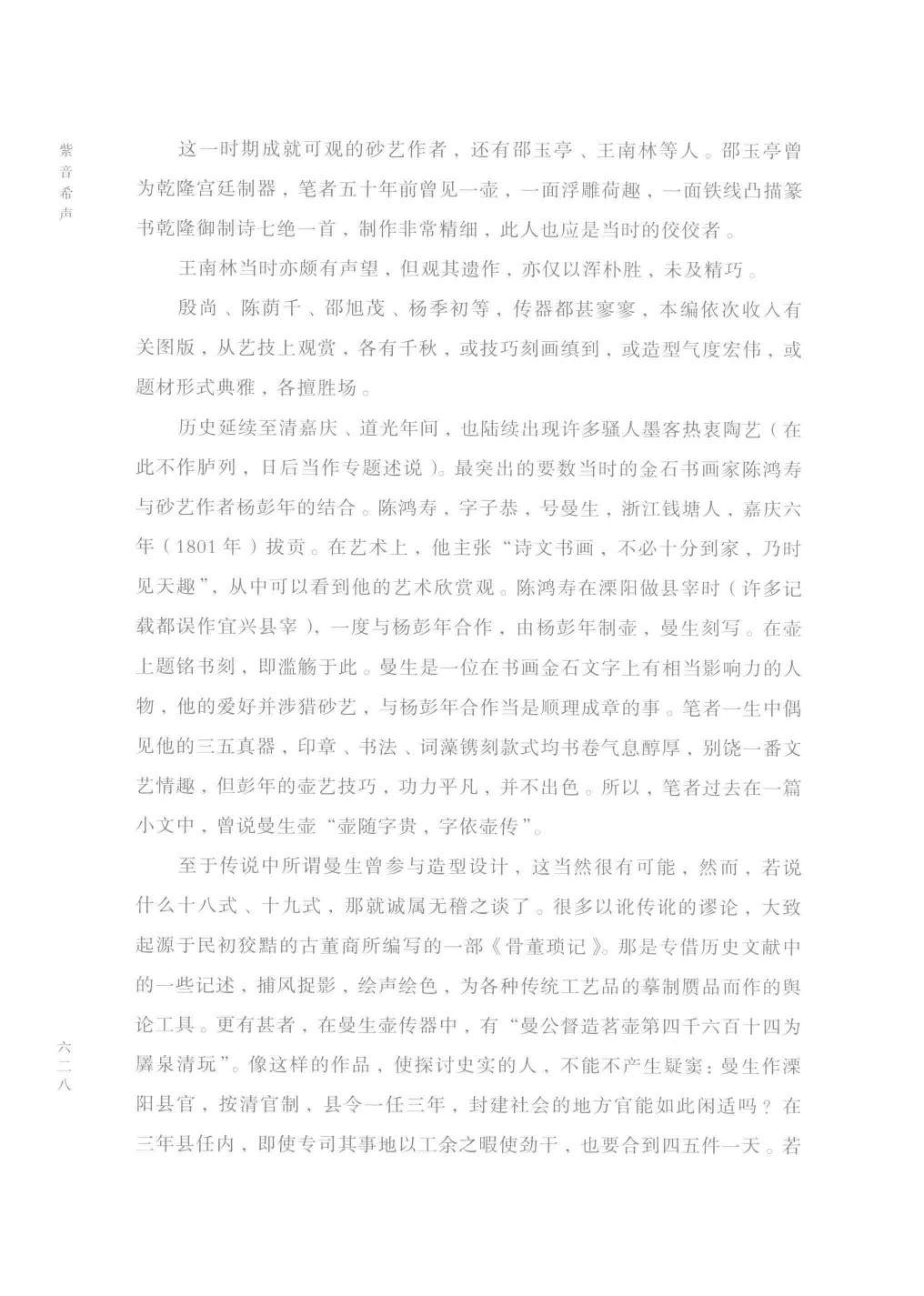
The accomplished sand pottery artists of this period also included Shao Yuting and Wang Nanlin. Shao Yuting once made vessels for the Qianlong imperial court. Fifty years ago, I saw a teapot with relief carving of lotus motifs on one side and iron-wire raised seal script on the other, inscribing a seven-character quatrain composed by Emperor Qianlong. The craftsmanship was extremely refined, and this person should also be considered among the outstanding figures of that time.
Wang Nanlin also enjoyed considerable reputation at the time, but observing his surviving works, they excel only in simplicity and do not achieve exquisite refinement.
Yin Shang, Chen Yinqian, Shao Xumao, Yang Jichu, and others have left very few transmitted works. This compilation includes relevant plates in sequence. From an artistic and technical perspective, each has its own merits—some excel in meticulous carving techniques, some in magnificent and imposing forms, some in elegant subject matter and style—each commanding their own domain.
As history continued into the Jiaqing and Daoguang periods of the Qing dynasty, many literati and scholars successively became enthusiastic about ceramic art (these will not be enumerated here but will be discussed as a special topic in the future). The most prominent was the collaboration between Chen Hongshou, a calligrapher, painter, and epigrapher of the time, and the sand pottery artist Yang Pengnian. Chen Hongshou, courtesy name Zijiao, art name Mansheng, was from Qiantang, Zhejiang. He became a *bagong* (recommended tribute student) in the sixth year of Jiaqing (1801). In art, he advocated that "poetry, prose, calligraphy, and painting need not be perfectly accomplished; it is enough to occasionally reveal natural charm," from which we can see his aesthetic appreciation. When Chen Hongshou served as county magistrate in Liyang (many records mistakenly state Yixing county magistrate), he collaborated with Yang Pengnian for a time. Yang Pengnian made the teapots, and Mansheng inscribed and carved on them, applying seal and inscription on the vessels. Mansheng was a figure of considerable influence in calligraphy, painting, epigraphy, and literature. His interest and involvement in sand pottery art made collaboration with Yang Pengnian a natural development. In my lifetime, I have occasionally seen three to five authentic pieces by him. The seals, calligraphy, and poetic inscriptions all exude a rich scholarly atmosphere and display a distinctive literary and artistic sensibility. However, Pengnian's teapot-making technique and skill were ordinary and not outstanding. Therefore, in a short essay I wrote in the past, I once said of Mansheng teapots: "The teapot becomes valuable through the calligraphy, and the calligraphy is transmitted through the teapot."
As for the legend that Mansheng participated in design, this is of course quite possible. However, claims about "eighteen styles" or "nineteen styles" are truly groundless nonsense. Much of the erroneous discourse passed down through hearsay largely originated from a book called *Miscellaneous Notes on Antiques* written by narrow-minded antique dealers in the early Republican period. This work specifically borrowed some accounts from historical documents, grasping at shadows and embellishing vividly, serving as a propaganda tool for reproductions and forgeries of various traditional craft items. Even more egregiously, among transmitted Mansheng teapots, there exists one inscribed "Supervised by Master Man, number four thousand six hundred and fourteen, for Lüquan's refined enjoyment." Works like this cannot help but raise doubts for those investigating historical facts: Mansheng served as county magistrate of Liyang. According to Qing official regulations, a county magistrate's term was three years. Could a local official in feudal society be so leisurely? Even if during the three-year county tenure he devoted all his spare time exclusively to this matter, it would require producing four to five pieces per day. If...
Chapter 10
附录
Appendix
Pages 526-651
View Chapter →
English Translation
The accomplished sand pottery artists of this period also included Shao Yuting and Wang Nanlin. Shao Yuting once made vessels for the Qianlong imperial court. Fifty years ago, I saw a teapot with relief carving of lotus motifs on one side and iron-wire raised seal script on the other, inscribing a seven-character quatrain composed by Emperor Qianlong. The craftsmanship was extremely refined, and this person should also be considered among the outstanding figures of that time.
Wang Nanlin also enjoyed considerable reputation at the time, but observing his surviving works, they excel only in simplicity and do not achieve exquisite refinement.
Yin Shang, Chen Yinqian, Shao Xumao, Yang Jichu, and others have left very few transmitted works. This compilation includes relevant plates in sequence. From an artistic and technical perspective, each has its own merits—some excel in meticulous carving techniques, some in magnificent and imposing forms, some in elegant subject matter and style—each commanding their own domain.
As history continued into the Jiaqing and Daoguang periods of the Qing dynasty, many literati and scholars successively became enthusiastic about ceramic art (these will not be enumerated here but will be discussed as a special topic in the future). The most prominent was the collaboration between Chen Hongshou, a calligrapher, painter, and epigrapher of the time, and the sand pottery artist Yang Pengnian. Chen Hongshou, courtesy name Zijiao, art name Mansheng, was from Qiantang, Zhejiang. He became a *bagong* (recommended tribute student) in the sixth year of Jiaqing (1801). In art, he advocated that "poetry, prose, calligraphy, and painting need not be perfectly accomplished; it is enough to occasionally reveal natural charm," from which we can see his aesthetic appreciation. When Chen Hongshou served as county magistrate in Liyang (many records mistakenly state Yixing county magistrate), he collaborated with Yang Pengnian for a time. Yang Pengnian made the teapots, and Mansheng inscribed and carved on them, applying seal and inscription on the vessels. Mansheng was a figure of considerable influence in calligraphy, painting, epigraphy, and literature. His interest and involvement in sand pottery art made collaboration with Yang Pengnian a natural development. In my lifetime, I have occasionally seen three to five authentic pieces by him. The seals, calligraphy, and poetic inscriptions all exude a rich scholarly atmosphere and display a distinctive literary and artistic sensibility. However, Pengnian's teapot-making technique and skill were ordinary and not outstanding. Therefore, in a short essay I wrote in the past, I once said of Mansheng teapots: "The teapot becomes valuable through the calligraphy, and the calligraphy is transmitted through the teapot."
As for the legend that Mansheng participated in design, this is of course quite possible. However, claims about "eighteen styles" or "nineteen styles" are truly groundless nonsense. Much of the erroneous discourse passed down through hearsay largely originated from a book called *Miscellaneous Notes on Antiques* written by narrow-minded antique dealers in the early Republican period. This work specifically borrowed some accounts from historical documents, grasping at shadows and embellishing vividly, serving as a propaganda tool for reproductions and forgeries of various traditional craft items. Even more egregiously, among transmitted Mansheng teapots, there exists one inscribed "Supervised by Master Man, number four thousand six hundred and fourteen, for Lüquan's refined enjoyment." Works like this cannot help but raise doubts for those investigating historical facts: Mansheng served as county magistrate of Liyang. According to Qing official regulations, a county magistrate's term was three years. Could a local official in feudal society be so leisurely? Even if during the three-year county tenure he devoted all his spare time exclusively to this matter, it would require producing four to five pieces per day. If...
章节导航 Chapter Navigation
Chapter 1
序文
Pages 6-6
Chapter 2
引言
Pages 28-31
Chapter 3
达变
Pages 32-133
Chapter 3
开宗立派
Pages 46-66
Chapter 3
传道授业
Pages 67-98
Chapter 3
大师淳友
Pages 99-120
Chapter 3
学艺谋生
Pages 121-133
Chapter 4
化神
Pages 134-141
Chapter 5
独妙
Pages 142-405
Chapter 5
匠心独运 不苟丝毫
Pages 142-179
Chapter 5
器利善事 物尽其用
Pages 180-199
Chapter 5
紫泥春华 研精究微
Pages 200-405
Chapter 6
驾简
Pages 406-427
Chapter 6
精雕细刻 文质合一
Pages 406-410
Chapter 6
师法自然 妙趣横生
Pages 411-415
Chapter 6
丝来线去 曲尽其妙
Pages 416-427
Chapter 7
明志
Pages 463-485
Chapter 7
高山仰止 淡泊明志
Pages 463-472
Chapter 7
啜墨看茶 气定神闲
Pages 473-478
Chapter 7
齿少心锐 怡志抒情
Pages 479-485
Chapter 8
存真
Pages 428-462
Chapter 8
规圆矩方 弃伪存真
Pages 428-436
Chapter 8
有物有则 钻尖仰高
Pages 437-462
Chapter 9
心营
Pages 506-525
Chapter 9
坚守传统 艺立潮头
Pages 506-513
Chapter 9
新型师承 桃李满园
Pages 514-525
Chapter 10
附录
Pages 526-651
Chapter 10
顾景舟紫艺论文
Pages 526-535
Chapter 10
技术课备课笔记
Pages 536-543
Chapter 10
顾景舟艺术年表
Pages 544-651
Chapter 11
参考文献
Pages 652-657
Chapter 12
鸣谢
Pages 658-659