Chapter 10
附录
Appendix
632
of 659
English Translation
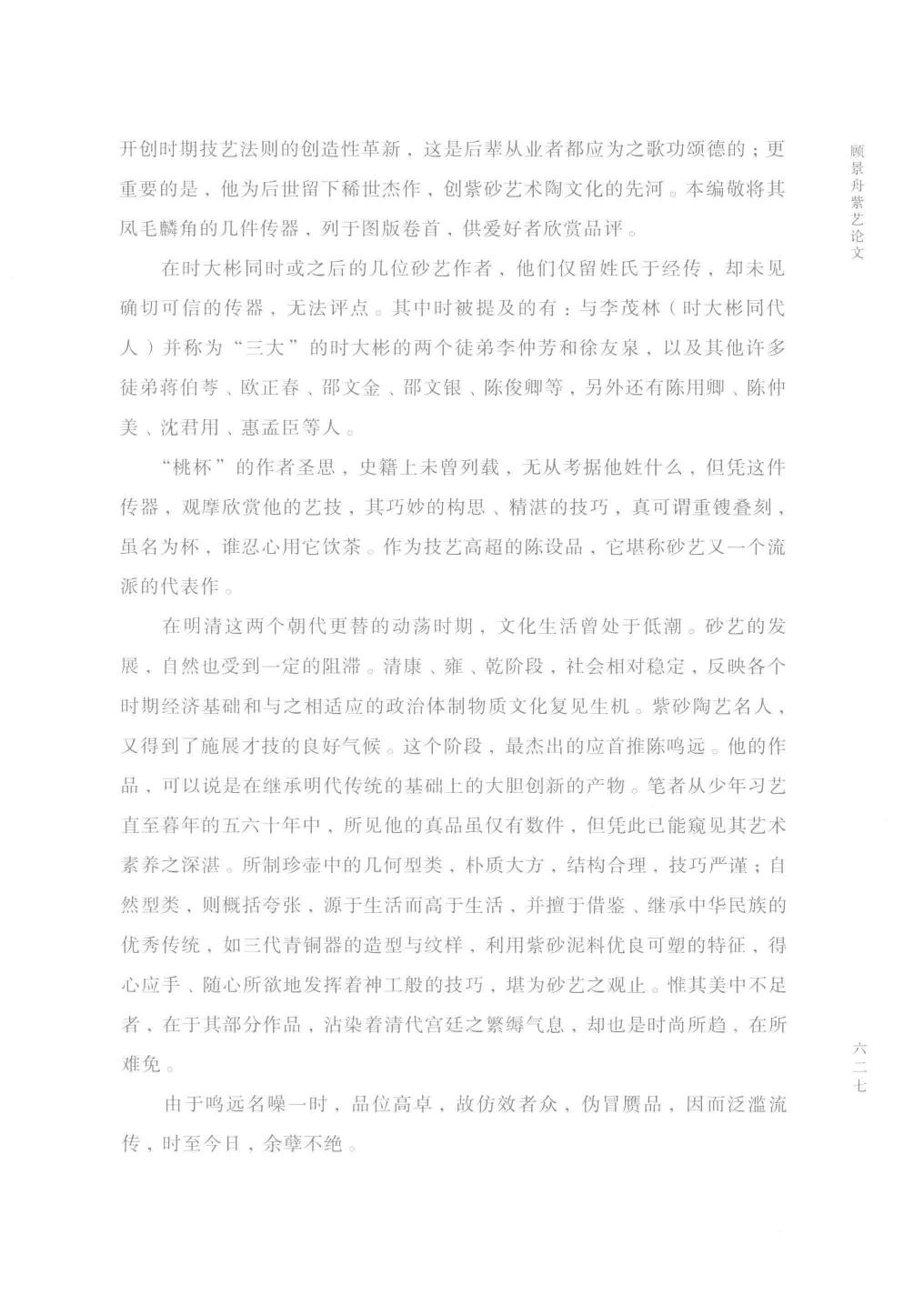
The creative innovation of technical principles in the founding period is something that all later practitioners should praise and celebrate. More importantly, he left behind rare masterpieces for future generations, pioneering the cultural tradition of Yixing pottery art. This volume respectfully places several of his rare surviving works at the beginning of the illustrated plates for enthusiasts to appreciate and evaluate.
Several Yixing pottery artists who were contemporaries of Shi Dabin or came after him left only their names in historical records, but no reliably authenticated surviving works can be found, making evaluation impossible. Among those frequently mentioned are: Li Zhongfang and Xu Youquan, two disciples of Shi Dabin who were called the "Three Greats" together with Li Maolin (a contemporary of Shi Dabin), as well as many other disciples including Shen Bojun, Ou Zhengchun, Shao Wenjin, Shao Wenyin, Chen Junci, and others such as Chen Yongqing, Chen Zhongmei, Shen Junyong, and Hui Mengchen.
The creator of the "Peach Cup," Sheng Si, was never recorded in historical documents, and there is no way to verify his surname. However, based on this surviving work and observing and appreciating his artistic skill, his ingenious conception and exquisite technique can truly be called a masterpiece of meticulous craftsmanship. Though named a cup, who would bear to use it for drinking tea? As a display piece of superior craftsmanship, it can be considered a representative work of another school of Yixing pottery art.
During the turbulent period of dynastic transition between the Ming and Qing dynasties, cultural life was at a low ebb. The development of Yixing pottery art naturally suffered certain setbacks. During the Kangxi, Yongzheng, and Qianlong reigns of the Qing dynasty, society was relatively stable, and the material culture reflecting the economic foundation and corresponding political system of each period showed renewed vitality. Masters of Yixing pottery art once again enjoyed favorable conditions to display their talents and skills. In this period, the most outstanding figure was undoubtedly Chen Mingyuan. His works can be said to be the product of bold innovation based on the inheritance of Ming dynasty traditions. From my youth learning the craft through my later years, spanning fifty to sixty years, I have seen only a few of his authentic pieces, but these alone are sufficient to glimpse the depth of his artistic cultivation. Among his precious works, the geometric types are simple and generous, with rational structure and rigorous technique; the naturalistic types are characterized by generalization and exaggeration, derived from life yet transcending it. He was skilled at drawing upon and inheriting the excellent traditions of the Chinese nation, such as the forms and patterns of bronze vessels from the Three Dynasties period. Utilizing the excellent plasticity of Yixing clay, he wielded his god-like skills with ease and freedom, creating the pinnacle of Yixing pottery art. The only flaw in his otherwise perfect work is that some pieces were tainted with the ornate atmosphere of the Qing court, though this was an inevitable trend of the times.
Because Mingyuan's fame resounded throughout the land and his works were of the highest quality, many imitated him, and counterfeit products proliferated, spreading widely. Even to this day, the stream continues unabated.
Chapter 10
附录
Appendix
Pages 526-651
View Chapter →
English Translation
The creative innovation of technical principles in the founding period is something that all later practitioners should praise and celebrate. More importantly, he left behind rare masterpieces for future generations, pioneering the cultural tradition of Yixing pottery art. This volume respectfully places several of his rare surviving works at the beginning of the illustrated plates for enthusiasts to appreciate and evaluate.
Several Yixing pottery artists who were contemporaries of Shi Dabin or came after him left only their names in historical records, but no reliably authenticated surviving works can be found, making evaluation impossible. Among those frequently mentioned are: Li Zhongfang and Xu Youquan, two disciples of Shi Dabin who were called the "Three Greats" together with Li Maolin (a contemporary of Shi Dabin), as well as many other disciples including Shen Bojun, Ou Zhengchun, Shao Wenjin, Shao Wenyin, Chen Junci, and others such as Chen Yongqing, Chen Zhongmei, Shen Junyong, and Hui Mengchen.
The creator of the "Peach Cup," Sheng Si, was never recorded in historical documents, and there is no way to verify his surname. However, based on this surviving work and observing and appreciating his artistic skill, his ingenious conception and exquisite technique can truly be called a masterpiece of meticulous craftsmanship. Though named a cup, who would bear to use it for drinking tea? As a display piece of superior craftsmanship, it can be considered a representative work of another school of Yixing pottery art.
During the turbulent period of dynastic transition between the Ming and Qing dynasties, cultural life was at a low ebb. The development of Yixing pottery art naturally suffered certain setbacks. During the Kangxi, Yongzheng, and Qianlong reigns of the Qing dynasty, society was relatively stable, and the material culture reflecting the economic foundation and corresponding political system of each period showed renewed vitality. Masters of Yixing pottery art once again enjoyed favorable conditions to display their talents and skills. In this period, the most outstanding figure was undoubtedly Chen Mingyuan. His works can be said to be the product of bold innovation based on the inheritance of Ming dynasty traditions. From my youth learning the craft through my later years, spanning fifty to sixty years, I have seen only a few of his authentic pieces, but these alone are sufficient to glimpse the depth of his artistic cultivation. Among his precious works, the geometric types are simple and generous, with rational structure and rigorous technique; the naturalistic types are characterized by generalization and exaggeration, derived from life yet transcending it. He was skilled at drawing upon and inheriting the excellent traditions of the Chinese nation, such as the forms and patterns of bronze vessels from the Three Dynasties period. Utilizing the excellent plasticity of Yixing clay, he wielded his god-like skills with ease and freedom, creating the pinnacle of Yixing pottery art. The only flaw in his otherwise perfect work is that some pieces were tainted with the ornate atmosphere of the Qing court, though this was an inevitable trend of the times.
Because Mingyuan's fame resounded throughout the land and his works were of the highest quality, many imitated him, and counterfeit products proliferated, spreading widely. Even to this day, the stream continues unabated.
章节导航 Chapter Navigation
Chapter 1
序文
Pages 6-6
Chapter 2
引言
Pages 28-31
Chapter 3
达变
Pages 32-133
Chapter 3
开宗立派
Pages 46-66
Chapter 3
传道授业
Pages 67-98
Chapter 3
大师淳友
Pages 99-120
Chapter 3
学艺谋生
Pages 121-133
Chapter 4
化神
Pages 134-141
Chapter 5
独妙
Pages 142-405
Chapter 5
匠心独运 不苟丝毫
Pages 142-179
Chapter 5
器利善事 物尽其用
Pages 180-199
Chapter 5
紫泥春华 研精究微
Pages 200-405
Chapter 6
驾简
Pages 406-427
Chapter 6
精雕细刻 文质合一
Pages 406-410
Chapter 6
师法自然 妙趣横生
Pages 411-415
Chapter 6
丝来线去 曲尽其妙
Pages 416-427
Chapter 7
明志
Pages 463-485
Chapter 7
高山仰止 淡泊明志
Pages 463-472
Chapter 7
啜墨看茶 气定神闲
Pages 473-478
Chapter 7
齿少心锐 怡志抒情
Pages 479-485
Chapter 8
存真
Pages 428-462
Chapter 8
规圆矩方 弃伪存真
Pages 428-436
Chapter 8
有物有则 钻尖仰高
Pages 437-462
Chapter 9
心营
Pages 506-525
Chapter 9
坚守传统 艺立潮头
Pages 506-513
Chapter 9
新型师承 桃李满园
Pages 514-525
Chapter 10
附录
Pages 526-651
Chapter 10
顾景舟紫艺论文
Pages 526-535
Chapter 10
技术课备课笔记
Pages 536-543
Chapter 10
顾景舟艺术年表
Pages 544-651
Chapter 11
参考文献
Pages 652-657
Chapter 12
鸣谢
Pages 658-659