Chapter 10
附录
Appendix
637
of 659
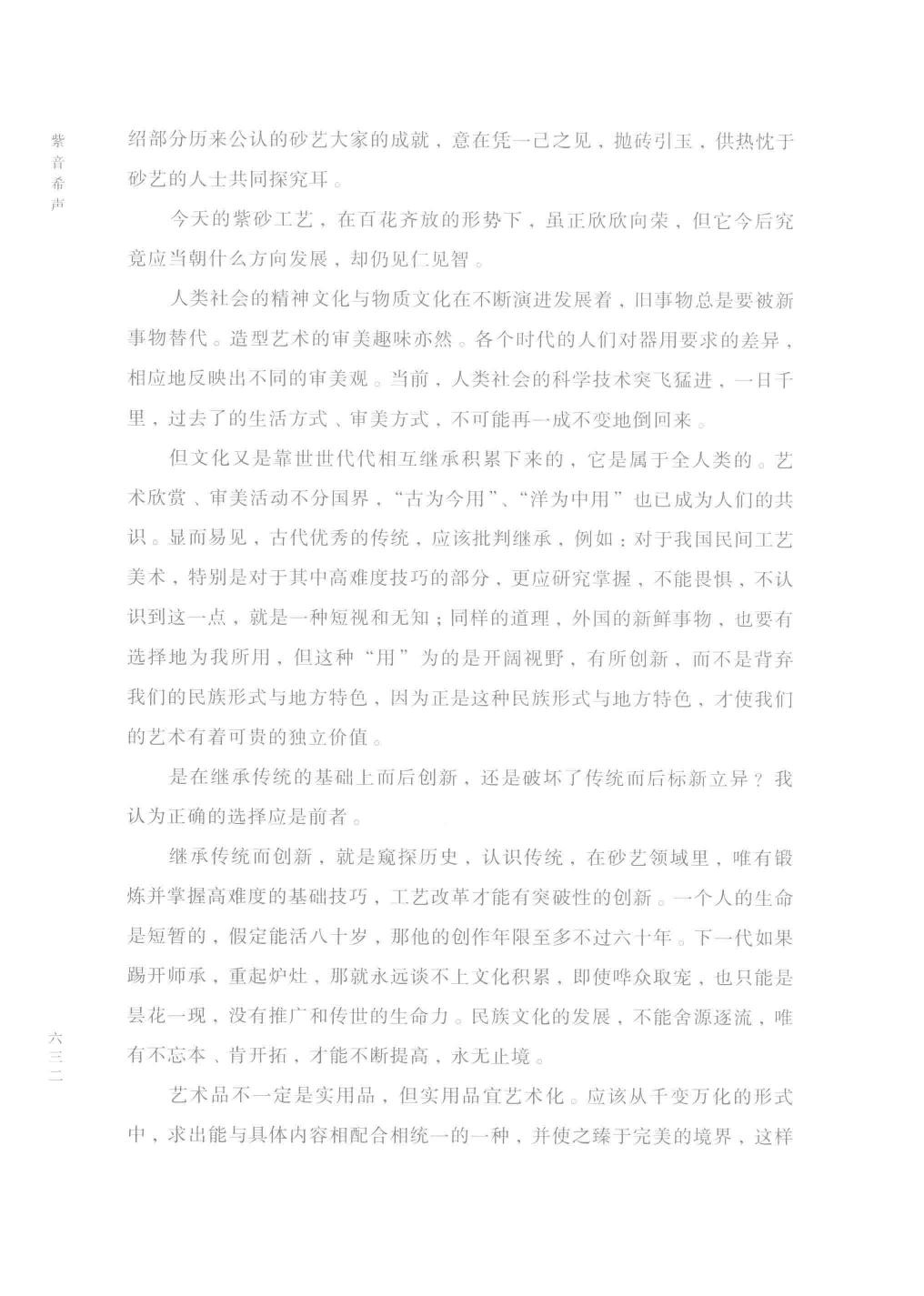
English Translation
I present the achievements of several historically recognized masters of zisha pottery art, offering my personal views in hopes of sparking discussion and providing material for those passionate about zisha art to explore together.
Today's zisha craft is flourishing under the policy of "letting a hundred flowers bloom," yet opinions still differ on what direction it should take in the future.
The spiritual and material culture of human society continues to evolve and develop; old things are always replaced by new ones. The same is true for aesthetic tastes in the plastic arts. The differing requirements people of each era have for utilitarian objects correspondingly reflect different aesthetic views. At present, science and technology in human society are advancing by leaps and bounds, changing with each passing day. The lifestyles and aesthetic approaches of the past cannot possibly return unchanged.
However, culture is also accumulated through inheritance from generation to generation; it belongs to all humanity. Artistic appreciation and aesthetic activity know no national boundaries. "Making the past serve the present" and "making foreign things serve China" have already become common understanding. Obviously, the excellent traditions of our ancestors should be critically inherited. For example, regarding Chinese folk arts and crafts, especially those parts involving highly difficult techniques, we should study and master them rather than abandon them. Failure to recognize this point represents shortsightedness and ignorance. By the same logic, we should also selectively adopt new things from abroad for our use, but this "use" is meant to broaden our horizons and achieve innovation, not to abandon our national forms and local characteristics, because it is precisely these national forms and local characteristics that give our art its precious independent value.
Should we innovate on the foundation of inheriting tradition, or should we destroy tradition and then pursue novelty for its own sake? I believe the correct choice should be the former.
To inherit tradition while innovating means to explore history and understand tradition. In the field of zisha art, only by refining and mastering highly difficult fundamental techniques can craft reform achieve breakthrough innovation. A person's life is brief; assuming one lives to eighty, their creative years amount to at most sixty years. If the next generation kicks away their teachers and starts from scratch, there can never be any cultural accumulation. Even if they attract attention through sensationalism, it can only be a flash in the pan, lacking the vitality for promotion and transmission to future generations. The development of national culture cannot abandon its source and pursue only the flow; only by not forgetting one's roots and being willing to forge ahead can we continuously improve without limit.
Art objects need not be utilitarian objects, but utilitarian objects should be made artistic. We should seek from ever-changing forms one that can coordinate and unify with specific content, bringing it to a state of perfection. In this way...
Chapter 10
附录
Appendix
Pages 526-651
View Chapter →
English Translation
I present the achievements of several historically recognized masters of zisha pottery art, offering my personal views in hopes of sparking discussion and providing material for those passionate about zisha art to explore together.
Today's zisha craft is flourishing under the policy of "letting a hundred flowers bloom," yet opinions still differ on what direction it should take in the future.
The spiritual and material culture of human society continues to evolve and develop; old things are always replaced by new ones. The same is true for aesthetic tastes in the plastic arts. The differing requirements people of each era have for utilitarian objects correspondingly reflect different aesthetic views. At present, science and technology in human society are advancing by leaps and bounds, changing with each passing day. The lifestyles and aesthetic approaches of the past cannot possibly return unchanged.
However, culture is also accumulated through inheritance from generation to generation; it belongs to all humanity. Artistic appreciation and aesthetic activity know no national boundaries. "Making the past serve the present" and "making foreign things serve China" have already become common understanding. Obviously, the excellent traditions of our ancestors should be critically inherited. For example, regarding Chinese folk arts and crafts, especially those parts involving highly difficult techniques, we should study and master them rather than abandon them. Failure to recognize this point represents shortsightedness and ignorance. By the same logic, we should also selectively adopt new things from abroad for our use, but this "use" is meant to broaden our horizons and achieve innovation, not to abandon our national forms and local characteristics, because it is precisely these national forms and local characteristics that give our art its precious independent value.
Should we innovate on the foundation of inheriting tradition, or should we destroy tradition and then pursue novelty for its own sake? I believe the correct choice should be the former.
To inherit tradition while innovating means to explore history and understand tradition. In the field of zisha art, only by refining and mastering highly difficult fundamental techniques can craft reform achieve breakthrough innovation. A person's life is brief; assuming one lives to eighty, their creative years amount to at most sixty years. If the next generation kicks away their teachers and starts from scratch, there can never be any cultural accumulation. Even if they attract attention through sensationalism, it can only be a flash in the pan, lacking the vitality for promotion and transmission to future generations. The development of national culture cannot abandon its source and pursue only the flow; only by not forgetting one's roots and being willing to forge ahead can we continuously improve without limit.
Art objects need not be utilitarian objects, but utilitarian objects should be made artistic. We should seek from ever-changing forms one that can coordinate and unify with specific content, bringing it to a state of perfection. In this way...
章节导航 Chapter Navigation
Chapter 1
序文
Pages 6-6
Chapter 2
引言
Pages 28-31
Chapter 3
达变
Pages 32-133
Chapter 3
开宗立派
Pages 46-66
Chapter 3
传道授业
Pages 67-98
Chapter 3
大师淳友
Pages 99-120
Chapter 3
学艺谋生
Pages 121-133
Chapter 4
化神
Pages 134-141
Chapter 5
独妙
Pages 142-405
Chapter 5
匠心独运 不苟丝毫
Pages 142-179
Chapter 5
器利善事 物尽其用
Pages 180-199
Chapter 5
紫泥春华 研精究微
Pages 200-405
Chapter 6
驾简
Pages 406-427
Chapter 6
精雕细刻 文质合一
Pages 406-410
Chapter 6
师法自然 妙趣横生
Pages 411-415
Chapter 6
丝来线去 曲尽其妙
Pages 416-427
Chapter 7
明志
Pages 463-485
Chapter 7
高山仰止 淡泊明志
Pages 463-472
Chapter 7
啜墨看茶 气定神闲
Pages 473-478
Chapter 7
齿少心锐 怡志抒情
Pages 479-485
Chapter 8
存真
Pages 428-462
Chapter 8
规圆矩方 弃伪存真
Pages 428-436
Chapter 8
有物有则 钻尖仰高
Pages 437-462
Chapter 9
心营
Pages 506-525
Chapter 9
坚守传统 艺立潮头
Pages 506-513
Chapter 9
新型师承 桃李满园
Pages 514-525
Chapter 10
附录
Pages 526-651
Chapter 10
顾景舟紫艺论文
Pages 526-535
Chapter 10
技术课备课笔记
Pages 536-543
Chapter 10
顾景舟艺术年表
Pages 544-651
Chapter 11
参考文献
Pages 652-657
Chapter 12
鸣谢
Pages 658-659