Chapter 10
附录
Appendix
636
of 659
English Translation
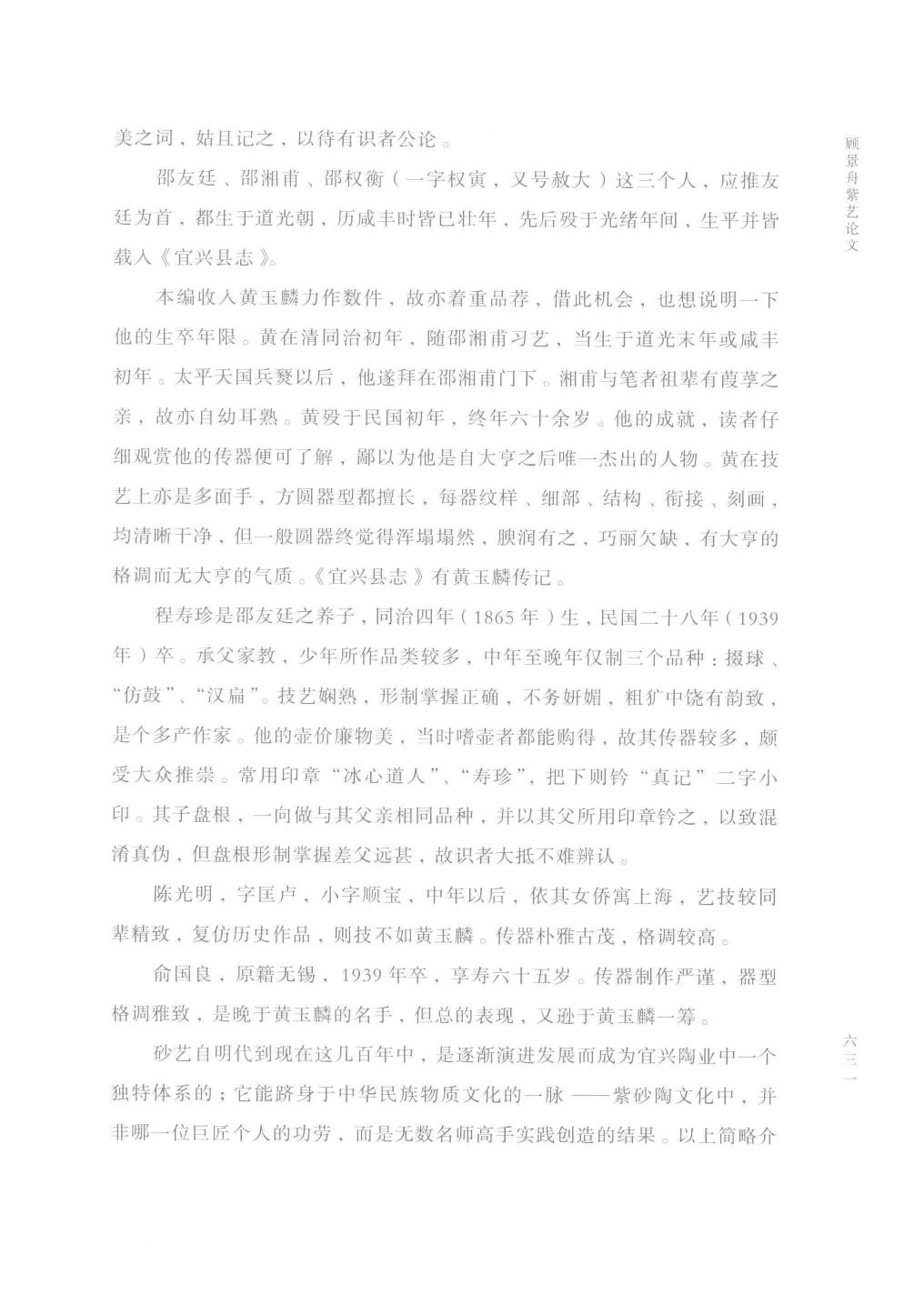
Yu Youting, Shao Xiangfu, and Shao Quanheng (also styled Quanxiu, with the sobriquet Shedai) — among these three men, Youting should be considered foremost. All were born during the Daoguang reign, reached their prime years during the Xianfeng period, and lived successively into the Guangxu era. The biographies of all three are recorded in the *Yixing County Gazetteer*.
This compilation includes several masterworks by Huang Yulin, and thus I wish to emphasize his achievements. Taking this opportunity, I would also like to clarify the dates of his life. Huang studied his craft under Shao Xiangfu in the early Tongzhi period, and was likely born in the late Daoguang or early Xianfeng years. After the Taiping Rebellion, he formally became Shao Xiangfu's disciple. Xiangfu had a close friendship with my grandfather's generation, so I heard of him from childhood. Huang passed away in the early Republican period at the age of sixty-some years. His achievements can be understood by carefully examining his surviving works. I consider him the only outstanding figure since Dapeng. Huang was also versatile in his technical skills, excelling in both square and round vessel forms. In every piece, the decorative patterns, details, structure, joints, and incised designs are all clear and refined. However, his round vessels generally feel somewhat heavy and solid — possessing smoothness but lacking delicate beauty, having the manner of a great master but not the spirit of one. The *Yixing County Gazetteer* contains a biography of Huang Yulin.
Cheng Shouzhen was the adopted son of Shao Youting, born in the fourth year of Tongzhi (1865) and died in the twenty-eighth year of the Republic (1939). Inheriting his father's teachings, he produced a greater variety of works in his youth, but from middle to late age made only three types: the ball-shaped pot, the "imitation drum," and the "Han flat." His technique was skilled, his grasp of form accurate, and he did not pursue superficial charm. Within his rustic simplicity lay a certain elegance — he was a prolific artist. His prices were reasonable and quality excellent, so teapot enthusiasts of the time could afford to purchase his work. Thus his surviving pieces are numerous and highly esteemed by the public. He commonly used the seals "Bingxin Daoren" and "Shouzhen," with a small seal reading "Zhenji" beneath the handle. His son Pangen always made the same types as his father and used his father's seals, leading to confusion between authentic and false pieces. However, Pangen's grasp of form was far inferior to his father's, so the discerning can generally distinguish between them without difficulty.
Chen Guangming, styled Kuanglu, childhood name Shunbao — in middle age and after, he lived with his daughter's family in Shanghai. His technical skill was more refined than his contemporaries', though when imitating historical works, his technique was inferior to Huang Yulin's. His surviving pieces are simple, elegant, and archaic in character, of relatively high quality.
Yu Guoliang, originally from Wuxi, died in 1939 at the age of sixty-five. His surviving works show rigorous craftsmanship, with vessel forms of elegant character. He was a master who came after Huang Yulin, though his overall achievement fell somewhat short of Huang's.
Over the several hundred years from the Ming dynasty to the present, the art of purple clay has gradually evolved and developed into a unique system within Yixing's ceramic industry. Its place within the material culture of the Chinese nation — the culture of purple clay ceramics — is not the achievement of any single great master, but rather the result of practical creation by countless renowned teachers and skilled artisans. The above is a brief introduction...
Chapter 10
附录
Appendix
Pages 526-651
View Chapter →
English Translation
Yu Youting, Shao Xiangfu, and Shao Quanheng (also styled Quanxiu, with the sobriquet Shedai) — among these three men, Youting should be considered foremost. All were born during the Daoguang reign, reached their prime years during the Xianfeng period, and lived successively into the Guangxu era. The biographies of all three are recorded in the *Yixing County Gazetteer*.
This compilation includes several masterworks by Huang Yulin, and thus I wish to emphasize his achievements. Taking this opportunity, I would also like to clarify the dates of his life. Huang studied his craft under Shao Xiangfu in the early Tongzhi period, and was likely born in the late Daoguang or early Xianfeng years. After the Taiping Rebellion, he formally became Shao Xiangfu's disciple. Xiangfu had a close friendship with my grandfather's generation, so I heard of him from childhood. Huang passed away in the early Republican period at the age of sixty-some years. His achievements can be understood by carefully examining his surviving works. I consider him the only outstanding figure since Dapeng. Huang was also versatile in his technical skills, excelling in both square and round vessel forms. In every piece, the decorative patterns, details, structure, joints, and incised designs are all clear and refined. However, his round vessels generally feel somewhat heavy and solid — possessing smoothness but lacking delicate beauty, having the manner of a great master but not the spirit of one. The *Yixing County Gazetteer* contains a biography of Huang Yulin.
Cheng Shouzhen was the adopted son of Shao Youting, born in the fourth year of Tongzhi (1865) and died in the twenty-eighth year of the Republic (1939). Inheriting his father's teachings, he produced a greater variety of works in his youth, but from middle to late age made only three types: the ball-shaped pot, the "imitation drum," and the "Han flat." His technique was skilled, his grasp of form accurate, and he did not pursue superficial charm. Within his rustic simplicity lay a certain elegance — he was a prolific artist. His prices were reasonable and quality excellent, so teapot enthusiasts of the time could afford to purchase his work. Thus his surviving pieces are numerous and highly esteemed by the public. He commonly used the seals "Bingxin Daoren" and "Shouzhen," with a small seal reading "Zhenji" beneath the handle. His son Pangen always made the same types as his father and used his father's seals, leading to confusion between authentic and false pieces. However, Pangen's grasp of form was far inferior to his father's, so the discerning can generally distinguish between them without difficulty.
Chen Guangming, styled Kuanglu, childhood name Shunbao — in middle age and after, he lived with his daughter's family in Shanghai. His technical skill was more refined than his contemporaries', though when imitating historical works, his technique was inferior to Huang Yulin's. His surviving pieces are simple, elegant, and archaic in character, of relatively high quality.
Yu Guoliang, originally from Wuxi, died in 1939 at the age of sixty-five. His surviving works show rigorous craftsmanship, with vessel forms of elegant character. He was a master who came after Huang Yulin, though his overall achievement fell somewhat short of Huang's.
Over the several hundred years from the Ming dynasty to the present, the art of purple clay has gradually evolved and developed into a unique system within Yixing's ceramic industry. Its place within the material culture of the Chinese nation — the culture of purple clay ceramics — is not the achievement of any single great master, but rather the result of practical creation by countless renowned teachers and skilled artisans. The above is a brief introduction...
章节导航 Chapter Navigation
Chapter 1
序文
Pages 6-6
Chapter 2
引言
Pages 28-31
Chapter 3
达变
Pages 32-133
Chapter 3
开宗立派
Pages 46-66
Chapter 3
传道授业
Pages 67-98
Chapter 3
大师淳友
Pages 99-120
Chapter 3
学艺谋生
Pages 121-133
Chapter 4
化神
Pages 134-141
Chapter 5
独妙
Pages 142-405
Chapter 5
匠心独运 不苟丝毫
Pages 142-179
Chapter 5
器利善事 物尽其用
Pages 180-199
Chapter 5
紫泥春华 研精究微
Pages 200-405
Chapter 6
驾简
Pages 406-427
Chapter 6
精雕细刻 文质合一
Pages 406-410
Chapter 6
师法自然 妙趣横生
Pages 411-415
Chapter 6
丝来线去 曲尽其妙
Pages 416-427
Chapter 7
明志
Pages 463-485
Chapter 7
高山仰止 淡泊明志
Pages 463-472
Chapter 7
啜墨看茶 气定神闲
Pages 473-478
Chapter 7
齿少心锐 怡志抒情
Pages 479-485
Chapter 8
存真
Pages 428-462
Chapter 8
规圆矩方 弃伪存真
Pages 428-436
Chapter 8
有物有则 钻尖仰高
Pages 437-462
Chapter 9
心营
Pages 506-525
Chapter 9
坚守传统 艺立潮头
Pages 506-513
Chapter 9
新型师承 桃李满园
Pages 514-525
Chapter 10
附录
Pages 526-651
Chapter 10
顾景舟紫艺论文
Pages 526-535
Chapter 10
技术课备课笔记
Pages 536-543
Chapter 10
顾景舟艺术年表
Pages 544-651
Chapter 11
参考文献
Pages 652-657
Chapter 12
鸣谢
Pages 658-659