Chapter 10
附录
Appendix
640
of 659
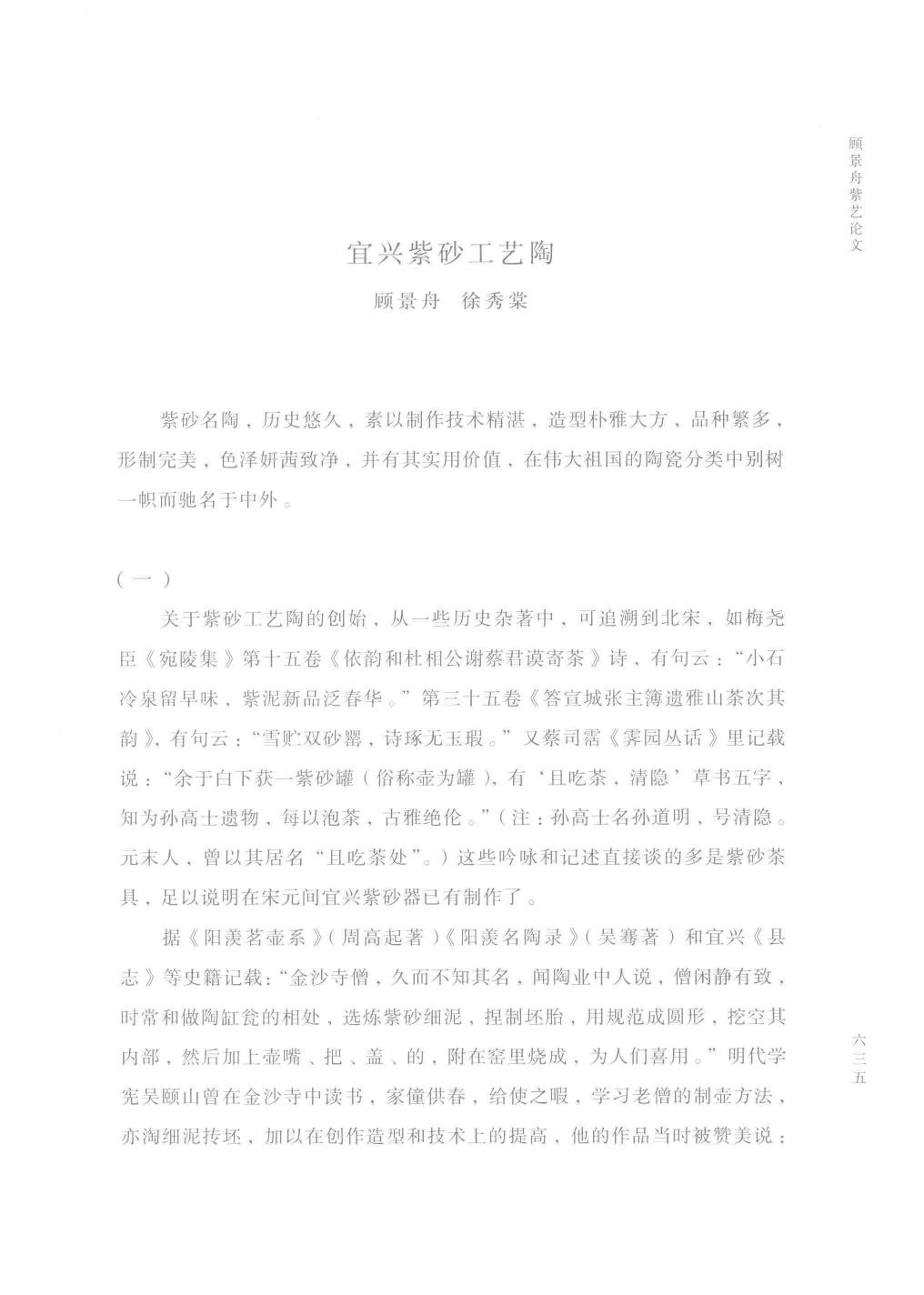
English Translation
Gu Jingzhou and Xu Xiudang
Purple clay renowned pottery has a long history. It has always been celebrated for its exquisite craftsmanship, elegant and dignified forms, abundant varieties, perfect shapes, lustrous and refined colors, and practical value. Among the pottery classifications of our great motherland, it stands uniquely distinguished and is famous both at home and abroad.
## (I)
Regarding the origins of purple clay craft pottery, historical miscellaneous writings trace it back to the Northern Song Dynasty. For example, in Mei Yaochen's *Wanling Collection*, Volume 15, the poem "Following the Previous Rhyme in Response to Minister Du's Thanks for the Gift of Tea" contains the lines: "Small stones and cold springs preserve the early flavor, purple clay new wares float with spring's splendor." Volume 35, "Replying to Zhang, Magistrate of Xuancheng, Who Sent Ya Mountain Tea, Matching His Rhyme," has the lines: "Snow stored in double sand jars turns black, poems carved without jade's descent." Also, in Chen Jiru's *Nigarden Miscellaneous Talks*, it is recorded: "I obtained a purple clay jar in Baixia (commonly called a guan), inscribed with five cursive characters '且吃茶清隐' (Just drink tea, Pure Recluse), and knew it to be a relic of the High Scholar Sun. Whenever I use it to brew tea, it is elegantly antique beyond compare." (Note: High Scholar Sun's name was Sun Daoming, styled Qingyin. A man of the Yuan Dynasty, he once named his dwelling "The Place for Just Drinking Tea.") These poetic compositions and records directly discuss purple clay tea wares, sufficiently demonstrating that Yixing purple clay vessels were already being produced during the Song and Yuan periods.
According to historical records such as *Yangxian Teapot System* (by Zhou Gaoqi), *Yangxian Famous Pottery Record* (by Wu Qian), and the Yixing *County Gazetteer*: "There was a monk at Jinsha Temple whose name has long been forgotten. According to people in the pottery trade, the monk was leisurely and refined in disposition, often associating with those who made pottery jars. He selected and refined purple clay fine mud, molded the clay body, used templates to form round shapes, hollowed out the interior, then added spout, handle, lid, and foot, and fired them in the kiln, making them beloved by people." During the Ming Dynasty, the scholar Wu Yishan once studied at Jinsha Temple. His family servant Gongchun accompanied him in service and learned the old monk's teapot-making methods. He also refined fine clay to form vessels, and through improvements in creative design and technique, his works were praised at the time as:
[The text appears to end mid-sentence in the original]
Chapter 10
附录
Appendix
Pages 526-651
View Chapter →
English Translation
Gu Jingzhou and Xu Xiudang
Purple clay renowned pottery has a long history. It has always been celebrated for its exquisite craftsmanship, elegant and dignified forms, abundant varieties, perfect shapes, lustrous and refined colors, and practical value. Among the pottery classifications of our great motherland, it stands uniquely distinguished and is famous both at home and abroad.
## (I)
Regarding the origins of purple clay craft pottery, historical miscellaneous writings trace it back to the Northern Song Dynasty. For example, in Mei Yaochen's *Wanling Collection*, Volume 15, the poem "Following the Previous Rhyme in Response to Minister Du's Thanks for the Gift of Tea" contains the lines: "Small stones and cold springs preserve the early flavor, purple clay new wares float with spring's splendor." Volume 35, "Replying to Zhang, Magistrate of Xuancheng, Who Sent Ya Mountain Tea, Matching His Rhyme," has the lines: "Snow stored in double sand jars turns black, poems carved without jade's descent." Also, in Chen Jiru's *Nigarden Miscellaneous Talks*, it is recorded: "I obtained a purple clay jar in Baixia (commonly called a guan), inscribed with five cursive characters '且吃茶清隐' (Just drink tea, Pure Recluse), and knew it to be a relic of the High Scholar Sun. Whenever I use it to brew tea, it is elegantly antique beyond compare." (Note: High Scholar Sun's name was Sun Daoming, styled Qingyin. A man of the Yuan Dynasty, he once named his dwelling "The Place for Just Drinking Tea.") These poetic compositions and records directly discuss purple clay tea wares, sufficiently demonstrating that Yixing purple clay vessels were already being produced during the Song and Yuan periods.
According to historical records such as *Yangxian Teapot System* (by Zhou Gaoqi), *Yangxian Famous Pottery Record* (by Wu Qian), and the Yixing *County Gazetteer*: "There was a monk at Jinsha Temple whose name has long been forgotten. According to people in the pottery trade, the monk was leisurely and refined in disposition, often associating with those who made pottery jars. He selected and refined purple clay fine mud, molded the clay body, used templates to form round shapes, hollowed out the interior, then added spout, handle, lid, and foot, and fired them in the kiln, making them beloved by people." During the Ming Dynasty, the scholar Wu Yishan once studied at Jinsha Temple. His family servant Gongchun accompanied him in service and learned the old monk's teapot-making methods. He also refined fine clay to form vessels, and through improvements in creative design and technique, his works were praised at the time as:
[The text appears to end mid-sentence in the original]
章节导航 Chapter Navigation
Chapter 1
序文
Pages 6-6
Chapter 2
引言
Pages 28-31
Chapter 3
达变
Pages 32-133
Chapter 3
开宗立派
Pages 46-66
Chapter 3
传道授业
Pages 67-98
Chapter 3
大师淳友
Pages 99-120
Chapter 3
学艺谋生
Pages 121-133
Chapter 4
化神
Pages 134-141
Chapter 5
独妙
Pages 142-405
Chapter 5
匠心独运 不苟丝毫
Pages 142-179
Chapter 5
器利善事 物尽其用
Pages 180-199
Chapter 5
紫泥春华 研精究微
Pages 200-405
Chapter 6
驾简
Pages 406-427
Chapter 6
精雕细刻 文质合一
Pages 406-410
Chapter 6
师法自然 妙趣横生
Pages 411-415
Chapter 6
丝来线去 曲尽其妙
Pages 416-427
Chapter 7
明志
Pages 463-485
Chapter 7
高山仰止 淡泊明志
Pages 463-472
Chapter 7
啜墨看茶 气定神闲
Pages 473-478
Chapter 7
齿少心锐 怡志抒情
Pages 479-485
Chapter 8
存真
Pages 428-462
Chapter 8
规圆矩方 弃伪存真
Pages 428-436
Chapter 8
有物有则 钻尖仰高
Pages 437-462
Chapter 9
心营
Pages 506-525
Chapter 9
坚守传统 艺立潮头
Pages 506-513
Chapter 9
新型师承 桃李满园
Pages 514-525
Chapter 10
附录
Pages 526-651
Chapter 10
顾景舟紫艺论文
Pages 526-535
Chapter 10
技术课备课笔记
Pages 536-543
Chapter 10
顾景舟艺术年表
Pages 544-651
Chapter 11
参考文献
Pages 652-657
Chapter 12
鸣谢
Pages 658-659