Chapter 10
附录
Appendix
641
of 659
English Translation
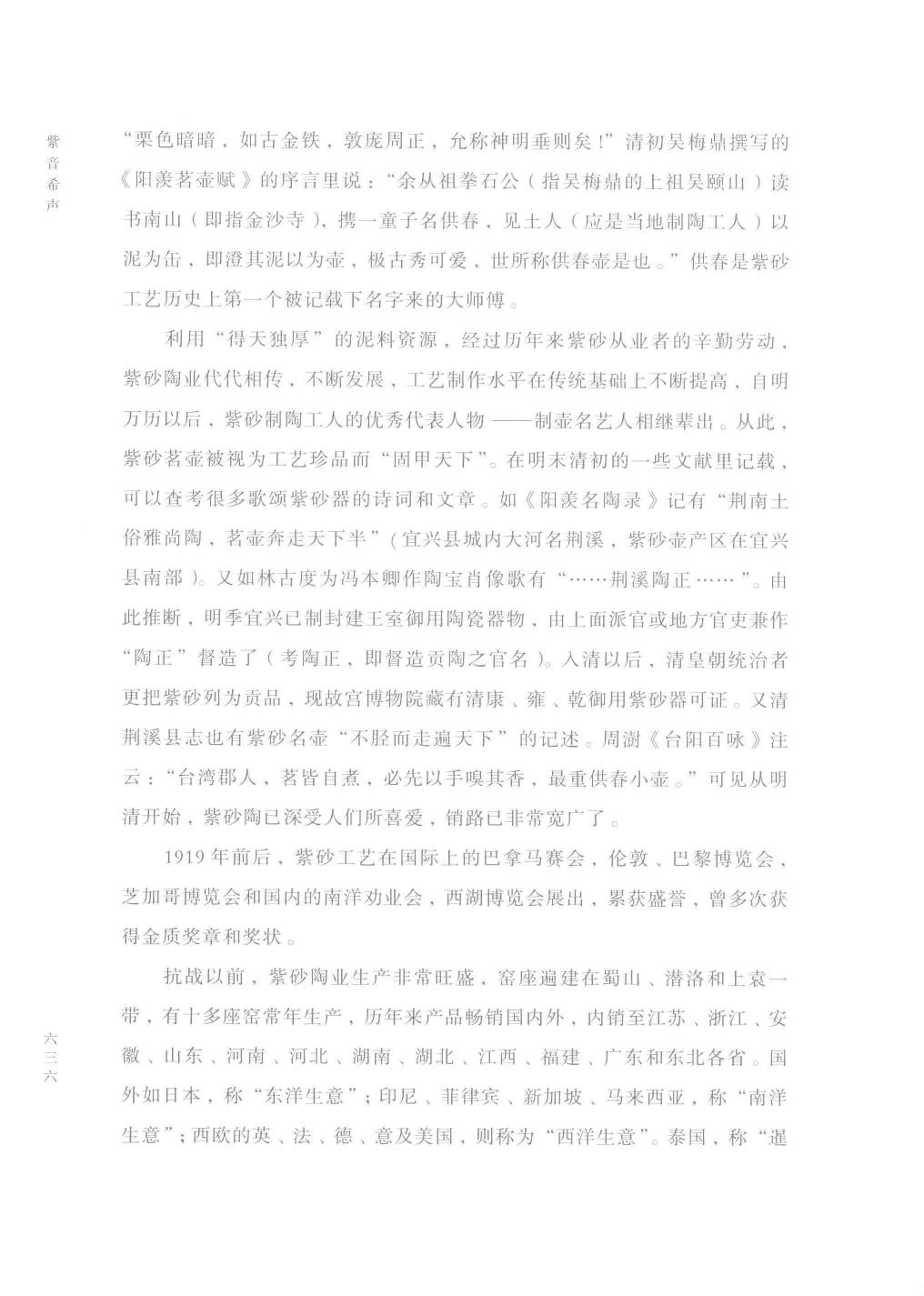
"Chestnut-colored and dark, like forged metal, solid and upright in form, truly worthy of being called a divine standard!" The preface to *Ode to the Yang Xian Teapot* written by Wu Meizhan in the early Qing Dynasty states: "My great-uncle Quanshi Gong (referring to Wu Meishan's ancestor Wu Jiangshan) was studying at Nanshan (referring to Jinsha Temple), accompanied by a servant boy named Gong Chun. Seeing local craftsmen (likely local pottery workers) making items from clay, he refined the clay to make teapots, which were extremely elegant and lovely. What the world calls Gong Chun teapots refers to these." Gong Chun was the first master craftsman in the history of Yixing pottery whose name was recorded.
Making use of the "uniquely advantageous" clay resources, through the diligent labor of Yixing pottery practitioners over the years, the Yixing pottery industry has been passed down through generations and continuously developed. The level of craftsmanship has constantly improved upon traditional foundations. Since the Wanli period of the Ming Dynasty, outstanding representatives of Yixing pottery workers—renowned teapot artisans—have emerged in succession. From then on, Yixing teapots were regarded as treasured works of craftsmanship and "ranked first under heaven." In various documents from the Ming and early Qing dynasties, one can find many poems and essays praising Yixing pottery. For example, *Record of Famous Pottery from Yang Xian* records: "The customs south of the Jing River elegantly favor pottery, teapots rush to half the world" (the great river within Yixing county town is named Jingxi, and the Yixing pottery production area is in the southern part of Yixing county). Another example is Lin Gudu's portrait song for Chen Benqing's pottery treasures, which mentions "...Jingxi pottery supervisor..." From this we can infer that by the late Ming Dynasty, Yixing was already producing ceramic vessels for imperial use by the feudal royal court, with officials dispatched from above or local officials concurrently serving as "pottery supervisors" to oversee production (the pottery supervisor was the official title for those overseeing the production of tribute pottery). After entering the Qing Dynasty, the Qing imperial rulers further designated Yixing pottery as tribute items, as evidenced by Yixing pottery vessels for imperial use from the Kangxi, Yongzheng, and Qianlong reigns now housed in the Palace Museum. The Qing *Yixing County Gazetteer* also records that famous Yixing pottery "traveled throughout the world without effort." Zhou Hu's *One Hundred Poems of Taiyang* notes: "The people of Taiwan, when drinking tea, must first smell its fragrance with their hands, and most highly value small Gong Chun teapots." It can be seen that from the Ming and Qing dynasties onward, Yixing pottery was deeply loved by people, and its market had become very extensive.
Around 1919, Yixing craftsmanship was exhibited at international events including the Panama Exhibition, London and Paris Expositions, Chicago Exposition, and domestic events such as the Nanyang Encouragement of Industry Fair and West Lake Exposition, repeatedly earning acclaim and winning gold medals and certificates of merit multiple times.
Before the War of Resistance, Yixing pottery production was extremely prosperous. Kilns were built throughout the Dingshu, Qianluo, and Shangxi areas, with more than ten kilns in constant production. Over the years, products sold well both domestically and internationally. Domestic sales reached Jiangsu, Zhejiang, Anhui, Shandong, Henan, Hebei, Hunan, Hubei, Jiangxi, Fujian, Guangdong, and the northeastern provinces. Internationally, Japan was called the "Eastern trade"; Indonesia, the Philippines, Singapore, and Malaysia were called the "Southern trade"; Western European countries including Britain, France, Germany, Italy, and the United States were called the "Western trade"; and Thailand was called the "Siam trade."
Chapter 10
附录
Appendix
Pages 526-651
View Chapter →
English Translation
"Chestnut-colored and dark, like forged metal, solid and upright in form, truly worthy of being called a divine standard!" The preface to *Ode to the Yang Xian Teapot* written by Wu Meizhan in the early Qing Dynasty states: "My great-uncle Quanshi Gong (referring to Wu Meishan's ancestor Wu Jiangshan) was studying at Nanshan (referring to Jinsha Temple), accompanied by a servant boy named Gong Chun. Seeing local craftsmen (likely local pottery workers) making items from clay, he refined the clay to make teapots, which were extremely elegant and lovely. What the world calls Gong Chun teapots refers to these." Gong Chun was the first master craftsman in the history of Yixing pottery whose name was recorded.
Making use of the "uniquely advantageous" clay resources, through the diligent labor of Yixing pottery practitioners over the years, the Yixing pottery industry has been passed down through generations and continuously developed. The level of craftsmanship has constantly improved upon traditional foundations. Since the Wanli period of the Ming Dynasty, outstanding representatives of Yixing pottery workers—renowned teapot artisans—have emerged in succession. From then on, Yixing teapots were regarded as treasured works of craftsmanship and "ranked first under heaven." In various documents from the Ming and early Qing dynasties, one can find many poems and essays praising Yixing pottery. For example, *Record of Famous Pottery from Yang Xian* records: "The customs south of the Jing River elegantly favor pottery, teapots rush to half the world" (the great river within Yixing county town is named Jingxi, and the Yixing pottery production area is in the southern part of Yixing county). Another example is Lin Gudu's portrait song for Chen Benqing's pottery treasures, which mentions "...Jingxi pottery supervisor..." From this we can infer that by the late Ming Dynasty, Yixing was already producing ceramic vessels for imperial use by the feudal royal court, with officials dispatched from above or local officials concurrently serving as "pottery supervisors" to oversee production (the pottery supervisor was the official title for those overseeing the production of tribute pottery). After entering the Qing Dynasty, the Qing imperial rulers further designated Yixing pottery as tribute items, as evidenced by Yixing pottery vessels for imperial use from the Kangxi, Yongzheng, and Qianlong reigns now housed in the Palace Museum. The Qing *Yixing County Gazetteer* also records that famous Yixing pottery "traveled throughout the world without effort." Zhou Hu's *One Hundred Poems of Taiyang* notes: "The people of Taiwan, when drinking tea, must first smell its fragrance with their hands, and most highly value small Gong Chun teapots." It can be seen that from the Ming and Qing dynasties onward, Yixing pottery was deeply loved by people, and its market had become very extensive.
Around 1919, Yixing craftsmanship was exhibited at international events including the Panama Exhibition, London and Paris Expositions, Chicago Exposition, and domestic events such as the Nanyang Encouragement of Industry Fair and West Lake Exposition, repeatedly earning acclaim and winning gold medals and certificates of merit multiple times.
Before the War of Resistance, Yixing pottery production was extremely prosperous. Kilns were built throughout the Dingshu, Qianluo, and Shangxi areas, with more than ten kilns in constant production. Over the years, products sold well both domestically and internationally. Domestic sales reached Jiangsu, Zhejiang, Anhui, Shandong, Henan, Hebei, Hunan, Hubei, Jiangxi, Fujian, Guangdong, and the northeastern provinces. Internationally, Japan was called the "Eastern trade"; Indonesia, the Philippines, Singapore, and Malaysia were called the "Southern trade"; Western European countries including Britain, France, Germany, Italy, and the United States were called the "Western trade"; and Thailand was called the "Siam trade."
章节导航 Chapter Navigation
Chapter 1
序文
Pages 6-6
Chapter 2
引言
Pages 28-31
Chapter 3
达变
Pages 32-133
Chapter 3
开宗立派
Pages 46-66
Chapter 3
传道授业
Pages 67-98
Chapter 3
大师淳友
Pages 99-120
Chapter 3
学艺谋生
Pages 121-133
Chapter 4
化神
Pages 134-141
Chapter 5
独妙
Pages 142-405
Chapter 5
匠心独运 不苟丝毫
Pages 142-179
Chapter 5
器利善事 物尽其用
Pages 180-199
Chapter 5
紫泥春华 研精究微
Pages 200-405
Chapter 6
驾简
Pages 406-427
Chapter 6
精雕细刻 文质合一
Pages 406-410
Chapter 6
师法自然 妙趣横生
Pages 411-415
Chapter 6
丝来线去 曲尽其妙
Pages 416-427
Chapter 7
明志
Pages 463-485
Chapter 7
高山仰止 淡泊明志
Pages 463-472
Chapter 7
啜墨看茶 气定神闲
Pages 473-478
Chapter 7
齿少心锐 怡志抒情
Pages 479-485
Chapter 8
存真
Pages 428-462
Chapter 8
规圆矩方 弃伪存真
Pages 428-436
Chapter 8
有物有则 钻尖仰高
Pages 437-462
Chapter 9
心营
Pages 506-525
Chapter 9
坚守传统 艺立潮头
Pages 506-513
Chapter 9
新型师承 桃李满园
Pages 514-525
Chapter 10
附录
Pages 526-651
Chapter 10
顾景舟紫艺论文
Pages 526-535
Chapter 10
技术课备课笔记
Pages 536-543
Chapter 10
顾景舟艺术年表
Pages 544-651
Chapter 11
参考文献
Pages 652-657
Chapter 12
鸣谢
Pages 658-659