Chapter 3
达变
Adaptation
74
of 659
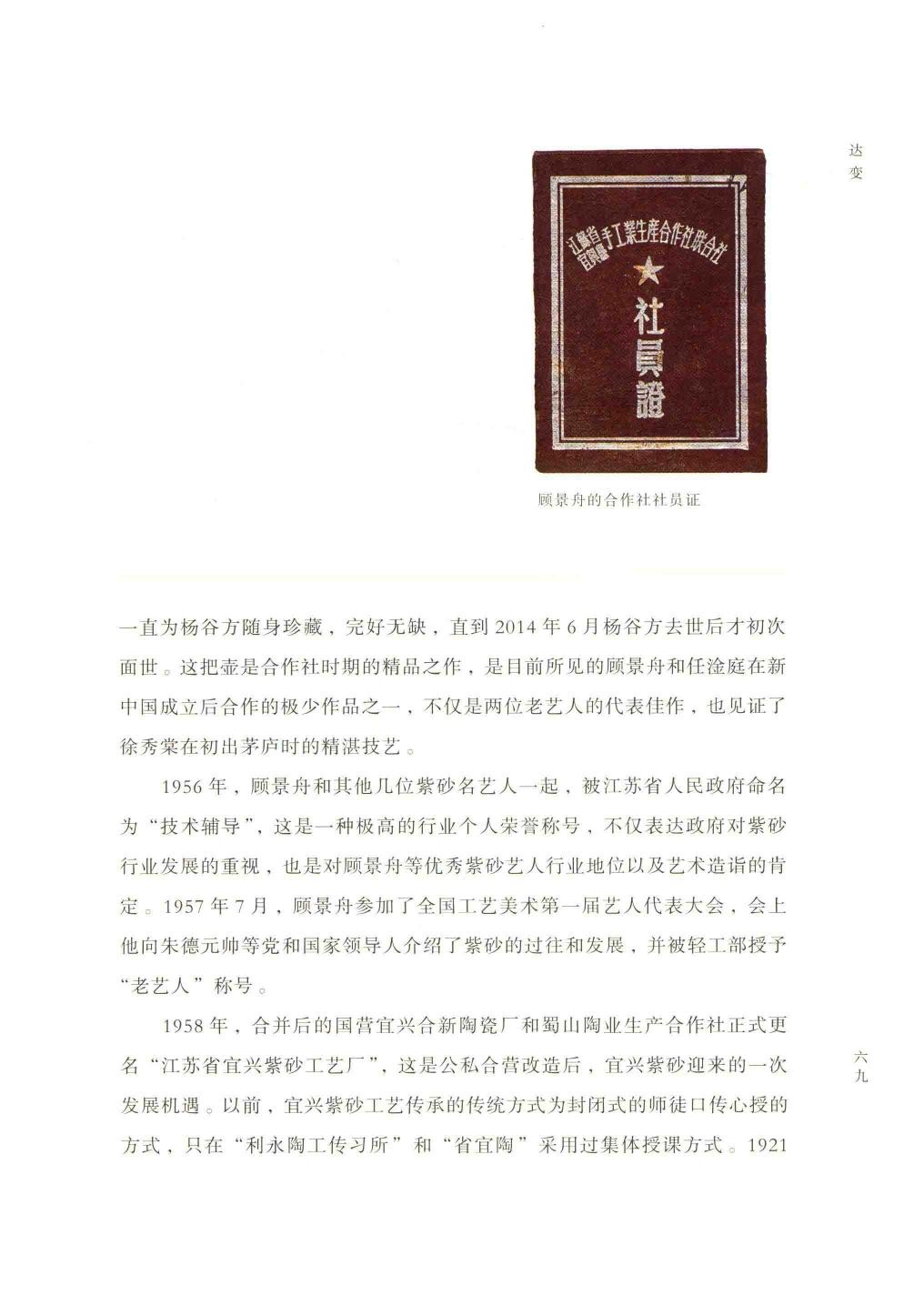
English Translation
It had been treasured by Yang Gufang throughout his life, remaining in perfect condition until it was first revealed to the public after Yang Gufang's death in June 2014. This teapot is an exquisite masterpiece from the cooperative period and represents one of the extremely rare collaborative works between Gu Jingzhou and Ren Huaiting after the founding of New China. It is not only a representative masterpiece of these two master artisans, but also bears witness to Xu Xiutang's exceptional craftsmanship during his early career.
In 1956, Gu Jingzhou, together with several other renowned Yixing pottery artisans, was designated as "Technical Instructor" by the People's Government of Jiangsu Province. This was an extremely high professional individual honor, expressing not only the government's emphasis on the development of the Yixing pottery industry, but also an affirmation of the professional status and artistic achievements of outstanding Yixing pottery artisans like Gu Jingzhou. In July 1957, Gu Jingzhou participated in the First National Congress of Arts and Crafts Artisan Representatives, where he introduced the history and development of Yixing pottery to Marshal Zhu De and other Party and state leaders, and was awarded the title of "Master Artisan" by the Ministry of Light Industry.
In 1958, the merged state-owned Yixing Hexin Ceramics Factory and Shushan Pottery Production Cooperative was officially renamed "Jiangsu Province Yixing Zisha Craft Factory." This marked a development opportunity for Yixing pottery following the public-private partnership transformation. Previously, the traditional method of transmitting Yixing pottery craftsmanship was through a closed master-apprentice system of oral instruction and personal demonstration, with collective teaching methods only having been adopted at the "Liyong Pottery Workers Training Institute" and the "Provincial Yixing Pottery" facility. In 1921...
Chapter 3
达变
Adaptation
Pages 32-133
View Chapter →
English Translation
It had been treasured by Yang Gufang throughout his life, remaining in perfect condition until it was first revealed to the public after Yang Gufang's death in June 2014. This teapot is an exquisite masterpiece from the cooperative period and represents one of the extremely rare collaborative works between Gu Jingzhou and Ren Huaiting after the founding of New China. It is not only a representative masterpiece of these two master artisans, but also bears witness to Xu Xiutang's exceptional craftsmanship during his early career.
In 1956, Gu Jingzhou, together with several other renowned Yixing pottery artisans, was designated as "Technical Instructor" by the People's Government of Jiangsu Province. This was an extremely high professional individual honor, expressing not only the government's emphasis on the development of the Yixing pottery industry, but also an affirmation of the professional status and artistic achievements of outstanding Yixing pottery artisans like Gu Jingzhou. In July 1957, Gu Jingzhou participated in the First National Congress of Arts and Crafts Artisan Representatives, where he introduced the history and development of Yixing pottery to Marshal Zhu De and other Party and state leaders, and was awarded the title of "Master Artisan" by the Ministry of Light Industry.
In 1958, the merged state-owned Yixing Hexin Ceramics Factory and Shushan Pottery Production Cooperative was officially renamed "Jiangsu Province Yixing Zisha Craft Factory." This marked a development opportunity for Yixing pottery following the public-private partnership transformation. Previously, the traditional method of transmitting Yixing pottery craftsmanship was through a closed master-apprentice system of oral instruction and personal demonstration, with collective teaching methods only having been adopted at the "Liyong Pottery Workers Training Institute" and the "Provincial Yixing Pottery" facility. In 1921...
章节导航 Chapter Navigation
Chapter 1
序文
Pages 6-6
Chapter 2
引言
Pages 28-31
Chapter 3
达变
Pages 32-133
Chapter 3
开宗立派
Pages 46-66
Chapter 3
传道授业
Pages 67-98
Chapter 3
大师淳友
Pages 99-120
Chapter 3
学艺谋生
Pages 121-133
Chapter 4
化神
Pages 134-141
Chapter 5
独妙
Pages 142-405
Chapter 5
匠心独运 不苟丝毫
Pages 142-179
Chapter 5
器利善事 物尽其用
Pages 180-199
Chapter 5
紫泥春华 研精究微
Pages 200-405
Chapter 6
驾简
Pages 406-427
Chapter 6
精雕细刻 文质合一
Pages 406-410
Chapter 6
师法自然 妙趣横生
Pages 411-415
Chapter 6
丝来线去 曲尽其妙
Pages 416-427
Chapter 7
明志
Pages 463-485
Chapter 7
高山仰止 淡泊明志
Pages 463-472
Chapter 7
啜墨看茶 气定神闲
Pages 473-478
Chapter 7
齿少心锐 怡志抒情
Pages 479-485
Chapter 8
存真
Pages 428-462
Chapter 8
规圆矩方 弃伪存真
Pages 428-436
Chapter 8
有物有则 钻尖仰高
Pages 437-462
Chapter 9
心营
Pages 506-525
Chapter 9
坚守传统 艺立潮头
Pages 506-513
Chapter 9
新型师承 桃李满园
Pages 514-525
Chapter 10
附录
Pages 526-651
Chapter 10
顾景舟紫艺论文
Pages 526-535
Chapter 10
技术课备课笔记
Pages 536-543
Chapter 10
顾景舟艺术年表
Pages 544-651
Chapter 11
参考文献
Pages 652-657
Chapter 12
鸣谢
Pages 658-659