Chapter 3
达变
Adaptation
75
of 659
English Translation
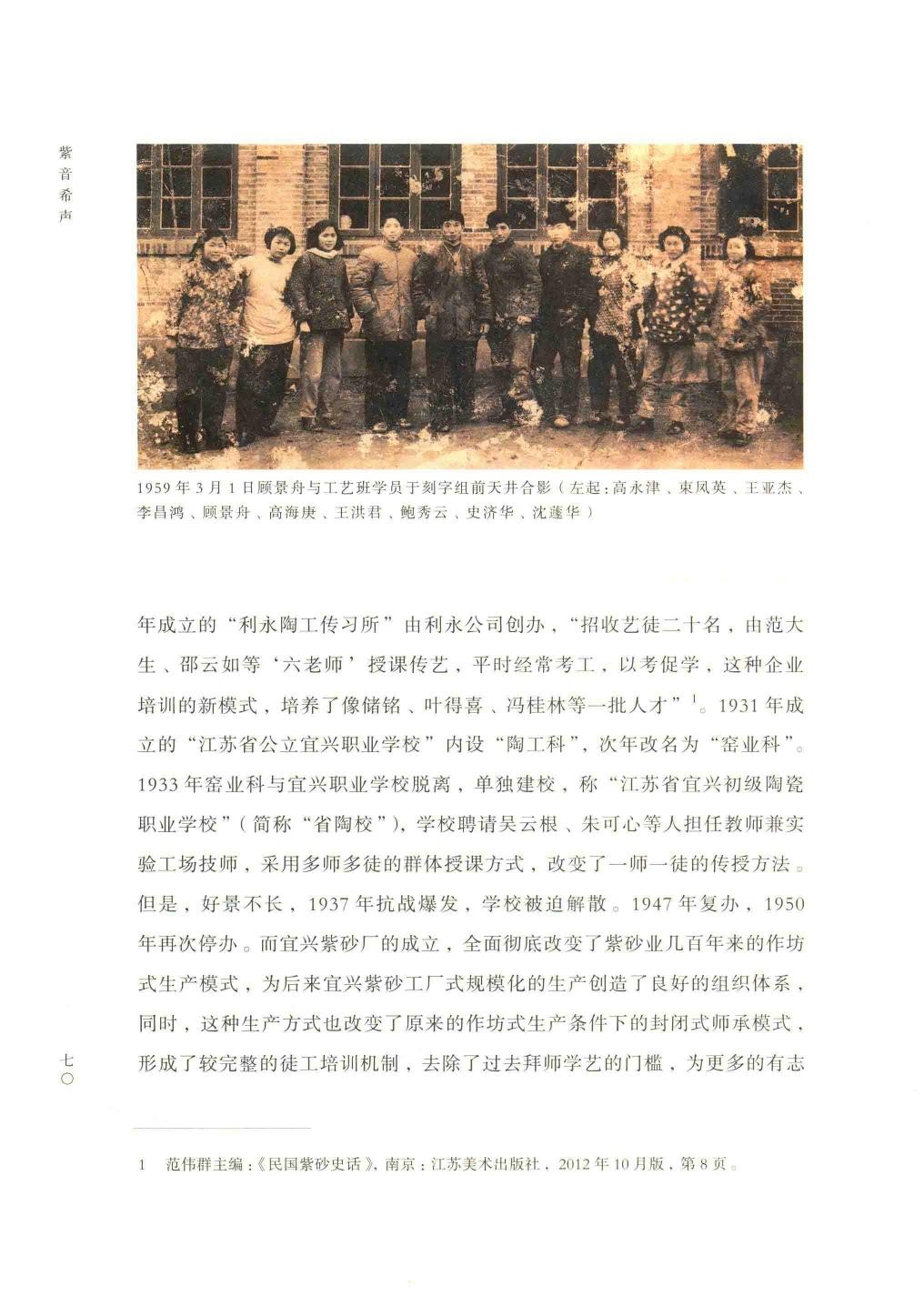
March 1, 1959: Group photo of Gu Jingzhou with craft class students in front of the courtyard of the calligraphy group (from left: Gao Yongjin, Shu Fengying, Wang Yajie, Li Changhong, Gu Jingjiao, Gao Haigeng, Wang Hongjun, Bao Xiuyun, Shi Jihua, Shen Guohua)
The "Liyong Pottery Apprentice Training Institute" was founded by the Liyong Company, "recruiting twenty apprentices, with instruction and skill transmission provided by Fan Da and the 'Six Masters.' Regular examinations were conducted to promote learning through assessment. This enterprise-based training model cultivated a group of talents including Chu Ming, Ye Dexi, and Han Guilin."[1] The "Jiangsu Provincial Public Yixing Vocational School," established in 1931, included a "Pottery Workers Department," which was renamed the "Ceramics Department" the following year. In 1933, the Ceramics Department separated from Yixing Vocational School to establish an independent institution called the "Jiangsu Provincial Yixing Junior Ceramic School" (abbreviated as "Provincial Ceramic School"). The school hired Wu Yungen, Zhu Kexin, and others as teachers and experimental workshop technicians, adopting a group teaching method with multiple masters and multiple apprentices, changing the traditional one-master-one-apprentice transmission method.
However, this prosperity was short-lived. In 1937, the outbreak of the War of Resistance forced the school to disband. It reopened in 1947 but closed again in 1950.
The establishment of the Yixing Zisha [pottery cooperative] completely transformed the centuries-old workshop-style production model of the zisha industry, creating a favorable organizational system for the later factory-scale production at the Yixing Zisha Factory. At the same time, this production method changed the closed master-apprentice model that existed under the original workshop-style production conditions, forming a more complete apprentice training mechanism that removed the barriers of the traditional master-apprentice system, opening opportunities for more aspiring individuals.
---
[1] Fan Weiqun, ed., *A Historical Account of Zisha Pottery in the Republican Era* (Nanjing: Jiangsu Fine Arts Publishing House, October 2012), p. 8.
Chapter 3
达变
Adaptation
Pages 32-133
View Chapter →
English Translation
March 1, 1959: Group photo of Gu Jingzhou with craft class students in front of the courtyard of the calligraphy group (from left: Gao Yongjin, Shu Fengying, Wang Yajie, Li Changhong, Gu Jingjiao, Gao Haigeng, Wang Hongjun, Bao Xiuyun, Shi Jihua, Shen Guohua)
The "Liyong Pottery Apprentice Training Institute" was founded by the Liyong Company, "recruiting twenty apprentices, with instruction and skill transmission provided by Fan Da and the 'Six Masters.' Regular examinations were conducted to promote learning through assessment. This enterprise-based training model cultivated a group of talents including Chu Ming, Ye Dexi, and Han Guilin."[1] The "Jiangsu Provincial Public Yixing Vocational School," established in 1931, included a "Pottery Workers Department," which was renamed the "Ceramics Department" the following year. In 1933, the Ceramics Department separated from Yixing Vocational School to establish an independent institution called the "Jiangsu Provincial Yixing Junior Ceramic School" (abbreviated as "Provincial Ceramic School"). The school hired Wu Yungen, Zhu Kexin, and others as teachers and experimental workshop technicians, adopting a group teaching method with multiple masters and multiple apprentices, changing the traditional one-master-one-apprentice transmission method.
However, this prosperity was short-lived. In 1937, the outbreak of the War of Resistance forced the school to disband. It reopened in 1947 but closed again in 1950.
The establishment of the Yixing Zisha [pottery cooperative] completely transformed the centuries-old workshop-style production model of the zisha industry, creating a favorable organizational system for the later factory-scale production at the Yixing Zisha Factory. At the same time, this production method changed the closed master-apprentice model that existed under the original workshop-style production conditions, forming a more complete apprentice training mechanism that removed the barriers of the traditional master-apprentice system, opening opportunities for more aspiring individuals.
---
[1] Fan Weiqun, ed., *A Historical Account of Zisha Pottery in the Republican Era* (Nanjing: Jiangsu Fine Arts Publishing House, October 2012), p. 8.
章节导航 Chapter Navigation
Chapter 1
序文
Pages 6-6
Chapter 2
引言
Pages 28-31
Chapter 3
达变
Pages 32-133
Chapter 3
开宗立派
Pages 46-66
Chapter 3
传道授业
Pages 67-98
Chapter 3
大师淳友
Pages 99-120
Chapter 3
学艺谋生
Pages 121-133
Chapter 4
化神
Pages 134-141
Chapter 5
独妙
Pages 142-405
Chapter 5
匠心独运 不苟丝毫
Pages 142-179
Chapter 5
器利善事 物尽其用
Pages 180-199
Chapter 5
紫泥春华 研精究微
Pages 200-405
Chapter 6
驾简
Pages 406-427
Chapter 6
精雕细刻 文质合一
Pages 406-410
Chapter 6
师法自然 妙趣横生
Pages 411-415
Chapter 6
丝来线去 曲尽其妙
Pages 416-427
Chapter 7
明志
Pages 463-485
Chapter 7
高山仰止 淡泊明志
Pages 463-472
Chapter 7
啜墨看茶 气定神闲
Pages 473-478
Chapter 7
齿少心锐 怡志抒情
Pages 479-485
Chapter 8
存真
Pages 428-462
Chapter 8
规圆矩方 弃伪存真
Pages 428-436
Chapter 8
有物有则 钻尖仰高
Pages 437-462
Chapter 9
心营
Pages 506-525
Chapter 9
坚守传统 艺立潮头
Pages 506-513
Chapter 9
新型师承 桃李满园
Pages 514-525
Chapter 10
附录
Pages 526-651
Chapter 10
顾景舟紫艺论文
Pages 526-535
Chapter 10
技术课备课笔记
Pages 536-543
Chapter 10
顾景舟艺术年表
Pages 544-651
Chapter 11
参考文献
Pages 652-657
Chapter 12
鸣谢
Pages 658-659