Chapter 3
达变
Adaptation
85
of 659
English Translation
## [Section Title Missing]
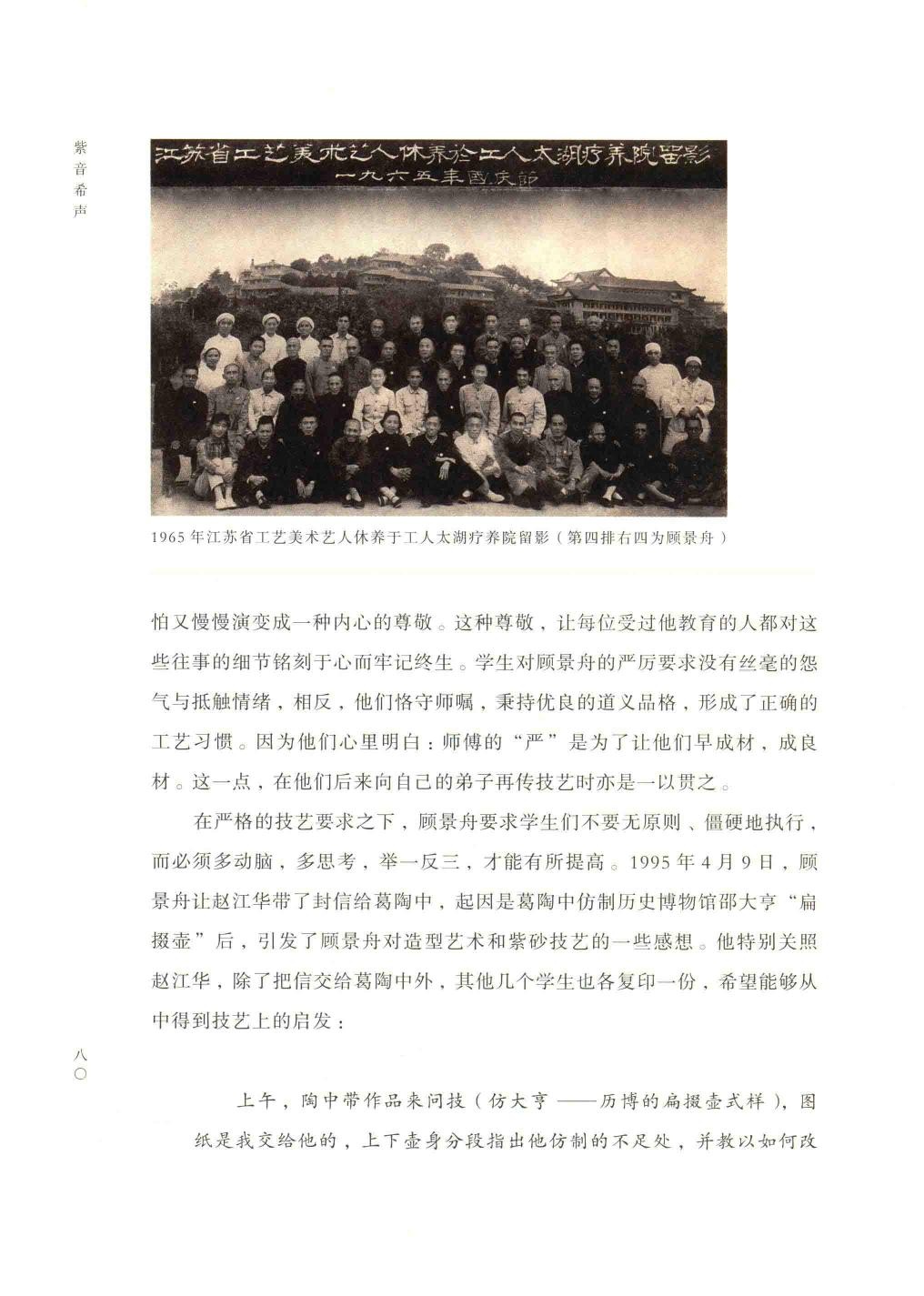
1965 photograph of Jiangsu Province arts and crafts artisans recuperating at the Workers' Taihu Sanatorium (Gu Jingzhou is fourth from right in the fourth row)
fear gradually evolved into a kind of inner respect. This respect made every person who received his instruction engrave these details in their hearts and remember them for life. The students harbored no resentment or resistance toward Gu Jingzhou's strict demands; on the contrary, they faithfully followed their teacher's instructions, upheld excellent moral character, and formed correct craft habits—because they understood in their hearts: the master's "strictness" was to help them mature early and become fine craftsmen. This principle was consistently carried forward when they later passed on their skills to their own disciples.
Under strict technical requirements, Gu Jingzhou demanded that students not execute tasks rigidly and without principle, but must think more, reflect more, and draw inferences from one case to achieve improvement. On April 9, 1995, Gu Jingzhou had Zhao Jianghua deliver a letter to Ge Taozhong. The occasion was Ge Taozhong's reproduction of Shao Dabu's "Bian Yuan Hu" from the National Museum of History, which sparked some of Gu Jingzhou's reflections on modeling art and Yixing pottery techniques. He specifically instructed Zhao Jianghua that, in addition to delivering the letter to Ge Taozhong, each of the other students should also receive a photocopy, hoping they could gain technical inspiration from it:
> This morning, Taozhong brought his work to ask about technique (imitating Dabu's style from the National Museum of History's tall *Bian Yuan* teapot). The drawing was one I had given him. I pointed out the inadequacies of his reproduction section by section, from top to bottom, and taught him how to improve...
Chapter 3
达变
Adaptation
Pages 32-133
View Chapter →
English Translation
## [Section Title Missing]
1965 photograph of Jiangsu Province arts and crafts artisans recuperating at the Workers' Taihu Sanatorium (Gu Jingzhou is fourth from right in the fourth row)
fear gradually evolved into a kind of inner respect. This respect made every person who received his instruction engrave these details in their hearts and remember them for life. The students harbored no resentment or resistance toward Gu Jingzhou's strict demands; on the contrary, they faithfully followed their teacher's instructions, upheld excellent moral character, and formed correct craft habits—because they understood in their hearts: the master's "strictness" was to help them mature early and become fine craftsmen. This principle was consistently carried forward when they later passed on their skills to their own disciples.
Under strict technical requirements, Gu Jingzhou demanded that students not execute tasks rigidly and without principle, but must think more, reflect more, and draw inferences from one case to achieve improvement. On April 9, 1995, Gu Jingzhou had Zhao Jianghua deliver a letter to Ge Taozhong. The occasion was Ge Taozhong's reproduction of Shao Dabu's "Bian Yuan Hu" from the National Museum of History, which sparked some of Gu Jingzhou's reflections on modeling art and Yixing pottery techniques. He specifically instructed Zhao Jianghua that, in addition to delivering the letter to Ge Taozhong, each of the other students should also receive a photocopy, hoping they could gain technical inspiration from it:
> This morning, Taozhong brought his work to ask about technique (imitating Dabu's style from the National Museum of History's tall *Bian Yuan* teapot). The drawing was one I had given him. I pointed out the inadequacies of his reproduction section by section, from top to bottom, and taught him how to improve...
章节导航 Chapter Navigation
Chapter 1
序文
Pages 6-6
Chapter 2
引言
Pages 28-31
Chapter 3
达变
Pages 32-133
Chapter 3
开宗立派
Pages 46-66
Chapter 3
传道授业
Pages 67-98
Chapter 3
大师淳友
Pages 99-120
Chapter 3
学艺谋生
Pages 121-133
Chapter 4
化神
Pages 134-141
Chapter 5
独妙
Pages 142-405
Chapter 5
匠心独运 不苟丝毫
Pages 142-179
Chapter 5
器利善事 物尽其用
Pages 180-199
Chapter 5
紫泥春华 研精究微
Pages 200-405
Chapter 6
驾简
Pages 406-427
Chapter 6
精雕细刻 文质合一
Pages 406-410
Chapter 6
师法自然 妙趣横生
Pages 411-415
Chapter 6
丝来线去 曲尽其妙
Pages 416-427
Chapter 7
明志
Pages 463-485
Chapter 7
高山仰止 淡泊明志
Pages 463-472
Chapter 7
啜墨看茶 气定神闲
Pages 473-478
Chapter 7
齿少心锐 怡志抒情
Pages 479-485
Chapter 8
存真
Pages 428-462
Chapter 8
规圆矩方 弃伪存真
Pages 428-436
Chapter 8
有物有则 钻尖仰高
Pages 437-462
Chapter 9
心营
Pages 506-525
Chapter 9
坚守传统 艺立潮头
Pages 506-513
Chapter 9
新型师承 桃李满园
Pages 514-525
Chapter 10
附录
Pages 526-651
Chapter 10
顾景舟紫艺论文
Pages 526-535
Chapter 10
技术课备课笔记
Pages 536-543
Chapter 10
顾景舟艺术年表
Pages 544-651
Chapter 11
参考文献
Pages 652-657
Chapter 12
鸣谢
Pages 658-659