Chapter 3
达变
Adaptation
94
of 659
English Translation
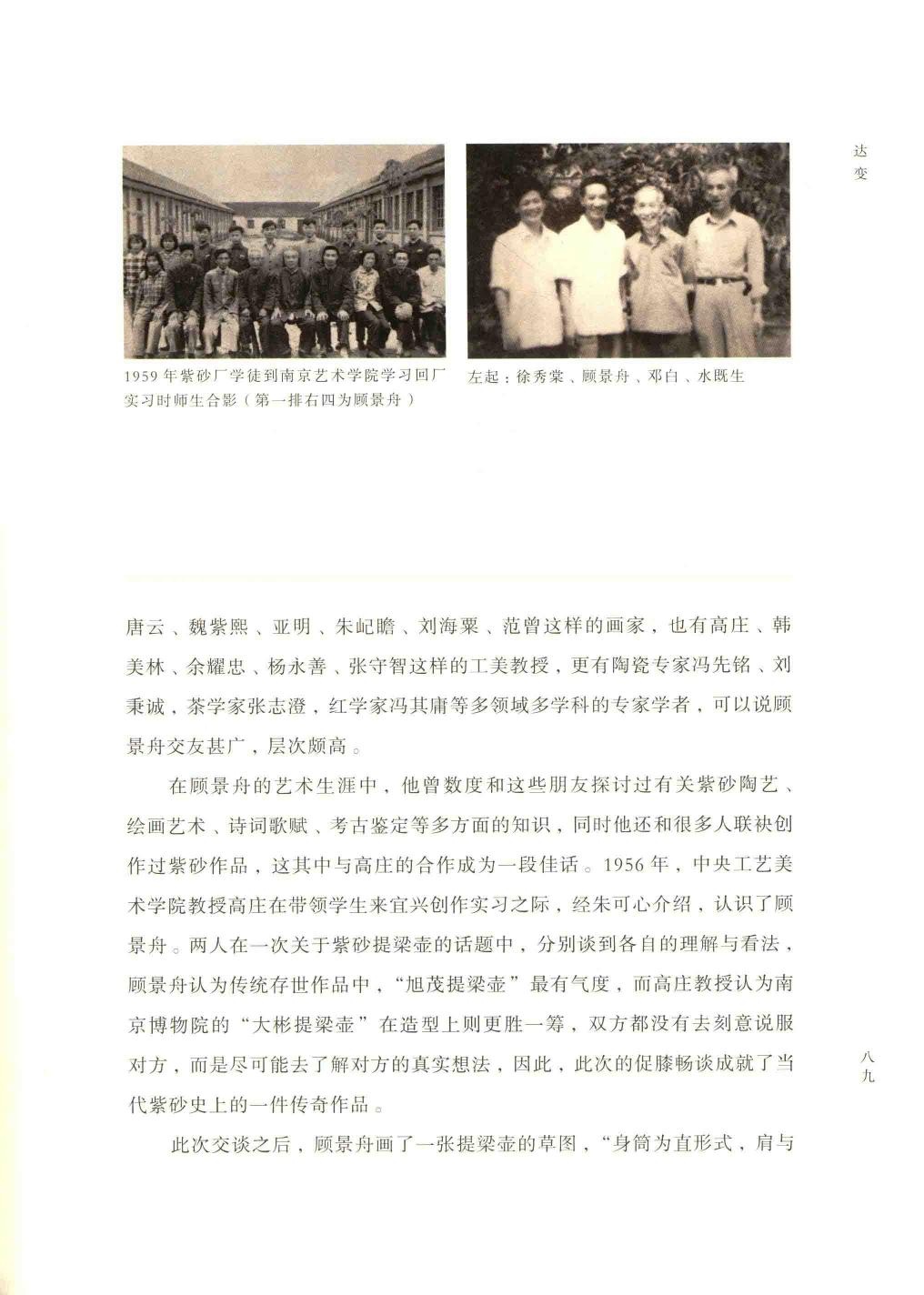
![Group photo of apprentices and teachers from the Zisha Factory studying at Nanjing Academy of Arts in 1959 (Gu Jingzhou is fourth from right in the first row)]
From left: Xu Xiudang, Gu Jingzhou, Deng Zi, Shui Jisheng
Gu Jingzhou had friendships with painters such as Tang Yun, Wei Zixi, Ya Ming, Zhu Dianyou, Liu Haisu, and Fan Zeng, as well as arts and crafts professors like Gao Zhuang, Ku Meilin, Yu Yaozhong, Yang Yongshan, and Zhang Shouzhi. He also maintained relationships with ceramic experts Feng Xianming and Liu Bingcheng, tea scholar Zhang Zhicheng, and *Dream of the Red Chamber* scholar Zhou Ruchang, among experts and scholars from many fields and disciplines. It can be said that Gu Jingzhou had an extensive network of friends at quite high levels.
Throughout his artistic career, Gu Jingzhou repeatedly discussed with these friends knowledge spanning multiple areas including zisha ceramic art, painting, poetry, and archaeological authentication. At the same time, he collaborated with many people to create zisha works, among which his collaboration with Gao Zhuang became a celebrated story. In 1956, Professor Gao Zhuang of the Central Academy of Arts and Crafts, while leading students to Yixing for creative practice, was introduced to Gu Jingzhou through Zhu Kexin. During a conversation about zisha handled teapots, the two men shared their respective understandings and perspectives. Gu Jingzhou believed that among traditional surviving works, the "Xumaosheng handled teapot" had the most imposing presence, while Professor Gao Zhuang felt that the "Dabin handled teapot" in the Nanjing Museum was superior in terms of form. Neither side deliberately tried to convince the other, but rather sought to understand each other's genuine thoughts as fully as possible. Therefore, this intimate conversation gave birth to a legendary work in contemporary zisha history.
After this conversation, Gu Jingzhou drew a sketch of a handled teapot, "with a straight cylindrical body, the shoulder and...
Chapter 3
达变
Adaptation
Pages 32-133
View Chapter →
English Translation
![Group photo of apprentices and teachers from the Zisha Factory studying at Nanjing Academy of Arts in 1959 (Gu Jingzhou is fourth from right in the first row)]
From left: Xu Xiudang, Gu Jingzhou, Deng Zi, Shui Jisheng
Gu Jingzhou had friendships with painters such as Tang Yun, Wei Zixi, Ya Ming, Zhu Dianyou, Liu Haisu, and Fan Zeng, as well as arts and crafts professors like Gao Zhuang, Ku Meilin, Yu Yaozhong, Yang Yongshan, and Zhang Shouzhi. He also maintained relationships with ceramic experts Feng Xianming and Liu Bingcheng, tea scholar Zhang Zhicheng, and *Dream of the Red Chamber* scholar Zhou Ruchang, among experts and scholars from many fields and disciplines. It can be said that Gu Jingzhou had an extensive network of friends at quite high levels.
Throughout his artistic career, Gu Jingzhou repeatedly discussed with these friends knowledge spanning multiple areas including zisha ceramic art, painting, poetry, and archaeological authentication. At the same time, he collaborated with many people to create zisha works, among which his collaboration with Gao Zhuang became a celebrated story. In 1956, Professor Gao Zhuang of the Central Academy of Arts and Crafts, while leading students to Yixing for creative practice, was introduced to Gu Jingzhou through Zhu Kexin. During a conversation about zisha handled teapots, the two men shared their respective understandings and perspectives. Gu Jingzhou believed that among traditional surviving works, the "Xumaosheng handled teapot" had the most imposing presence, while Professor Gao Zhuang felt that the "Dabin handled teapot" in the Nanjing Museum was superior in terms of form. Neither side deliberately tried to convince the other, but rather sought to understand each other's genuine thoughts as fully as possible. Therefore, this intimate conversation gave birth to a legendary work in contemporary zisha history.
After this conversation, Gu Jingzhou drew a sketch of a handled teapot, "with a straight cylindrical body, the shoulder and...
章节导航 Chapter Navigation
Chapter 1
序文
Pages 6-6
Chapter 2
引言
Pages 28-31
Chapter 3
达变
Pages 32-133
Chapter 3
开宗立派
Pages 46-66
Chapter 3
传道授业
Pages 67-98
Chapter 3
大师淳友
Pages 99-120
Chapter 3
学艺谋生
Pages 121-133
Chapter 4
化神
Pages 134-141
Chapter 5
独妙
Pages 142-405
Chapter 5
匠心独运 不苟丝毫
Pages 142-179
Chapter 5
器利善事 物尽其用
Pages 180-199
Chapter 5
紫泥春华 研精究微
Pages 200-405
Chapter 6
驾简
Pages 406-427
Chapter 6
精雕细刻 文质合一
Pages 406-410
Chapter 6
师法自然 妙趣横生
Pages 411-415
Chapter 6
丝来线去 曲尽其妙
Pages 416-427
Chapter 7
明志
Pages 463-485
Chapter 7
高山仰止 淡泊明志
Pages 463-472
Chapter 7
啜墨看茶 气定神闲
Pages 473-478
Chapter 7
齿少心锐 怡志抒情
Pages 479-485
Chapter 8
存真
Pages 428-462
Chapter 8
规圆矩方 弃伪存真
Pages 428-436
Chapter 8
有物有则 钻尖仰高
Pages 437-462
Chapter 9
心营
Pages 506-525
Chapter 9
坚守传统 艺立潮头
Pages 506-513
Chapter 9
新型师承 桃李满园
Pages 514-525
Chapter 10
附录
Pages 526-651
Chapter 10
顾景舟紫艺论文
Pages 526-535
Chapter 10
技术课备课笔记
Pages 536-543
Chapter 10
顾景舟艺术年表
Pages 544-651
Chapter 11
参考文献
Pages 652-657
Chapter 12
鸣谢
Pages 658-659