Chapter 3
达变
Adaptation
95
of 659
English Translation
After reviewing the drawings, he proposed modifications:
> "The upper part should slope, making the base wider, more stable, and more comfortable. The connection should be more rounded, more harmonious, and more unified."
From Gao Zhuang's modifications, particularly the adoption of a hexagonal spout, we can see the continuation of his aesthetic perspective on the "Dabin Tiliang Pot." Professor Gao Zhuang's modification suggestions were respected and reflected in Gu Jingzhou's later Yixing pottery designs. On the basis of fully understanding, digesting, and modifying the drawings, Gu Jingzhou completed the configuration of specialized production tools that summer, then trial-formed the body according to the pot sample, assembled the relevant components, and ultimately completed the physical finished product.
---
Nan Jian, *Artists Who Created the Tiliang Pot*, Issue 17, p. 17.
Ibid.
---
**Emotional Context**
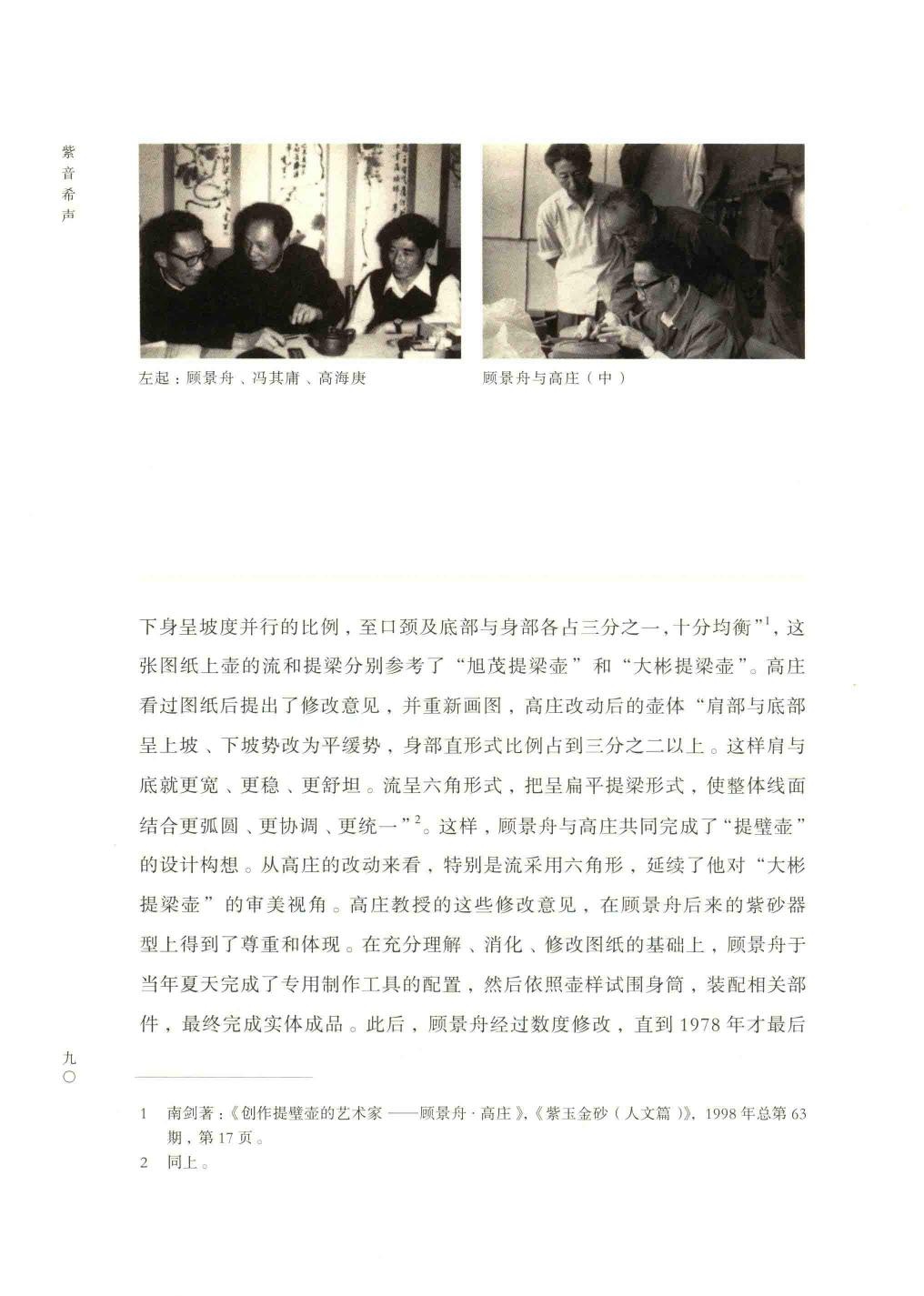
Gu Jingzhou and Gao Zhuang (center)
> "The lower body maintains a proportional slope, with the neck opening and base each occupying one-third in relation to the body, achieving perfect balance."
On this drawing, the spout and handle of the pot referenced the "Xu Collection Tiliang Pot" and "Dabin Tiliang Pot" respectively. After redrawing, Gao Zhuang's modified pot body featured "shoulders and base in hexagonal form, with a flat overhead handle form, making the overall lines and surfaces more rounded." The downward slope was changed to a gentle slope, with the straight body form occupying more than two-thirds of the proportion. In this way, the shoulders and base...
Thus, Gu Jingzhou and Gao Zhuang jointly completed the "Tiliang Pot."
After numerous revisions, Gu Jingzhou did not finalize it until 1978.
---
[1] Gu Jingzhou and Gao Zhuang, *Purple Jade and Golden Sand (Humanities Volume)*, 1998, Issue 63.
Chapter 3
达变
Adaptation
Pages 32-133
View Chapter →
English Translation
After reviewing the drawings, he proposed modifications:
> "The upper part should slope, making the base wider, more stable, and more comfortable. The connection should be more rounded, more harmonious, and more unified."
From Gao Zhuang's modifications, particularly the adoption of a hexagonal spout, we can see the continuation of his aesthetic perspective on the "Dabin Tiliang Pot." Professor Gao Zhuang's modification suggestions were respected and reflected in Gu Jingzhou's later Yixing pottery designs. On the basis of fully understanding, digesting, and modifying the drawings, Gu Jingzhou completed the configuration of specialized production tools that summer, then trial-formed the body according to the pot sample, assembled the relevant components, and ultimately completed the physical finished product.
---
Nan Jian, *Artists Who Created the Tiliang Pot*, Issue 17, p. 17.
Ibid.
---
**Emotional Context**
Gu Jingzhou and Gao Zhuang (center)
> "The lower body maintains a proportional slope, with the neck opening and base each occupying one-third in relation to the body, achieving perfect balance."
On this drawing, the spout and handle of the pot referenced the "Xu Collection Tiliang Pot" and "Dabin Tiliang Pot" respectively. After redrawing, Gao Zhuang's modified pot body featured "shoulders and base in hexagonal form, with a flat overhead handle form, making the overall lines and surfaces more rounded." The downward slope was changed to a gentle slope, with the straight body form occupying more than two-thirds of the proportion. In this way, the shoulders and base...
Thus, Gu Jingzhou and Gao Zhuang jointly completed the "Tiliang Pot."
After numerous revisions, Gu Jingzhou did not finalize it until 1978.
---
[1] Gu Jingzhou and Gao Zhuang, *Purple Jade and Golden Sand (Humanities Volume)*, 1998, Issue 63.
章节导航 Chapter Navigation
Chapter 1
序文
Pages 6-6
Chapter 2
引言
Pages 28-31
Chapter 3
达变
Pages 32-133
Chapter 3
开宗立派
Pages 46-66
Chapter 3
传道授业
Pages 67-98
Chapter 3
大师淳友
Pages 99-120
Chapter 3
学艺谋生
Pages 121-133
Chapter 4
化神
Pages 134-141
Chapter 5
独妙
Pages 142-405
Chapter 5
匠心独运 不苟丝毫
Pages 142-179
Chapter 5
器利善事 物尽其用
Pages 180-199
Chapter 5
紫泥春华 研精究微
Pages 200-405
Chapter 6
驾简
Pages 406-427
Chapter 6
精雕细刻 文质合一
Pages 406-410
Chapter 6
师法自然 妙趣横生
Pages 411-415
Chapter 6
丝来线去 曲尽其妙
Pages 416-427
Chapter 7
明志
Pages 463-485
Chapter 7
高山仰止 淡泊明志
Pages 463-472
Chapter 7
啜墨看茶 气定神闲
Pages 473-478
Chapter 7
齿少心锐 怡志抒情
Pages 479-485
Chapter 8
存真
Pages 428-462
Chapter 8
规圆矩方 弃伪存真
Pages 428-436
Chapter 8
有物有则 钻尖仰高
Pages 437-462
Chapter 9
心营
Pages 506-525
Chapter 9
坚守传统 艺立潮头
Pages 506-513
Chapter 9
新型师承 桃李满园
Pages 514-525
Chapter 10
附录
Pages 526-651
Chapter 10
顾景舟紫艺论文
Pages 526-535
Chapter 10
技术课备课笔记
Pages 536-543
Chapter 10
顾景舟艺术年表
Pages 544-651
Chapter 11
参考文献
Pages 652-657
Chapter 12
鸣谢
Pages 658-659