Chapter 5
独妙
Unique Excellence
387
of 659
English Translation
## Jiqi (起缉)
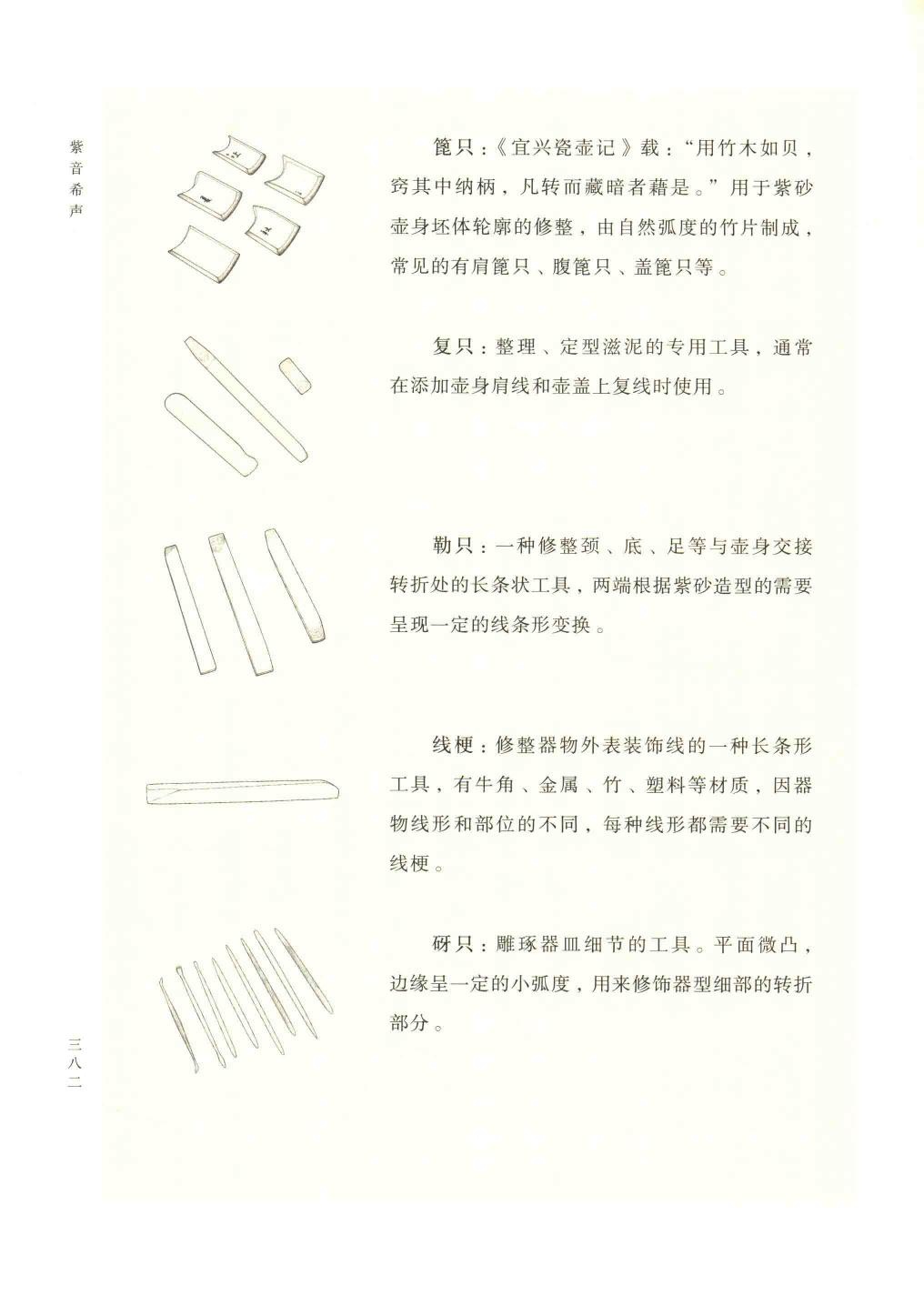
**Jiqi (起缉)**: As recorded in *Records of Yixing Teapots* (《宜兴紫砂壶记》): "Made from bamboo or wood like shells, hollowed in the center to accommodate a handle, used for turning and concealing hidden parts." Used for refining the contours of the clay body of Zisha teapots, made from naturally curved bamboo strips. Common types include shoulder jiqi, belly jiqi, lid jiqi, and others.
**Fuqi (复只)**: A specialized tool for organizing and shaping clay, typically used when adding shoulder lines to the teapot body and compound lines on the lid.
**Leqi (勒只)**: A long strip-shaped tool for refining the transitional junctures where the neck, base, and foot meet the teapot body. Both ends exhibit certain linear variations according to the requirements of the Zisha form.
**Xiangeng (线梗)**: A long strip-shaped tool for refining decorative lines on the exterior surface of vessels. Made from materials such as ox horn, metal, bamboo, or plastic. Due to differences in the linear forms and positions on vessels, each type of line requires a different xiangeng.
**Yanqi (研只)**: A tool for carving fine details on vessels. The surface is slightly convex with edges forming a certain small arc, used to refine the transitional parts of detailed vessel forms.
Chapter 5
独妙
Unique Excellence
Pages 142-405
View Chapter →
English Translation
## Jiqi (起缉)
**Jiqi (起缉)**: As recorded in *Records of Yixing Teapots* (《宜兴紫砂壶记》): "Made from bamboo or wood like shells, hollowed in the center to accommodate a handle, used for turning and concealing hidden parts." Used for refining the contours of the clay body of Zisha teapots, made from naturally curved bamboo strips. Common types include shoulder jiqi, belly jiqi, lid jiqi, and others.
**Fuqi (复只)**: A specialized tool for organizing and shaping clay, typically used when adding shoulder lines to the teapot body and compound lines on the lid.
**Leqi (勒只)**: A long strip-shaped tool for refining the transitional junctures where the neck, base, and foot meet the teapot body. Both ends exhibit certain linear variations according to the requirements of the Zisha form.
**Xiangeng (线梗)**: A long strip-shaped tool for refining decorative lines on the exterior surface of vessels. Made from materials such as ox horn, metal, bamboo, or plastic. Due to differences in the linear forms and positions on vessels, each type of line requires a different xiangeng.
**Yanqi (研只)**: A tool for carving fine details on vessels. The surface is slightly convex with edges forming a certain small arc, used to refine the transitional parts of detailed vessel forms.
章节导航 Chapter Navigation
Chapter 1
序文
Pages 6-6
Chapter 2
引言
Pages 28-31
Chapter 3
达变
Pages 32-133
Chapter 3
开宗立派
Pages 46-66
Chapter 3
传道授业
Pages 67-98
Chapter 3
大师淳友
Pages 99-120
Chapter 3
学艺谋生
Pages 121-133
Chapter 4
化神
Pages 134-141
Chapter 5
独妙
Pages 142-405
Chapter 5
匠心独运 不苟丝毫
Pages 142-179
Chapter 5
器利善事 物尽其用
Pages 180-199
Chapter 5
紫泥春华 研精究微
Pages 200-405
Chapter 6
驾简
Pages 406-427
Chapter 6
精雕细刻 文质合一
Pages 406-410
Chapter 6
师法自然 妙趣横生
Pages 411-415
Chapter 6
丝来线去 曲尽其妙
Pages 416-427
Chapter 7
明志
Pages 463-485
Chapter 7
高山仰止 淡泊明志
Pages 463-472
Chapter 7
啜墨看茶 气定神闲
Pages 473-478
Chapter 7
齿少心锐 怡志抒情
Pages 479-485
Chapter 8
存真
Pages 428-462
Chapter 8
规圆矩方 弃伪存真
Pages 428-436
Chapter 8
有物有则 钻尖仰高
Pages 437-462
Chapter 9
心营
Pages 506-525
Chapter 9
坚守传统 艺立潮头
Pages 506-513
Chapter 9
新型师承 桃李满园
Pages 514-525
Chapter 10
附录
Pages 526-651
Chapter 10
顾景舟紫艺论文
Pages 526-535
Chapter 10
技术课备课笔记
Pages 536-543
Chapter 10
顾景舟艺术年表
Pages 544-651
Chapter 11
参考文献
Pages 652-657
Chapter 12
鸣谢
Pages 658-659